This will likely not develop into a series but I am being brave and adding a #1 to this post.
Trying out some visual novels
I recently played a couple of ‘visual novel’ games and they immediately made me think about branching eLearning scenarios. From a little bit of research online, it is clear that there is an identified gap here between current visual novel markets and their potential use. A 2020 paper describing this thus “there are genres with untapped potential for teaching, such as narratively driven…visual novel games” (Oygardslia et al, 2020).
The games I played noticeably achieved a few things, including:
(1) Strong character development through storytelling.
(2) Narrative choices for the player that really impact on the story and resulting scenes (albeit that this is not always obvious until you play through multiple times, look online for the different options, etc.).
(3) Motivation for the player to continue due to cliff-hangers and other drama devices, managing to create a desire to find out “what is going to happen next”.
These attributes are of course not unique to visual novels (aka ‘narrative games’). For example, I am currently playing Assassins Creed Valhalla (as mentioned in a previous post) and this game has strong character development and a compelling story to keep you playing – it even specifically separates the game into “story arcs” (effectively chapters in traditional written storytelling). Where traditional games, and particularly rich 3D open worlds like Valhalla, struggle is how much narrative choices can impact the game. Valhalla, for example, gives you choices for the conversations of your character but few actually impact outcomes or the game’s story. It is not obvious to the player of Valhalla which conversations impact things either, hence a number of explainer articles online such as this one.

If a quick Google is anything to go by, there has been relatively limited interest in visual novels (specifically) within the wider interest of gamification and how games may, or may not, educate.
Gamification has, of course, been a bit of a buzz term but I would agree with quite a lot of this post regarding explaining that the real reason that gamification has become a focus is because of concerns around motivation. The other half of the puzzle here really is the storytelling element which has also had a lot of interest in L&D (see here for an example article). This is of course nothing new in so much as video based and drama based learning have long played on the benefits of storytelling and emotional response.
There are though a few articles discussing the attempts to use visual novels, for example this one on an example use case in education.
Scale of visual novels as a medium
As with most categorisations in gaming, what makes a ‘visual novel’ is debatable. However, games categorised as such amount to 4,588 items on the hugely popular Steam Store. Perhaps inevitably a large subsection of these are tagged as “dating” sims or even “adult”. There are also the usual visual gaming splits between anime style graphics, more western style cartoon, more realistic 3D models, etc. The quality of these graphics of course impact the experience but at the same time it was nice for me to play a few things with real character development – rather than the stock Microsoft, Articulate and other cut out “characters” we see in so many webinars, eLearning modules, etc.
Reading this, you might presume these games, often free-to-play or low cost, are terrible. However, reviews on Steam are an interesting read for learning professionals – for example people fearing “click-fest type” games are instead “genuinely surprised” thanks, again, to the storytelling. How often have ‘click next’ eLearning courses ever really surprised you?
One authoring tool, Ren.Py, has a seperate directory of free games you can try. Interestingly, this directory does give you the word count of the game (something I have previously suggested would be possible for the wider gaming industry).
But branching is hard
Such games are, of course, complex – at least with regards to the branching and storytelling. In the past I have worked for organisations that have outsourced such storytelling into bespoke eLearning. However, today, the basics of branching is relatively straightforward in many eLearning tools.
However, if you play a few visual novels it soon becomes clear how shallow some eLearning branching is. And I include some of what I have worked on in the past in that statement.
If we want to avoid branching due to the complexity then what we are working towards is a different categorisation: “A kinetic novel is a linear type of visual novel where there is a linear storyline with no player choice or gameplay.”.
Authoring tools
There are numerous options in this space, here are a few I have looked at…
A few years back I had a bit of a play with Twine. Twine is primarily text based so might not be appropriate for all situations.
There are some tools marketed for education including ones which shift to a 3D model, like this from CoSpaces, rather than the more scene style of other visual novel tools.
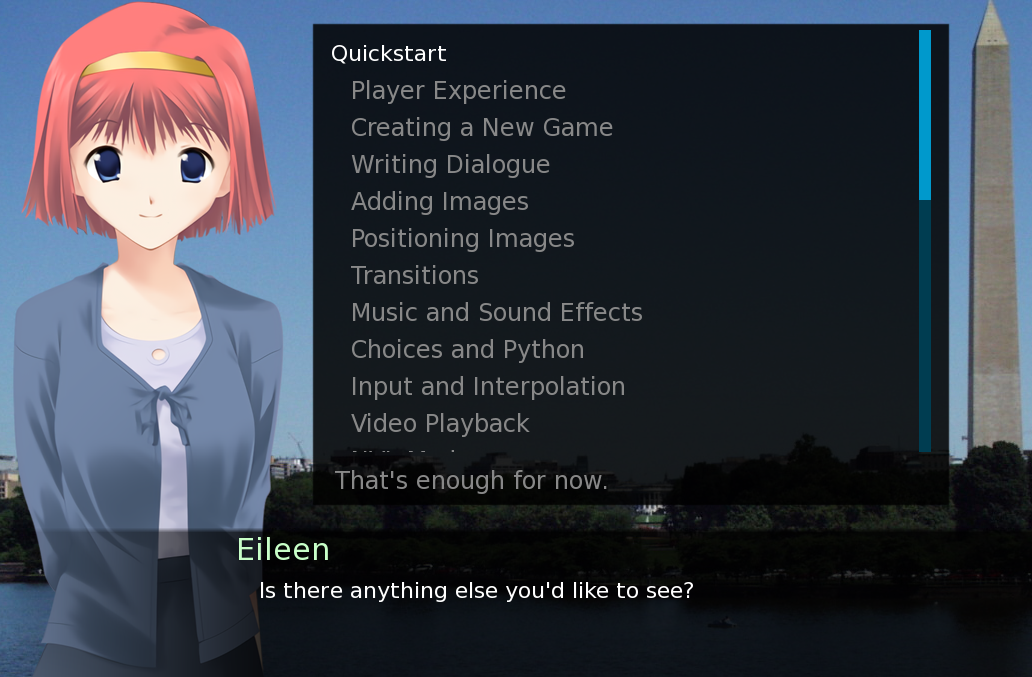
PCGamer considers some of the options in this article. In addition, there are some useful threads on Reddit, both in instructional design and gaming channels [warning not all are safe for work if you go looking]. For example it was here that I realised that many tools are combining RenPy with 3D model assets from DAZ. RenPy’s tutorial, built within the tool, is actually very good and shows how well it can work:
Challenges
A big problem for those working in corporate environments has always been the restrictions in place with regards to technology. This is why the more recent publishing tools tend to be helpful in being browser based, gone are the days where companies have needed to keep supporting old tech (including Flash) or insisting on everything being in a SCORM package.
Renpy.org requires local .exe files so is likely a non-starter for many corporate environments. Indeed the open source authoring tool but is sponsored by companies that will help you get published elsewhere, such as on games stores. Other options such as TyranoBuilder offer export to browser functionality (although Tyrano is an example with an upfront software cost so I haven’t tried it) which might be more suitable for corporates.
Therefore getting the tool installed and the games out to users to install will be a blocker for some organisations. The mobile app publication option might be a solution for some though.
Nothing new?
In many ways the learning that could be designed in RenPy and other tools is similar to narrative based eLearning in other tools and just as reliant on the quality of writing and story based learning.
This is of course nothing new, indeed conferences for eLearning and games based learning are long running:
What should we use?
With time to learn them, these authoring tools become very powerful. However, the challenges of installation and publication would likely block many corporates/organisations from using them.
Personally, I am going to try and go deeper into Ren.Py in part as it is basically teaching you some Python language through a simple interface which I suspect might be of help in the future. In addition the option to publish to Android and iOS might offer some solutions to the desktop publication problems.
For now, the ease at which Articulate and other tools have made branching become something anyone can do (rather than expensive bespoke eLearning like it used to be) is probably the way that makes sense. However, the cost of developing on a free tool like Ren.Py is likely much lower than a fully blown interactive video experience. Therefore, there are no doubt use cases out there.


 Whose Education Is It Anyway?