Why we should all be a little bit more like Faith No More

I’m not a huge music fan, certainly when compared to a number of my school and university friends who have been in various bands over the years, I have never really been a big follower.  Sure, I tend to have LastFM (old format anyway) or YouTube on in the background when working but my gig attendance has always been fairly limited.

The gigs I have attended over the years have tended to be those bands that caught my attention in my youth. These are the bands who have kept a place in my ears, through my not particularly rebellious years, the dance floors of my student days and into our modern streaming world.  One band that has made it through that whole journey is Faith No More.

An excellent Guardian article on Faith No More’s most recent comeback and album got me thinking that their style and refusal to be easily classified into one musical genre or another has, perhaps, had a more profound impact on me than I had ever realized.

So what did I take from that article?  Well, messages such as:

  1. make decisions based on your desires and convictions
  2. be prepared to take the implications of your decisions
  3. don’t fall into a box just because people think you should
  4. we are all unique.

I still see a lot of comments in the workplace related literature that is keen to put people into some kind of ‘social style’ or other box – be it based on sex, age, characteristic or other factor.  I have never been keen on this kind of profiling and perhaps the variety of my music tastes (from early 80s hip-hop to early 00s cheese; from Elvis Presley to Edith Pilaf) suggest some ‘out of the box’ thinking on my part.  However, I suspect I am far from abnormal in not being easily ‘profiled’.

So let’s celebrate our differences, let’s recognize our individual capabilities, let’s share our experiences and let’s combine all of this into something even greater than the sum of our parts.  This is at least part of what L&D should be doing, encouraging people to reflect and make the workplace better through their unique contributions, as one member of FnM puts it in the article:

“We came back and we made it better. If that’s the only lesson we learned, that’s a good lesson.”

Webinar live blogging: A 3D virtual business simulation for experiential learning in first year accounting

As mentioned many a time on this blog, I do not post all the notes I make from webinars, reading and the like on here.  This is partly as they totally consumed my old blog and made more reflective posts difficult to find.

Anyway, I was up early today to attend a “Transforming Assessment” webinar from ascilite in Australia and thought I would post some thoughts here in real-time, [in brackets is me rather than session content].

  • [I have attended a few of this series and thought this one might be interesting in understanding what my organization’s grad hires might be expecting going forward].
  • [Business sims are, of course, tricky but they have the scope to really achieve practical learning].
  • [Quick screen shot at start – looks like using Second Life].
  • 800-1000 students per semester.
  • Title: “Accounting for Decision-Making”.  Not intended as a technical, debit/credit, course.  Instead focus on supporting business decision-making.
  • Includes face-to-face lectures and seminars and some traditional assessments.  However, reviewed course off back of some negative student survey feedback around engagement (business students not enjoying the accounting element and therefore not picking up the correct outcomes).
  • Therefore, try to get more active learning with students more actively participating.
  • Reviewed in 2015, including simulation and web based assessment – complete overhaul of lectures, seminars, etc. too, all with active learning focus.
  • Not off the shelf – worked with piersim.com/about : International Education Services who had used a 3D world for a number of years.  Collaborated with them to develop the world for their use.
  • Developed the Virtual Business Enterprise (VBE).  20 student operated businesses with a supporting central bank.  Students control a number of things, including product pricing.
  • App is available at all times, can plan work around the trading session.
  • http://pier-enterprise.com/
  • [ran through some of the functionality] VBE dashboard allows students to communicate, to view financial reports, manage their profile, select their ‘job’ in company.
  • To access the VBE requires download of the VBE Viewer.
  • What happens in a session: uses avatars, preplanned and agreed tasks as well as in-world decisions (buy inventory or not, pricing of products, advertising decisions).
  • Software based on OpenSim.
  • Once a week for six weeks: 50 min trading session within the world.
  • One student per group use avatar, others communicating and performing tasks on dashboard.
  • Use financial statement from each session to consider what to do for next.
  • VBE is a shopping mall [showed some screenshots].
  • Game elements – if do not trade then the character’s health drops.  Had a staff member in session to rejuvenate any character that died[!].
  • Want them to take risks and make decisions (based on the accounting information) in a safe environment.
  • Can go to bank and take loans if they think appropriate: balance repayments/interest rates/etc.
  • In world law court for dealing with disputes [sounded like quite a lot of logic behind it] – if you cut quality of products you can be sued via court.  The in-house staff member (‘controller’) decides as judge.
  • Video: https://www.youtube.com/watch?v=cYDaYgt7i-M&feature=youtu.be – slower than real: is more frantic in the 50 minute trading sessions.
  • Assessment was linked to: business plan assignment combining lecture, tutorial and virtual world learning.
  • Business plan was to support a loan application on next 12 months worth of planning.
  • Induction session [https://www.facebook.com/uqbusiness/videos/988464357871851/] run for people on the VBE prior to first trade session.
  • Student feedback: https://www.youtube.com/watch?v=Y-y6WhIhrLc&feature=youtu.be : overall has gone well, with positive feedback, but not all students liked it – including due to technical problems.

Overall a good presentation and an interesting approach for trying to deliver the learning outcomes.

The (Work)Force Awakens

There has been a lot of interest recently in the importance of engagement in the workplace.  My view would be that this is not as generation influenced as some commentators would believe and has to be looked at as part of the bigger picture.

Emergent trends such as the rise of holocracy, and apparent disappointment with it, can be seen as part of a growth in thinking, again, about the nature of work.  Even if it is easy to see holocracy, itself, as the latest management fadThe Workforce Awakens

The rise of the ‘manager class’, seen in many fields (including Chinese Higher Education), seems to be slowing through association with unnecessary bureaucracy.  Therefore, we are left with valid questions about what the alternatives may be.

Some politicians would have you believe that workers are no longer exploited, the argument from many quarters would no doubt be that without some kind of partnership model for all staff there remains inequality and a lack of engagement.

If we consider organizational knowledge management, in the format it has emerged around SharePoint solutions at least, as reinforcing silos in organizations through endless permission setting.  The ‘circles’ of holocracy and alternative structures offer an appealing alternative.  Indeed If we consider the future to be that of ‘learner workers’, not ‘knowledge workers’, then we can perhaps go so far as to say the individual finally moves to the position of prominence beyond any kind of team structure.

There would be additional options here, data can now be gathered and presented in so many ways that an appeal by the workforce for more engaging workplaces and better representation will likely come at a cost of closer (and often automatic) scrutiny.

This is all in an environment where the ‘war for talent’ might be hotting up with demand outstripping labor supply in some markets.  In the UK at least this will likely result in further brain drain from public sector austerity and then more finger pointing when public expenses come in over budget, projects delayed and seemingly using never ending streams of temporary staff (from high-end consultants to the large volume of agency nurses plugging NHS staffing gaps).

There are plenty of suggestions for ways to engage the workforce, such as opening the books, to make people better understand their influence on the bottom line.  The challenge is that many options come back, again, to the ownership model and if that supposed end to exploitation sees a future of joint ownership rather than one of zero hour contracts, freelancing and uncertainty.

This all obviously has huge implications for any local learning and how fit for purpose models such as PLC will be going forward.  L&D can play their part, but the post-recession awakening in high demand jobs is only likely to lead to your people following the dark side (of more money at your competitors) if you can not fundamentally consider them as equals.

Reflecting on some recent surveys

There have been a few surveys that I have been asked to complete of late which have highlighted some of the issues in multiple choice questions and how, when we use questions, we need to avoid our own bias from influencing proceedings.

CILIP’s

Now, most survey advice sites would recommend test groups to iron out bugs in the system.  CILIP’s recent survey, part of the workforce mapping project, seems to fail pretty early on.  As the included picture shows, the survey attempted to enforce something of a discipline taxonomy on those completing the survey.  There was little space in this question for people making use of information skills but in a different discipline (like Learning and Development for example) even when the project website itself states “professionals are developing new roles in business, industry, government, and the third sector”.  Indeed it ignores, for example, someone who has gone down a data scientist route and, I presume, the question will cause the usual consternation from the old Institute of Information Scientists members, although they perhaps would just opt for the option with a mention for “information”.  Overall, it is presumably part of an attempt by CILIP to engage with groups they have lost touch with, so at the very least not conditioning the question to say, something like, “which discipline do you most affiliate yourself with?” seemed a misstep.

CILIP Workforce Mapping Question - what type of library do you work in?
As your skills will clearly fall into a traditional discipline, there is no other.

70:20:10

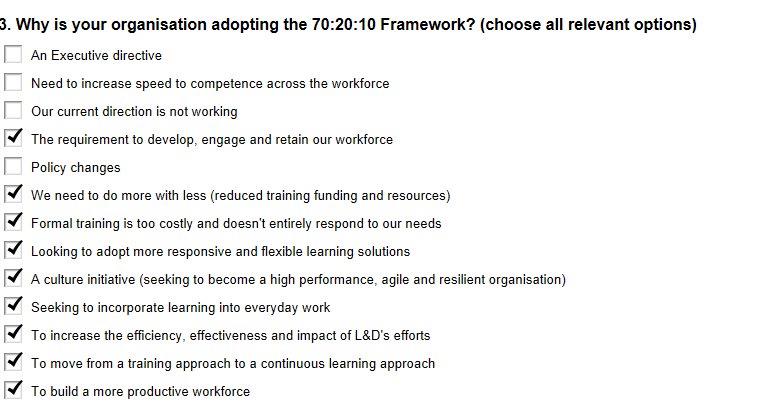
Pretty sure the 70:20:10 Forum were the source of the below question.  Now I appreciate that people may be ‘adopting’ the framework, in terms of the support and recommendations in the model.  However, surely half the battle (or 80/90%) is just making L&D realize that very few (if any) professions have ever been able to teach everything people need to know through formal learning.  Again, I guess my gripe is in the wording but it seems to be suggesting something to adopt rather than saying the 80/20 split is about right (let’s go as far as to say accurate/truthful) so why are you only now doing something about it?

Recent question on why you might adopt 702010
Do you want to know the truth? You can’t adopt the truth.

Training Journal

Credit to Training Journal for doing some work on the feeling, that most people probably have in L&D circles, that the gender balance seems to get skewed towards the masculine end of the spectrum as you look at who occupies more senior roles.  Whilst I completed the survey my major problem was that, according to it, all organizations are 10,000 people or smaller.  This seems a really odd one to get wrong unless it is deliberately aiming at SME type organizations (if it is then fair enough but I must have missed the note to that effect).

Learning Technologies Summer Forum 2015

When I reflected on the winter Learning Technologies event I felt the main message was that Learning and Development professionals, collectively, seemed to be failing.  In contrast, the summer event seemed to have a feel of ‘things are getting better’.  Certainly, in the case of my own practice, I can say we have been able to have more of the right kinds of conversations internally – much more about appropriate performance support, via a blend of solutions and that these conversations are starting to happen with senior leadership very much engaged.

In the context of the first paragraph, the final session I attended at the Summer Forum, on Learning Leadership, was perhaps of most interest.  Learning Leadership Big QuestionsThe focus was on practical things we can do to have great conversations, with a vision for the future beyond order taking.  Based on the good work of Towards Maturity there was an opportunity to tackle ‘the big questions’ (see pic) via a group workshop to capture some of the crowd’s wisdom.  Overall, the message slowly seems to be getting through that you need an evidence based approach, using data to back conversations with the business (which in turn need to be in business, not L&D, language).  A point was made that, as we have not read L&D’s postmortem, the doomsayers were wrong, I’d say the key thing here is ‘not right yet’.  Things might be getting better there’s undoubtedly a lot still to do for many organizations.

Prior to the above session, the others I attended were:

  • Opening Keynote: The Power of Play – Deborah Frances-White.  A very invigorating and funny opening keynote.  The theme was familiar, as children we play (learning in the process) but we get scared to fail as we get older, but there some fun activities involved which I could try in groups as icebreakers in the future.  As the presenter pointed out, play and work can be both be seen as processes – which is appropriate depends on what you are trying to achieve (I particularly liked the idea that you cant ‘work on a relationship’ to save a marriage: you have to re-inject play).  The presentation ended with a mass game of rock, paper, scissors – with you told to cheer on who you lost to and then their conquerors, and so on.  It was provided as something you could do in your office to inject play and change culture – I wonder how many people have been brave enough to try it since!
  • Video for Learning – was made up of two parts, one a video with some tips on technique and equipment.  The second an update on where BP have got to with their video usage.

There were two interesting bits in the first section:

  1. some tips on making sure your mobile phone footage is good quality
  2. a very good video which managed to capture emotion, including by playing an interview over real footage – rather than just talking heads.

The BP experience is interesting, to me, in how in the in-house video solution has been owned by learning, and allows for user generated content, whilst the team includes people with marketing and journalism backgrounds to ensure the right skills are in place.  In other words, the learning team did not wait for someone else to get the platform in place for them (it would seem).

  • Mobile Learning – some tips from Telefonica on their experiences.  Unlike Qualcomm’s winter presentation that showed an app store with multiple in-house apps, Telefonica have gone down the single app route via CM Group.  The app is heavily used but, similar to tools like CampusM in Higher Education, it offers other elements (like bus timetables) so is not ‘learning’ in a pure sense.  However, the argument was this is more of what was needed for new graduate hires and had advantages, such as offline access.

Conversations around the event space included a number of topics.  There was some concern that eLearning vendors are not really ‘stepping up to the plate’ with some kind of truly engaging paradigm in our new mobile/HTML5 world.  I also had some conversations around the continuing value of big library solutions (Skillsoft, Lynda, etc) and if L&D are best to retract to ‘in-house’ and allow people to source other generic things elsewhere, possibly via LinkedIn Lynda subscription (since the event I have had an email from LinkedIn offering a seven day trial for subscription to Lynda so that acquisition seems to be leading to some new models already).