Starting my London-based career in an ‘Information Services’ team has led to me always having quite an interest in the semantics of support departments. Information has become a hugely overused term since then, closely associated with the ‘Knowledge Economy’, as business and academia have worried about the growth of technology and overload of web content in the last 20 years. However, whilst information teams have often dwindled in the face of ‘free’ material on the open web other support services continue along.
At a CILIP event about 5 years back there was an agitated former Institute of Information Scientists member who was furious at perceived continued dumbing down, in other words, a focus on libraries rather than information science. The challenge, of course, is that ‘information’ is a term largely usurped by technology, either as IT or ICT. In this respect the BCS and other groups have usurped the second I in CILIP and there were valid opinions expressed that the CILIP renaming debacle could of done worse than to embrace the old ‘Library Association’ moniker. However, the risk with this would be to alienate members, such as myself, who have long moved on from physical spaces whilst still using an information orientated mindset (I tend to avoid ‘skills’ here as I fear that might be over-egging my pudding!).
So if “information” has become synonymous with technological solutions and support departments what for those with an information mindset? In many cases they will be found embedded within another traditional department such as research, HR, marketing or training/learning. They may (like me) or may not have formal academic credentials in these areas but do have the option of engaging with professional bodies and potentially seeking professional status such as MCILIP, CMALT, etc.
Of course the challenge is that in ‘knowledge’ (and many other) roles ICT solutions are essential, and I include the C to recognize the role of communication and collaboration tools.
So what of all these support teams? Well, whilst ICT and the currently vogue ESN have tried to break silos they often still exist. This often is not helped by the splits to C-Suite reporting across various groups including COOs, Heads of People and (of course) the CIO.
What I’m going to suggest today though is that disciplinary focus doesn’t help. Instead let’s pick the best elements to create a single support structure. But what to call it? Well how much your (and I’m largely talking office based support here) support make up of your workforce will impact.
However let’s adopt “Productivity and Performance”. In this model, Ullrich-esque HRBPs can become performance consultants and help identify where things need to improve and have full scope of measures (finance and other data) versus solutions (digital solutions for marketing and learning), etc.
Obviously organisations will vary but it’s starting to feel like claiming the ‘productivity’ name is a solution – as recognised by Microsoft, Apple and others who recognise software by that name. Indeed if one looks at the latest top 100 tools for learning many are not ‘learning’ specific but productivity/office focused. Many on this list would appear for a lawyer, finance, marketing and other pros. Let’s recognize the value in the tech and bring together the support staff with different mindsets, strengths and expertise.
I’ve drafted a few brief reflective pieces for the site of late – only for referendums, snippets of policy and other articles to make me pause and reflect again. This is an attempt to capture some of the excellence points being made about apprenticeships as the future for UK (well English) skills development (as well as linking back to old articles on the topics). I’m well aware that elements will be made out-of-date between typing and publication!
Whilst partly being driven by (and carried along in the tsunami of) Brexit news – the potential implications and the importance of the changes to Apprenticeships are also being drowned out by the huge stories in Europe, Syria, America and elsewhere. This is a shame as whilst the potential for new Grammar Schools has managed to grab headlines, the apprentice changes have struggled to. This is particularly striking considering the levy policy largely amounts to Government intervention in workplace people development and, therefore, a potentially more important change. This is especially so for a Conservative government that continues to talk of free trade opportunities whilst having changed minimum wages, pension laws and other cost of business regulations.
Reflections on the emergent policy
The Apprenticeship Levy and related policies (or at least information on them) have been delayed at virtually every stage. This is not helped, as anyone who has tried to work through the process will find out, that the related gov.uk pages have no real help, support contacts or feedback (beyond formal consultations). I know it is better than it used to be, as they aim to move to the one site, but there are still plenty of errors on existing sites (see image from an example link on the Skills Funding Agency registration process).
Ultimately, there seems to be a shift from the government or individuals deciding ‘whose education is it anyway?’ to what business and employers determine is appropriate. However this is within a government structure of shifting the financial cost to business in return. Yet discussion continues over if some form of central linking of growth strategy and apprenticeships is needed, independent of the market forces of employer led levy policy.
The challenge may be more for universities. With a clear challenge on how to keep relevant when charging huge fees. To massively simplify – why would anyone want to study for 3 years for £40,000+ of debt when you could get an equivalent qualification whilst working? Whilst the American Dream has been challenged as unattainable (as you can no longer work your way through college – but the universities and other interested parties dont want you to know that), apprenticeships are effectively challenging the ‘traditional’ UK model that started to take shape pre-Blair and was accelerated by his administrations. Universities are going to have to become more responsive and imaginative in the design of degree-level apprenticeships.
Whilst a university education allows mobility, albeit I am an example of someone who chose a location for my undergraduate university (in part) as it was relatively close to home and cheap, there is the question of social value versus gaining efficiency through competition. Of course, UK HE has some approaches that make entry to the market difficult (and better use of economies of scale, perhaps through mergers, could be made). JISC could, for example, support degree apprenticeships through technology in a way that would be difficult for employer providers.
Fundamentally, there is also the question over why universities have failed to adopt wider competency models. The US focus on competency based education in HE has shifted the model somewhat towards a more broken down skill profile assessment, akin in some ways to our apprenticeships. Inevitably UK HE will have to move away from the vagueness of 1st, 2nd and 3rd class degrees. Of course a lot of this is not new, I even presented on related issues at a conference in 2010. There were also sessions on competency based learning beyond the standard curriculum at the same conference. You have to presume that changes to traditional degree models will be accelerated by the ‘competition’ with new apprenticeships.
And to the future…
The arguments over graduate skills (or lack there of) will continue. The shift to the Levy means employers paying to the levy have three real options it seems to me:
do nothing – accept the loss as a tax
work with vendors – accept apprenticeships as your career development pathways but also accept the “loss” of the levy money
A key feature to the planned changes with the apprenticeship policy, throughout the planning, has been the promise of a shift to them becoming (more) ’employer led’. There will be less of an education-sector focus in their organisation, especially in the change to allow people to be an apprentice at a lower or equal level to past qualifications (a big change).
The presumption seems to be that larger employers, who already have L&D resources, can consider the provider route. This makes sense, not least as apprenticeships focus on learning across the 70/20/10 spectrum. However, the enforcement of L&D teams working within rules they might not have worked on themselves (depending on if they worked on the standard or not) will be a challenge to many – not least when there has been such a focus on informal elements and recognising the value of learning achieved away from credentialing (this also being part of the challenge for HE). There have also been lots of questions over supporting smaller companies in supply chains (aka ‘extended enterprise’) and the need to apply as a full provider to train other companies’ staff may be too much of a logistical burden for many organisations. However, again, there is potential here for L&D departments to really transform their position within their organisations and their relation to partner companies.
Indeed the options for what levy money can be used for, by employer providers, are quite comprehensive:
“Employer-providers will be able to use funds in their digital account to pay for the following: • training to achieve the apprenticeship, which could include qualifications, elearning (as part of a broader training package), vendor qualifications • registration, assessment, materials and examination • administration related to the delivery of the apprenticeships. • accommodation for residential trips if necessary for all apprentices to achieve • costs for use of premises where these are used for the apprenticeship • wages and associated costs (such as pension and National Insurance contributions) for employees directly involved in the delivery of the apprenticeship.”
and it is difficult to see quite how the government will regulate and audit against ‘misuse’, even if their attempts are mostly logical:
“To claim eligible costs, employer-providers are required to input the price of these costs on the digital apprenticeship service and through the Individualised Learner Record. As detailed below, employers must retain evidence of these costs. This evidence may be requested as part of the SFA’s audit and assurance checks.
They won’t be able to use it for: • costs that are the employer’s responsibility, for example health and safety requirements, wages, travel, commercial choices (e.g. CSCS cards) • wages for line managers or other colleagues supporting the apprentice 16 • wages of the apprentice • profit or employee bonuses • capital purchases • more than one apprenticeship at a time for an individual apprentice • re-taking qualifications or assessment where no additional learning takes place • apprentice recruitment • anything that has received other government funding (for example European Social Fund)”.
The 20% rule
Historically the opposition to apprenticeships has often focused on the 20% rule:
“All apprenticeships must include 20% off the job training. It is up to you to decide at what point during the apprenticeship the training is best delivered (for example, one day a week throughout, 1 week out of every 5, a proportion at the beginning, middle and end). This will depend on what is best for your organisation and the apprentice. You need to ensure that all apprentices receive all of the training.”
Overall, there remain many grey areas over how the FY17 model will work but the support being given to apprenticeships does seem to be hugely important and something for all L&D departments to consider in their strategies – even if to say the ‘brand’ of apprenticeships (one of the outstanding issues according to the CIPD) still isn’t strong enough to work for them. Many useful links still haven’t made it into this reflective piece so I may well add to the comments.
I have been asked a few times lately why I have never personally submitted anything to awards such as the e-Learning Awards.
There is first, of course, the question of if any of my work would be a valid entry, or at least good enough to warrant some of the judges’ time. However, there are more fundamental issues with such awards in my opinion.
My primary complaint is that they still encourage a ‘solutioneering’, static, approach to learning. If you can package something in a way that can be submitted for external review it seems, to me, to miss the point of being embedded in a wider learning/knowledge framework – never-mind being embedded in workplace practice. Even if we take it as being a demonstration of quality content, as presented to an audience via a Learning Management System (LMS), it suggests a chunking of content into large components – rather than breaking things down into a way that allows people to pick and choose what is relevant to them.
Whilst I appreciate award shows offer an opportunity to celebrate success and foster team engagement/morale I am still to be sold on the benefits outweighing the sense of verging into Hollywood-esque hubris.
Don’s original post (link in the tweet above) brings together two tweets that, as he says, nicely summarize the state of L&D. My tweet’s comment around the difference between L&D and external ‘training’ really comes from my own background – having moved from working for a training provider in the HE space to L&D.
I think we need to a much better job, as learning (technology) professionals working in different sectors to explain the value in continuous learning via:
day to day work activities (that will happen anyway and L&D can help support develop unconscious learning)
specific learning activities (with their added value of being a distinct activity away from work and often with some form of accreditation)
personal learning networks (for many graduates these will start to be built at university and everyone in formal/informal learning roles should be supporting PLN development by our people). I would argue reflection is key in this, making people aware of their unconscious learning and adding value for others by communicating around this learning.
In 2015 we need to ensure the above all continue to develop and learning professionals support them appropriately to stay relevant.
The MSc I studied is no longer offered as the awarding university opted against running any further cohorts (declining student numbers against a need to update the content). This is a shame, in my opinion, as it was about the only course I could find, in the UK at the time, that specifically called out “instructional design” (ID) in its content. The take on ID was probably different to how the more numerous American ID courses viewed the subject but ID was there nonetheless.
Anyway, due to work I recently found myself in Malaysia – my first ever trip to Asia. All in all, this was an enjoyable experience. One very obvious thing in Malaysia was the clear messaging that the distinct ethnic groups in the country should support its “unity”, for example this fountain:
This was particularly interesting as I was there during the week of the Scottish Referendum vote, not to mention the ongoing fragmentation within ethnic and religious groups the world over – not least in Syria and Iraq.
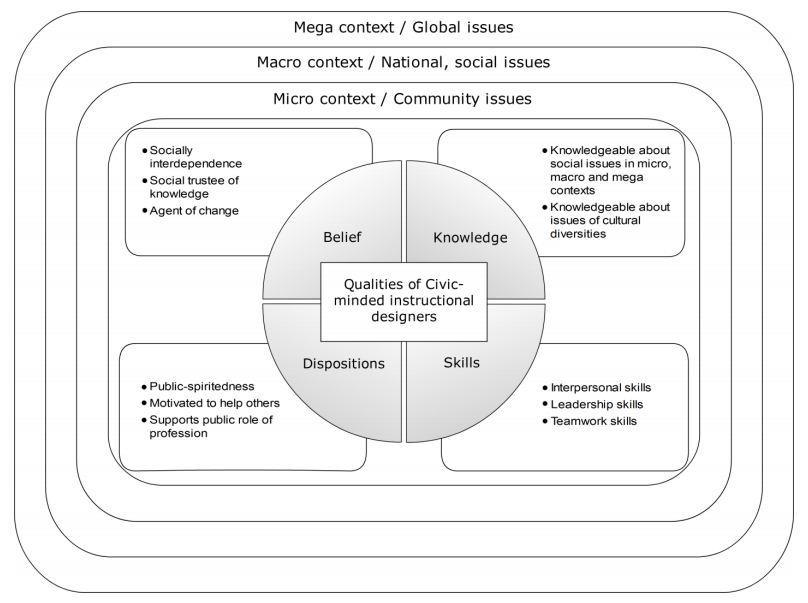
On coming back from Malaysia it was then coincidence to see an article on instructional designer training in that country:
Source: sorry, I seem to have lost the link to the site this was on
could, in many ways, be applicable to any profession/industry. However, the suggestion of social responsibility for all is, no doubt, missing in most university education. Would training bankers in such a way have helped avoid previous crashes?
The article suggests a focus on simply technical skills fails to develop designers of the type that are needed. This made we wonder – perhaps if there was more universal consideration of social responsibility there would be less reason for so many companies to feel the need to train staff into values that cross-borders and get everyone onto ‘the same page’? My hope would be, from a Learning and Development perspective, that any values or other cultural change program does not ignore the wider environment (as included in the above ID training model).
The conclusion of the article suggests the need for civic responsibility to increase in the balance against the “career-centric and technically orientated” content of most courses. However, perhaps too much of a shift would have a negative impact on Malaysia in decreasing the technical ability to compete with, say, India in the global ID marketplace? “The needs of the design industry” perhaps need to be better articulated with more cross border understanding of ID as a concept, after all my UK MSc almost certainly took a different angle to the predominate North American viewpoint. Here, through ID, is an interesting example of where we could look to benchmark skills globally whilst providing what a society feels it needs locally, regionally and globally (or micro, macro and mega).
Anyway, something of a rambling post but interesting that some of what I could see as an issue for a country in general is quite clearly embedded into the professional conversation of what it means to be a (ID) professional.



 Whose Education Is It Anyway?