Apprenticeship changes: reflections thus far

I’ve drafted a few brief reflective pieces for the site of late – only for referendums, snippets of policy and other articles to make me pause and reflect again.  This is an attempt to capture some of the excellence points being made about apprenticeships as the future for UK (well English) skills development (as well as linking back to old articles on the topics).  I’m well aware that elements will be made out-of-date between typing and publication!

In summary, it is hard not to feel we are in the middle of a seismic shift, akin to the Blair years’ promise of 50% Higher Ed attendance and the earlier end of polytechnics.

Whilst partly being driven by (and carried along in the tsunami of) Brexit news – the potential implications and the importance of the changes to Apprenticeships are also being drowned out by the huge stories in Europe, Syria, America and elsewhere.  This is a shame as whilst the potential for new Grammar Schools has managed to grab headlines, the apprentice changes have struggled to.  This is particularly striking considering the levy policy largely amounts to Government intervention in workplace people development and, therefore, a potentially more important change.  This is especially so for a Conservative government that continues to talk of free trade opportunities whilst having changed minimum wages, pension laws and other cost of business regulations.

Reflections on the emergent policy

The Apprenticeship Levy and related policies (or at least information on them) have been delayed at virtually every stage.  This is not helped, as anyone who has tried to work through the process will find out, that the related gov.uk pages have no real help, support contacts or feedback (beyond formal consultations).  I know it is better than it used to be, as they aim to move to the one site, but there are still plenty of errors on existing sites (see image from an example link on the Skills Funding Agency registration process).

Ultimately, there seems to be a shift from the government or individuals deciding ‘whose education is it anyway?’ to what business and employers determine is appropriate.  However this is within a government structure of shifting the financial cost to business in return.  Yet discussion continues over if some form of central linking of growth strategy and apprenticeships is needed, independent of the market forces of employer led levy policy.

screen-shot-2016-10-13-at-21-04-12
Dead-links from the Skills Funding Agency website

Reflections on the impact on Higher Ed

As this opinion piece from the OU on CIPD.co.uk and a previous post from me suggested, the levy offers L&D departments a huge opportunity.

The challenge may be more for universities.  With a clear challenge on how to keep relevant when charging huge fees.  To massively simplify – why would anyone want to study for 3 years for £40,000+ of debt when you could get an equivalent qualification whilst working?  Whilst the American Dream has been challenged as unattainable (as you can no longer work your way through college – but the universities and other interested parties dont want you to know that), apprenticeships are effectively challenging the ‘traditional’ UK model that started to take shape pre-Blair and was accelerated by his administrations.  Universities are going to have to become more responsive and imaginative in the design of degree-level apprenticeships.

If we accept there will be a (re)balance in the future between apprenticeships and degrees, then we also have to consider the nature of the labour market.  HE fees have discouraged mobility (encouraging people to stay and study at home) and social mobility in applications to ‘top end’ unis from lower income families.  Yet similar mobility challenges are being raised with apprenticeship changes.

Whilst a university education allows mobility, albeit I am an example of someone who chose a location for my undergraduate university (in part) as it was relatively close to home and cheap, there is the question of social value versus gaining efficiency through competition.  Of course, UK HE has some approaches that make entry to the market difficult (and better use of economies of scale, perhaps through mergers, could be made).  JISC could, for example, support degree apprenticeships through technology in a way that would be difficult for employer providers.

Fundamentally, there is also the question over why universities have failed to adopt wider competency models.  The US focus on competency based education in HE has shifted the model somewhat towards a more broken down skill profile assessment, akin in some ways to our apprenticeships.  Inevitably UK HE will have to move away from the vagueness of 1st, 2nd and 3rd class degrees.  Of course a lot of this is not new, I even presented on related issues at a conference in 2010.  There were also sessions on competency based learning beyond the standard curriculum at the same conference.  You have to presume that changes to traditional degree models will be accelerated by the ‘competition’ with new apprenticeships.

And to the future…

The arguments over graduate skills (or lack there of) will continue.  The shift to the Levy means employers paying to the levy have three real options it seems to me:

  1. do nothing – accept the loss as a tax
  2. work with vendors – accept apprenticeships as your career development pathways but also accept the “loss” of the levy money
  3. employer provider route – try and claim back the money whilst doing apprenticeship programmes yourself.  Comes with the highest risk (including dealing with Ofsted) but potentially highest rewards.  Risk is also associated with continuing lack of clarity, not least over assessment standards.

Another area where questions remain is if the target of three million apprenticeships will bring down quality.

Option 3: Employer providers

A key feature to the planned changes with the apprenticeship policy, throughout the planning, has been the promise of a shift to them becoming (more) ’employer led’.  There will be less of an education-sector focus in their organisation, especially in the change to allow people to be an apprentice at a lower or equal level to past qualifications (a big change).

The summer’s raft of announcements, typically made when I was on holiday, seemed to suggest (yet further) that becoming an ’employer-provider’ is a Good Thing for employers.  Questions remain though and I was personally turned down for the pilot of the apprenticeship funding website – again you could probably argue that giving some companies the early access and others not is, again, interventionist and potentially a help to some companies over others in competitive environments.  Yet confidence with the levy seems to only be possible if you think the current government will be in power for a while at least, opposition being in place from across the benches of the commons albeit sometimes ignoring the levy altogether.  Yet the government has continued to tinker with the planned new structures in the face of some of this opposition.

The presumption seems to be that larger employers, who already have L&D resources, can consider the provider route.  This makes sense, not least as apprenticeships focus on learning across the 70/20/10 spectrum.  However, the enforcement of L&D teams working within rules they might not have worked on themselves (depending on if they worked on the standard or not) will be a challenge to many – not least when there has been such a focus on informal elements and recognising the value of learning achieved away from credentialing (this also being part of the challenge for HE). There have also been lots of questions over supporting smaller companies in supply chains (aka ‘extended enterprise’) and the need to apply as a full provider to train other companies’ staff may be too much of a logistical burden for many organisations.  However, again, there is potential here for L&D departments to really transform their position within their organisations and their relation to partner companies.

Indeed the options for what levy money can be used for, by employer providers, are quite comprehensive:

“Employer-providers will be able to use funds in their digital account to pay for the following: • training to achieve the apprenticeship, which could include qualifications, elearning (as part of a broader training package), vendor qualifications • registration, assessment, materials and examination • administration related to the delivery of the apprenticeships. • accommodation for residential trips if necessary for all apprentices to achieve • costs for use of premises where these are used for the apprenticeship • wages and associated costs (such as pension and National Insurance contributions) for employees directly involved in the delivery of the apprenticeship.”

and it is difficult to see quite how the government will regulate and audit against ‘misuse’, even if their attempts are mostly logical:

“To claim eligible costs, employer-providers are required to input the price of these costs on the digital apprenticeship service and through the Individualised Learner Record. As detailed below, employers must retain evidence of these costs. This evidence may be requested as part of the SFA’s audit and assurance checks.

They won’t be able to use it for: • costs that are the employer’s responsibility, for example health and safety requirements, wages, travel, commercial choices (e.g. CSCS cards) • wages for line managers or other colleagues supporting the apprentice 16 • wages of the apprentice • profit or employee bonuses • capital purchases • more than one apprenticeship at a time for an individual apprentice • re-taking qualifications or assessment where no additional learning takes place • apprentice recruitment • anything that has received other government funding (for example European Social Fund)”.

The 20% rule

Historically the opposition to apprenticeships has often focused on the 20% rule:

“All apprenticeships must include 20% off the job training. It is up to you to decide at what point during the apprenticeship the training is best delivered (for example, one day a week throughout, 1 week out of every 5, a proportion at the beginning, middle and end). This will depend on what is best for your organisation and the apprentice. You need to ensure that all apprentices receive all of the training.”

To myself, as an L&D person, this sounds awful and in opposition to the wider potential of workplace learning and on-the-job ‘training’.  Indeed I chose to focus on this point when commenting on the Learning and Skills Group Forum a while back.  The noise seems to be that this can be more flexible than it has perhaps been in the past.


Overall, there remain many grey areas over how the FY17 model will work but the support being given to apprenticeships does seem to be hugely important and something for all L&D departments to consider in their strategies – even if to say the ‘brand’ of apprenticeships (one of the outstanding issues according to the CIPD) still isn’t strong enough to work for them.  Many useful links still haven’t made it into this reflective piece so I may well add to the comments.
learndirect Policy Exchange Session – July 2016

Last week around 50 learning professionals braved the hotest day of the year and a room with no air con to listen to an update on apprenticeships, mostly from Sue Husband from the Department of Education (recently moved over from BIS).

The overwhelming message was really “we’re not quite there yet, there will be more soon” – the latest raft of levy information unsurprisingly being held up by the changes resulting from the referendum result.  Therefore, I wont include everything from the day here as a lot was what we already knew.

There were positives though – rough notes below [with some of my comments included]:

  • There is clearly a belief that it will work (although the CBI is still pushing for a delay/rethink).  [Hence the apparent lack of contingency planning.]
  • Focus is on apprenticeship quality [although you suspect that will be under challenge from the ‘claim back’ employers – no doubt a test for the new Institute for Apprenticeships].
  • NI contributions abolished for under 25 apprentices.
  • 2.3% of workforce target now in place for government to encourage them to support the policy.  Recommended that people look up the 5% Club.
  • Post code of person will be determining factor on which pot money goes to – so good for English people working in Scotland/Wales, not so much the other way around [so employers may be forced into decisions that go against equal opportunities].
  • Funds will expire after 18 months – system is clever enough to know how ‘old’ a pound is and move into general pot at correct time.
  • Levy online tool is available for people to pilot [still awaiting my access after requesting last week following the event].  April 2017 will only be available to levy payers – smaller orgs later [makes sense and should help with stability].
  • Pooling funds and granting to supply chain are on road-map [potentially] but issues with potential for misuse of funds [payments for favours, etc].
  • They expect employers running own apprenticeships to grow [good that not just about supporting a market for the FE and skills sector].
  • The current advertising [which is all over my train route in South London at least] is young person orientated – the next raft will highlight that it is about all ages and current employees too.
  • Graduations now underway for people coming through apprenticeships designed to new standards [presumably a good thing but no doubt some questions over quality versus the old frameworks in some areas].
  • Acknowledged higher qualification [degree] cap does not make sense, as funding going from government to employers now looking at it from different perspective. More in next publications. [Might be a real game changer if this removes the blocker on graduates training into a career via an apprenticeship].
  • About half of all standards in development are at degree level [watch out HE!].
  • ‘Use levy wisely’ was the response to the question from the room about why the levy is being forced on those who already do good people development.  [Guess the challenge might be that the room was clearly people engaged with the agenda – no doubt the % of employers who currently under invest in L&D will be the more vocal in complaining about the levy].  20,ooo firms will be paying in; 5,000 of those will be new to apprenticeships.
  • Definitely don’t have to have ‘apprentice’ or similar in your job title [but good for your apprenticeship brand if people realise that is what they are doing – plus they do have to know they are an apprentice as part of the rules].
  • 20% off work can be blended, do not think about as 20% in classroom.  They recognise that continuous learning makes the best programmes [yay!].
  • Will be information coming for employers looking to do some of the training and back charging to provider.
  • Brexit may be good for apprenticeships [if cuts on immigration].
  • May encourage permanent employment [this is me extrapolating from the amount of people in the room unhappy that their temporary staff will be included in the levy tax but not in those who can be apprentices – presumably also the likes of SportDirect wont be happy with that one].
  • Digital Apprenticeship Service screenshots [It’s Alive!!  Will comment more on this when I get access].

The future of the Learning Management System? The LMS move from destination to distribution

I have mentioned many a time on this site that the use of an LMS has got to make sense within the ecosystem of tools that an organisation makes use of.  However, having recently taken over day-to-day responsibility for one in my new role, I have been thinking again about how they can be used.

The VLE/LMS is dead debate has, in my opinion, long become a bit boring.

My experiences so far, in my first months in my role, has reinforced my views.  Overall, your LMS may well be dead but it does not mean that is best for everyone.  This largely comes down to the platforms and communication channels you have available to you.

There is much talk currently about platforms, the school of thought being you need to control the platforms that people use so that the social (conversational) and push (advertising, etc) can be monetized, as well as the users and their data.  Facebook is the platform in this chain of thought – especially with Oculus and Live making their moves into the real world.  Now, of course, part of the VLE is dead debate was that we could distribute to users via Facebook and elsewhere that meant the platform was no longer needed.  This ignore the fact that for many organisations, at least education companies/suppliers/institutions, the organisation is the LMS.  It is the face of the company to the users/clients/students and often the authoring and collaboration place for staff.

For many non-education/learning focused organisations the LMS is, of course, not high on the lists of priorities for any staff.  Therefore, it is then a case of understanding how it can help.  Distribution by geolocation, time, etc. is surely then the future, no longer relying on ‘time out’ to go away and do learning in a training room where productivity is impacted rather than enhanced.

This stub has been in my drafts for a while so I thought I would post it.

CIPD L&D Show May 2016

I attended the second day of this year’s CIPD L&D Exhibition. There didn’t appear to be too much new on the exhibition floor and there remained a strong showing from CIPD qualification training providers, somewhat surprisingly considering the availability of the experience assessment and the rise of apprenticeships.

Included below are some rough notes from the free learning sessions I attended. [My comments in square brackets]

Management and Leadership Development: what does the future look like?

The presenter argued that MLD is all about return on investment and performance improvement. How you will measure impact should be essential part of your scoping and considerations [obviously, although it is probably a fair assumption that people have historically had lots of away days, and the like, with no real reasoning – I also suspect he was using RoI in a loose sense].

Recommended that bespoke is best as you can tailor to your needs and requirements.

Example of an IT company that used the presenter for the delivery of full sessions. These were recorded and then delivered to other audiences in 2 hour chunks due to large numbers being trained. [There were quite a few mentions for ‘bitesize’ solutions – interestingly this was later described as 2 hour chunks, not what most people would could call ‘bitesize’].

Connecting people key, including Skype and ongoing networks after events. Managers want bitesize and the opportunity to talk to each other.

Negative numbers from TM Embracing Change were mention, L&D is failing to meet challenge of seeing productivity increase. Treat management seriously and have people move toward chartered management and ongoing development if that is focus of their role to help.

If looking at providers need detailed review, including asking to speak to other clients. Too many bad purchasing decisions in this space.

Would you say people are still using tools you introduce in interventions? Need reinforcement [not least to tackle forgetting curve].

5 identified options: can be appropriate to do in-house. [He ran through these different blends and approaches they have used with clients inc. Level 5/7 ILM].

Would say 5% of people on leadership programs are really leaders, rather than managers. ILM7 can drive change.

Slide on recommended programme [largely aligned with what we’re trying to do with talent framework].

Remember is about fun and energy, metabolic management about creating higher energy levels. Open air can have big impact.

Embedding a Growth Mindset – Raising courage for maximum performance

[Presenters’ company focuses on helping people develop a “courageous growth mindset” – I’ve won a personal free session with them so will be able to comment more in a few weeks].

The UK has major issues with engagement and job satisfaction – 24% in CIPD survey looking to move on from current employer.

Priorities coming from the (lack of) satisfaction include well-being programmes, cracking management development issues, etc.

Pennsylvania researchers developed the GRIT score based on Duckworth 12 item questionnaire. When tested with students at Penn the GRIT outweighed pure academic scores as indicator of performance.

So what we can do to up GRIT scores?

[Their solution is a reflective activity and workshop. They ran through part of this development piece with the group attending the session].

[Some of the points from the session:]

  • You can’t be too conformist to achieve this
  • Mind tactics page – things that block you from behaving the way you would [would you say you hold yourself back? Would consider I am fairly self reflective and aware. However would agree that subconsciously complacent]
  • [I liked the point that you need to think about how you act when engaged and what that means and looks like]
  • Don’t pigeon yourself. Celebrate your successes. [Their] iAM tool develops who you are at heart.
  • Have free events where you can experience it further. 4 a year.

Adding Business Value: proving the impact of L&D through evaluation

Proving value through evaluation (Trainingevaluation.com).

Need to be thinking of business value [obviously].

Need to stand up for ourselves [i.e. L&D] with evidence, unlikely anyone else will.

Yet innovation in learning not being matched with innovation in evaluation, LMS often adds to problem.

[Ran through a list of things from 1954] Same year as Kirkpatrick. How many other industries still using something from 50s? Not into kicking Kirkpatrick, as some presenters do, but there are clearly issues. [I’d agree but most industries build upon existing historic theories and to be fair Kirkpatrick is not in the same form, or at least expectations of use are not, as in 50s]

Really about behaviors and evaluation.

Evaluation thinkers have built upon KP or used alternatives [my point above], they make use of forecasting and other items from other fields.

One major issue with KP is that it is summative.

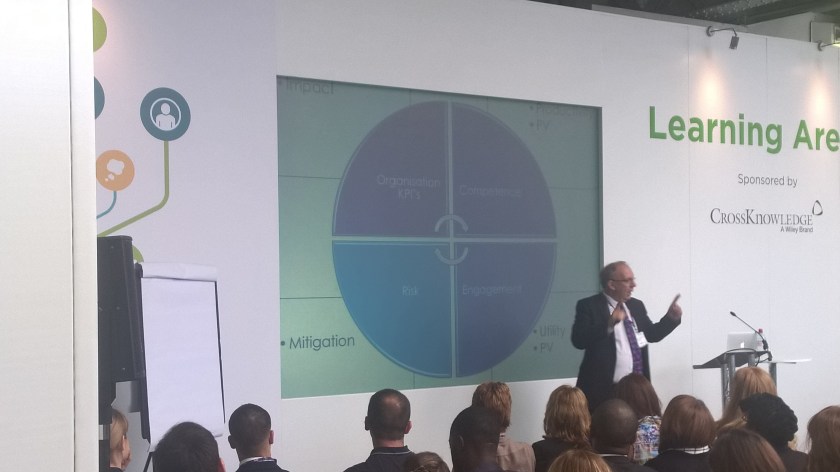
Instead decide what want and be strategic (four things can really look at):

WP_20160512_11_09_01_Pro.jpg

[Fine but I would have thought most people realise they need to roll Kirkpatrick up to beyond a ‘course’ or ‘session’ to show real evaluation]

Decide target / what measure to say achieved / by when [yes, I like this as a simplification – effectively though is just saying L&D need SMART targets?].

Where appropriate, weigh input values (i.e. how much your element is impacting an organizational KPI) compared to other things. There are not too many valuables – banking, and other industries don’t claim that. They make forecasts, etc. so why can’t L&D?

Competencies [presenter’s] favorite area [from the above four quadrant wheel] to target as quick and easy with clearer returns.

Kirkpatrick can be simple and easy solution. Not likely what should actually be doing though.

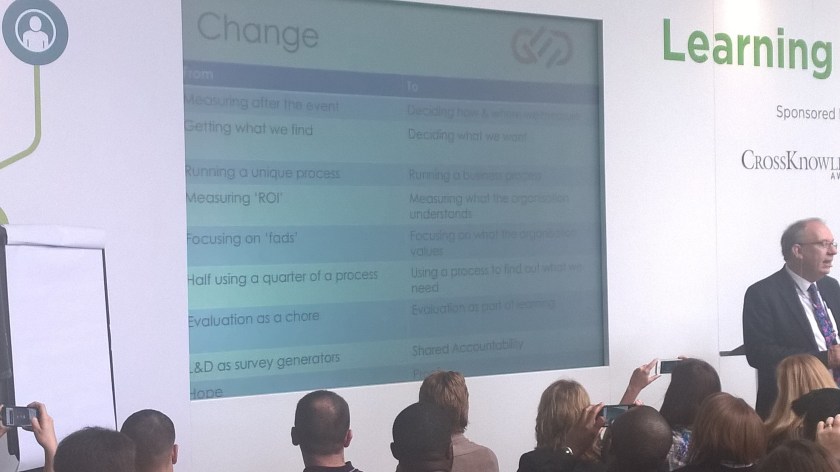
Focus via points of value. Don’t rate in traditional ways, instead focus on specifics – instead of just asking if someone liked a session ask for measure of the presenter’s presentation skills and where could improve. Forget reaction, focus on intention.

Shifting focus:

WP_20160512_11_20_54_Pro

Evaluation revolution book coming soon.

A practical framework for modern technology-based (L&D)

[Might have been my tiredness but this one felt a little all over the place with minimal reward]

Core skills for learning and Development – the ICS Learn Learner Support Model.

Response to changing shape of business, including technology, needs to include various factors, including creating self directed learners.

Generation Y/C analysis [not all of which id agree with – not specific to young people]. [Baisc argument was that] children can use technology and are using it at schools, with implications for workplace.

There will be a more fluid workplace, including career matching and a skills marketplace.

Need empowered culture, including feedback.

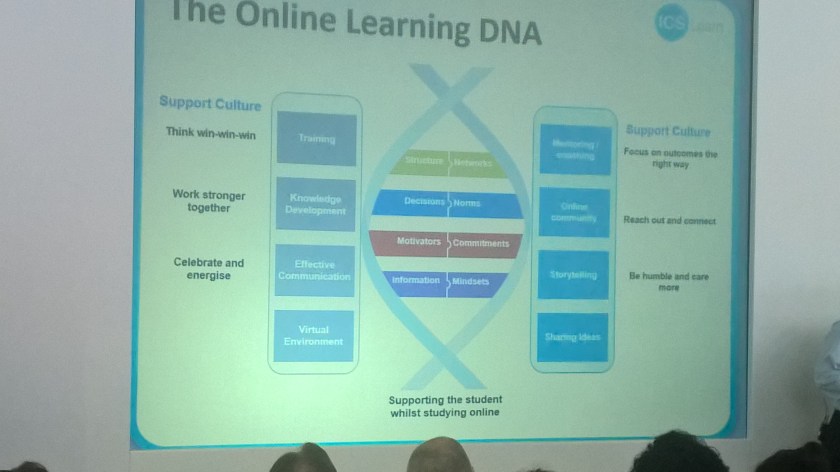
DNA of what goes in to be effective:

WP_20160512_12_01_35_Pro.jpg

Learner support model for technology-enhanced-learning requires systems/tools and content but only works if all underpinned by support. [Anyone really not expect this to be part of it? Fair point though that tech alone isn’t enough – albeit one we’ve surely moved beyond having to make].

Example given of company where everyone holds responsibility for learning and development, yet L&D department is one person, you don’t have to have huge L&D staff or costs if doing well.

Effective online combines tech etc with capture/connect/communicate [i.e. social learning?].

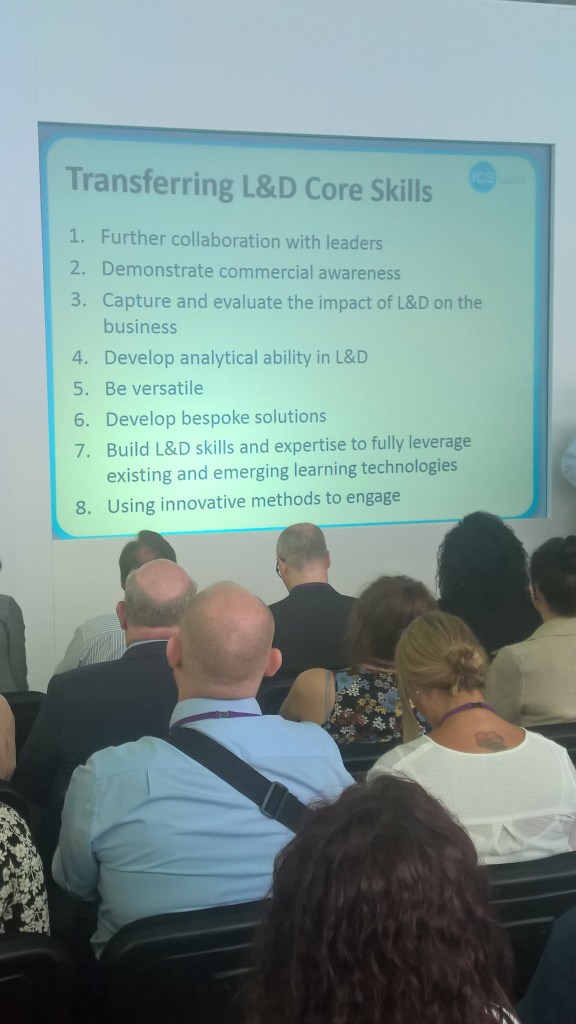
Transferring L&D key skills:

WP_20160512_12_09_19_Pro

25th May running live stream on Facebook, their first. Live Q&A on online learning experiences. 12pm on their Facebook page.

Virtual Employee Management: achieving business success using digital resources

Tribal historically focused on apprenticeships. Have taken apprenticeship ‘standards’ logic and tracking into a different focus of tracking operating standards and tracking objectives (e-track tool) – inc for remote staff. [Basically point of presentation was showing how their tool helps] Manage learning programmes overtime via tech, using portfolio and MIS.

Talked through approach: First map job role to competencies.

Example shown on e-track tool. [Basically a competency database with self assessment/certification – with attachments of evidence, etc]

What found was very granular models, so did additional piece focused on tasks. Simplify standards into tasks, if can perform then competent. Showed this mapped to standards but employee themselves sees as more practical as task based.

Different options for tracking, including self-certification versus supervisory roles doing it. Feedback throughout.

All based on fine level details for reporting to regulators that people can do jobs.

Showed some of interface for reporting, for example, managers being able to see progress. [quite nice interface, colours, etc]

Can develop a Learning and Development plan off back of it [effectively here you are taking a roles > competencies > learning approach but, of course, many orgs are at different stages in terms of their maturity in those three areas].

Communities functionality within the tools to have discussions, can pick up eLearning and other content from here – all ticking off competencies in background [effectively performing LMS functionality but in a competencies-first world?]

Interactive data and charts looked quite good, can drill down live within the browser. Can bring in information from other sources, such as payroll, to evaluate worth.

[Basically argue that providing the tracking needed in many industries, clients including nuclear and oil & gas, technology] easing their way.

Bringing the Appraisal Conversation to Life to Tackle Underperformance

Michael West NHS appraisal research – good appraisal correlates to mortality rates in hospital.

How make people love them? Needs to be whole organisation, not just managers – people need to own their performance. Manager only manages it.

Engage everyone, [their favourite approach is forum theatre, went on to demo this with couple of actors. Audience acting as director, stopping action and making recommendations, etc.]

[Quite a nice approach to showing the way to have the conversation].

Apprenticeships, the real future for L&D?

Somewhat under the radar in the UK, well in England at least, we seem to be facing a fundamental decision point for what workplace learning means.

The government’s apprenticeship levy is threatening to create, from my current perspective at least, what looks like a three-tier system:

  1. small organisations who will take on apprentices over other training as they dont have to pay into the levy so its ‘free money’ reducing the need for their own L&D
  2. medium to large employers who see the levy as a substantial cost and feel they need to ‘claim back’ as much of the money as possible via shifting their learning focus to apprenticeships.
  3. large employers who can live with the cost of the levy and will continue as they were.

Overall though it seems the main feeling is one of confusion.  The slow feed of clarification from the government means that forward planning is tricky and at the recent 70/20/10 event I spoke to a number of people who felt apprenticeships were fast becoming their number one issue, without any real discussion in the L&D press.  The issue perhaps being that if an organisation shifts to the ‘claim back’ or ‘free money’ mentality they will be impacting on a number of traditional disciplines including finance, L&D, recruitment and more.  Perhaps the problem is that, as no single discipline ‘owns’ this issue,  apprenticeships remain somewhat out-of-scope for many (at least in their own perceptions of their role).

There is, of course, a very recent precedent for government policy increasing the so called ‘cost of business’.  That so many organisations are being accused of cut backs to benefits to pay for the living wage, raises the suspicion that L&D budgets face a similar cull in the face of such a training related ‘tax’.  The CBI have already warned that successful learning initiatives will suffer in the face of the levy.

With a target of 3 million apprenticeships over the next few years we are talking about comparable numbers to higher education entryMeanwhile, 2014-2024 figures suggest just 1.8 million new jobs – with degree apprenticeships one solution – implying that apprenticeships will need to be used for promotion.

There are some fundamental issues for workplace learning is how apprenticeships can align with wider trends.  Modern apprenticeships will need to focus on bringing in certifying skills from a range of experience, exposure and education.  This will almost certainly have to include some formalisation of the informal, blurring the lines therein (such as staff using tools such as Lynda’s learning paths).