Back in June 2021 (3 years ago, really?!?) I wrote about RenPy as a platform for choice-driven branching gaming. Since then I have played around a few times with an idea for potentially developing a game to make leaders reflect on their personal approaches.
I had not really got going with this at all. So, as it is 2024, I asked Chat GPT (3.5) for a start.
Write me a renpy game about leadership in corporate environments
Me to ChatGPT
Even this simple prompt delivered 97 lines of code. So here we go, I might just have to try and give this a go!
If I manage to find some time – some more work on this might follow, hopefully not in 3 years!
One New Year’s resolution (for me) was to try and blog more as I am conscious I am being less reflective on things I read, webinars I attend, podcasts I listen to, etc. We will see over the coming months if I manage to keep the blogging up or not!
Obviously, I am at risk of being shouted down here but, in my opinion, there are a few things in this article I thought I would reflect on:
“leave their jobs to get their needs met” and an increasing gap between men and women – are differences between men and women’s needs still so pronounced?
“the economic and personal pressure is higher on women than ever before” – this sounds like a big claim but it may be the case – see my thoughts in the paragraph below*
“burnout as the main reason” – again, is this not a universal issue? What is happening in corporate America!?
“harassment and microaggressions” perhaps answers the question in the last bullet along with “lack of flexibility” and “limited advancement opportunities”. All of these reasons can, of course, be issues for groups beyond women and the suggestions listed – such as “flexible hours” and hybrid work really should be the minimal for most leadership roles in a modern environment.
*Ultimately the issue for all households (whatever the gender) is that we have gone from a situation where many households could get by on one salary (my mum, for example, missed several years of work including a spell of around only 0.2FTE and later my dad was made redundant and had years of part-time work before retirement) to most families needing two FTE salaries to get by. This leads to political issues – for example, whilst President Biden might expect a good run into the election based on a (relative to other countries) strong economic position we are instead in the situation where memes like the below are rife.
The reality, of course, was very different for many people. However, the point about purchasing power of the masses versus the “1%” is clearly a major issue in many countries. Where women are being expected to fulfil traditional roles alone plus economic pressure then clearly there will be severe “economic and personal” pressure (as mentioned in the article – see bullets above).
The conclusion of the Forbes article includes “if companies want to retain valuable talent, they need to create an equitable workplace where women can thrive”. I think it is fair to say we can simply rewrite that as “if companies want to retain valuable talent, they need to create an equitable workplace where everyone can thrive”.
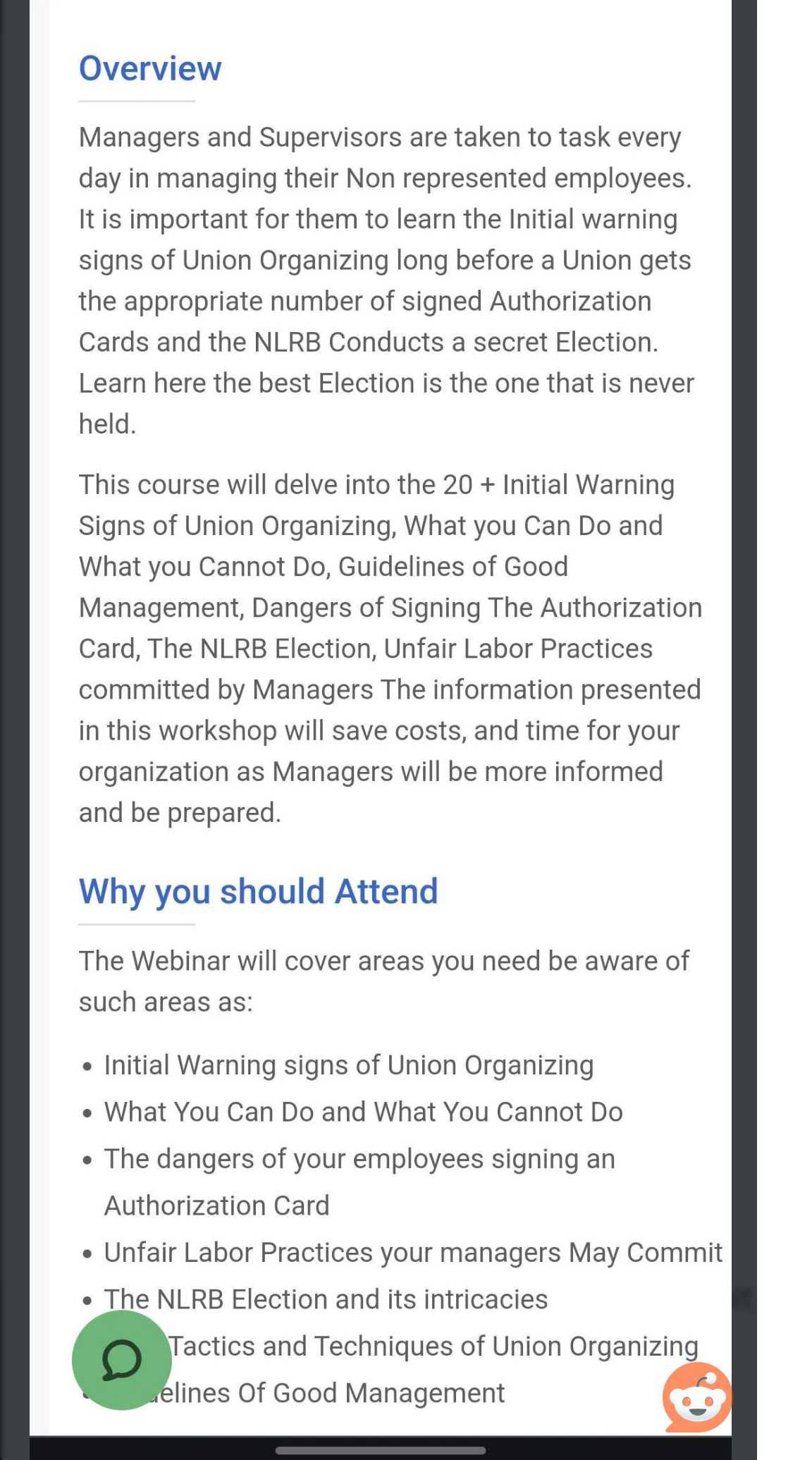
All in all, the above “course”/”webinar” sounds pretty terrifying. Clearly there are big macro-economic issues at play in the (US) labour market but surely no manager or L&D team should consider that the kind of snooping to identify “warning signs” is morally acceptable – no matter your opinion on unions.
Having read a lot of union-related material from c.1900 for my undergraduate dissertation this really sounds like we (or perhaps western capitalism) have regressed in many industries to the “them vs us” mentality of the past. Therefore, those with good workplace environments, strong career development opportunities and high engagement/satisfaction really need to be vocal to show we do not need to revert to the negative and combative approach. There are enough bad things going on in the world, and real challenges to face, to not be fighting internally in our organizations and managers/L&D need to focus on achieving goals not fostering surveillance cultures.
The article’s explanation of the question reminded me of arguments around information seeking behaviours and “knowing” versus “knowing where to look”. Nothing much else to add but an interesting one for issues such as capturing tacit knowledge and the nature of collaboration in different organizations.
I am a big fan of counterfactual history (aka “virtual history” or “what if?”). This goes back to my time as an undergraduate history student and a module at my university that was made up of a series of counterfactual history scenarios, the assessment for the module being to write your own. In hindsight this was the most useful module in the degree as it developed the skills and habits for other modules, including empathy with the historical subjects, problem solving, thinking about alternative scenarios, challenges of cause and effect, etc.
Overall, that module stays with me as a transformational learning experience, even if historians are snobby about history that is not “real”. In many ways it was a fun, safe, space to consider the skills of history – a subject where you tend not to have labs or simulations offering such experiences.

 Whose Education Is It Anyway?