Reflections after being a visitor to UN HQ (New York) event

Prior to my recent visit to the UN Headquarters in New York I was not really sure what to expect. This was, in part, as it was difficult to get information online (Google seems to default to information on tourist/information tours rather than visiting for events). Therefore, I thought I would capture here:

  1. some tips for anyone attending such events for the first time (akin to a first time visitor guide)
  2. some reflections on this experience, including reflection on the UN, how to run events more generally, etc.

I should say these are from a position of ignorance – I do not have a qualification in international relations (or related discipline) so (as mentioned in the last post) these are the feelings of an “outsider” coming in. It is also fair to say that many organisations and events are confusing when you first attend and by day two many issues are resolved, this is true enough for a lot of the below but I thought there was some value in capturing this before I forget my time there.

The event I attended did have an “information note” of 17 pages. I will try and avoid repeating what was in that although I did find that too long, repetitive in places and (alas) inclusive of information that is not really needed anymore (e.g. information on local currency is Googleable – far better to focus on what is really needed and unique to the event/venue).

Things to know before you go

1: Passes/security

As you would likely expect, you need a pass to get through security. There are then some internal security areas you can and can not access based on your pass (for example you can get from the gift shop areas to the conference rooms but not beyond into the secretariat office space).

Temporary day passes for event: I was offered a one-day pass as I was presenting. It is worth knowing these seem to be deployed by UN staff literally handing them out by the guest entrance at the time they tell you to be there. How this works in bad weather I have no idea but when I was there you could see people handing out passes by the gate most mornings.

Longer term passes: as travel was an issue for me I wanted to register for the bigger event, rather than just go to present and then leave. This required registration online and there were multiple options – it was not clear to me which option was the correct one so you need to hope someone in your organisation is okay with UN-lingo and can guide you (kudos also to my side event’s UNITAR contact for helping with questions).

Once you are registered you have to attend the UN pass office, this is advertised as being open from 9:00-16:00 (Mon-Friday) and is roughly across the street from the entrance (although not with great signage and in one of the more rundown entrances, not a swanky building that many UN offices appear to be from the outside). When I arrived at 08:45ish, there was already a line being dealt with. Therefore, go as soon as you can, some people even mentioned they got their passes on the Sunday, I can not confirm if this is possible but it would 100% make sense for them to open on a Sunday before a big event. When I left at 09:30ish the line was out the door and down the street, none of those people outside will have made the opening session that started at 10:00. The line is slow moving but there is free Wi-Fi within the pass office. It is relatively painless to get the pass – you show your registration confirmation and passport. Note you get a photo taken there (I think you had to upload a photo in advance but this is not used for the pass) that is printed onto the pass (although the webcam approach to taking pictures was not great, I was too tall and had to duck whilst I saw other people who were too short for the setup).

Entrance security: Security guards at the gate do check you against your photo so if you are one of those people who changes hair, glasses, beard, etc a lot your photo might become out-of-date. I kept forgetting to take my sunglasses off much to the annoyance of the security guards. Unfortunately the entrance security does not differentiate between groups coming on tours and those attending events, therefore, I got stuck behind a large group of teenagers on one day which slowed passing through the airport-style scanners. Basically you do not want to be in a rush and should allocate plenty of time.

Pass returns: this was an odd experience – passes have an expiry date printed on the front (the Friday of the week for me) and instructions on the back insisting passes are returned. However, when I tried to return the pass on the Thursday, when I no longer needed it, I was told to keep it for any future events. This seems bad on multiple levels – the instructions on the card are wrong, the plastic cards are seemingly not recycled and presumably there is a level of security risk too. I presume the idea is that you can bring an old card for future renewals if you go again?

2: The UN as an organisation

The side events and different things going on during the week seemed very siloed, asking questions of UN staff seemed to reinforce this. Whilst those of us on the outside might think of the “UN” it is clear those more ‘in the know’ will see a series of entities. This is not unique to the UN, of course, I have worked for multiple organisations who have been going through their “one company x” phase of trying to bring units together, the UN no doubt has similar conversations internally.

One solution to the challenges put forward by a number of people during the session on the SDG related to water was that a “special envoy” was needed. I feel inclined to agree with the limited number of countries that said the UN should really already have enough powers to move the agenda forward without adding more layers/roles.

There was also a hint of cult of personality with a lot of António Guterres on videos on screens in hallways, photos around the place and references to him in talks. I found this odd for an organisation about humanity’s collective history and power.

3: The UN hierarchy

Few of the more senior UN, World Bank and other speakers stayed after sessions to discuss or network (in contrast to the external organisations who presented in the Learning, Teaching and Practice [LTP] event*). Meanwhile a lot of the work, such as laptop management and moving slides, was delegated to interns. Talking to a few interns it does not sound like it is the best place to work and in this regard the UN seems to take some bad practice from being based in the USA and their approach to workplace relations.

* Kudos to the diplomat from Switzerland who presented to the LTP side event (and did not just attend the main event as others seemed to).

I personally have a real problem with the approach of people being called “his/her excellency” and “distinguished representative”. I appreciate these are senior diplomats, heads of UN agencies, etc but it just reinforces elitism and self-importance. I would personally get rid of “right honourable” in UK politics too, as well as the honours system, because it all just feels like nonsense to me (do career diplomats/politicians deserve such praise?). On a very practical basis, with so many countries and many speakers in some sessions, you would save time by simply saying “country x next” rather than an elongated version (see also companies that insist on outros and intros on videos – time adds up folks).

Chairs of the main sessions also seemed to leave at the halfway point, I guess this is standard behaviour but it seems rude (to me) if everyone else stays for the duration. I appreciate this is “the day job” for UN staff and, therefore, not special but it is a useful reminder to us all that the mundane is often not so for everyone in the room. No doubt there will have been other people there, like me, where this might be a once-in-a-lifetime experience.

3: Ear pieces

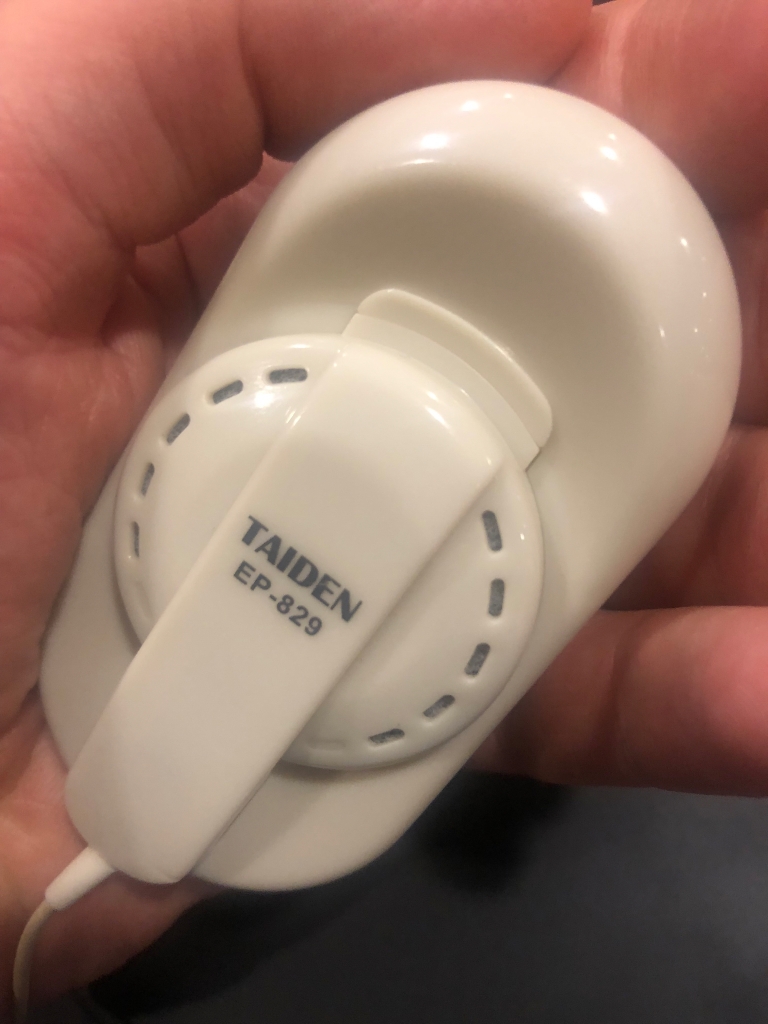
This might sound stupid (maybe the whole blog post does? let me know in the comments) but I had always presumed the UN ear pieces (that you will likely have seen on TV) were for translation.

In reality, you also need them for the English speakers (the vast majority) as the sound system in the room is very quiet (I guess so you can hear the ear piece over the in-room audio). Unfortunately, not all the chairs in galleries seemed to come with an ear piece and they also had a tendency to get tangled up with the chairs and other ear pieces.

UN ear piece

Ear piece

4: Expect dry

I am sure it is recommended, due to the diplomatic nature, but be warned – the vast majority of speakers and presentations are very very drily delivered. Even senior UN people seemed to mumble into microphones and most speakers read from scripts. Again, I suspect this is a failure of the system (rather than individuals) as statements are published – nonetheless there are ways to be better via presentation skills, storytelling, etc. The pre-prepared nature contributed to a lot of repetition between country speakers. There was also a lot of repetition when some people presented at a side event (report launch) and then a wider event on the same topic. Kudos to Tajikistan who seemed to break the mould and specifically said they were going off script to avoid being repetitive in one session.

The main sessions had different types of speakers – panellists, discussants and then the representatives from countries. The country speakers got 3 minutes each – when people overran their mics were cut, leading to odd giggles among some gallery attendees, you get your laughs where you can I guess.

5: UN as a conference venue

Some things about the UN experience were great; the Wi-Fi seemed very fast, rooms are setup with audio facilities (for translation but also for live coverage on UN TV and amplification in the room), everywhere was very clean, plenty of toilets and water fountains…

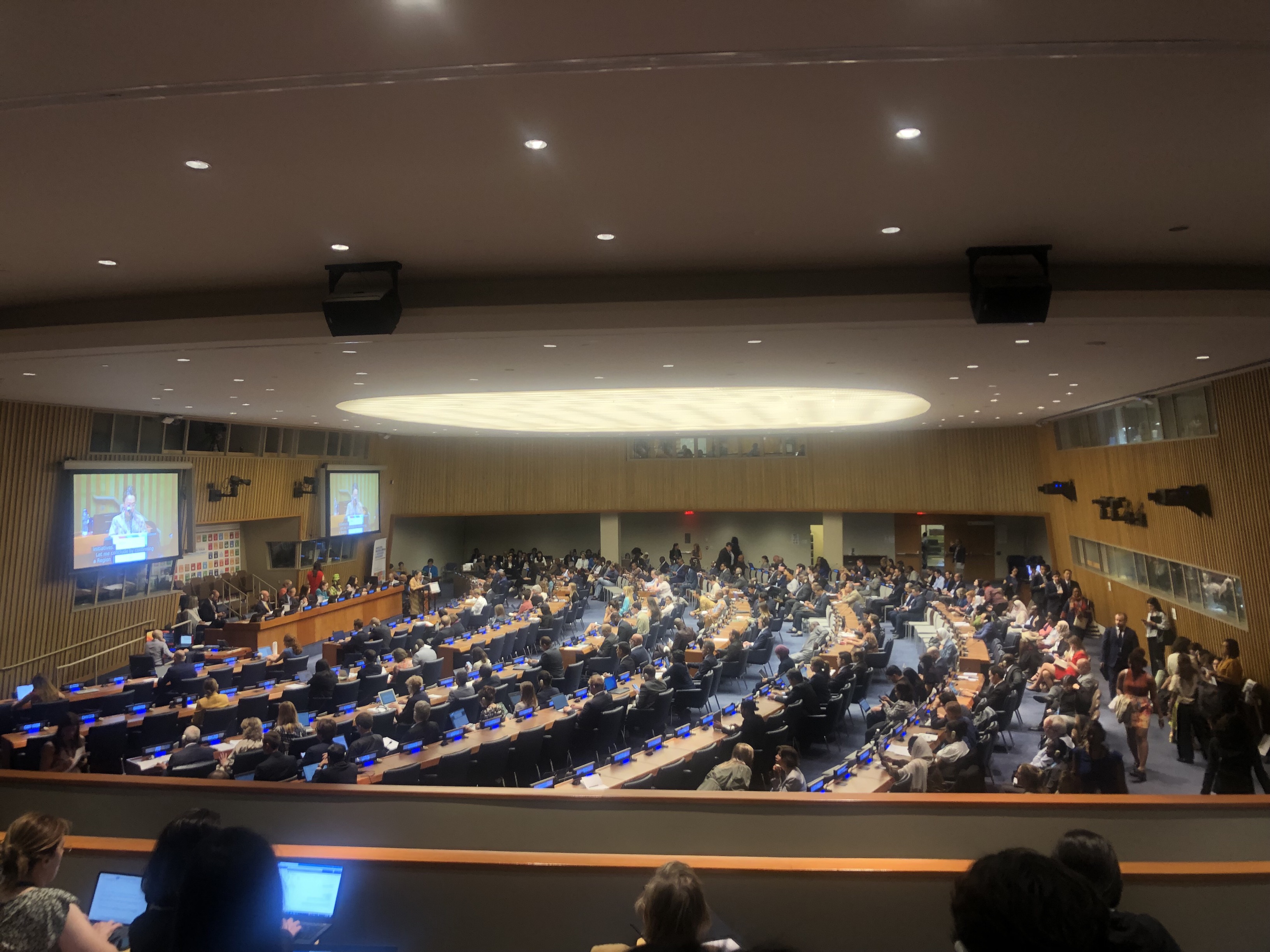
…less good was that screens in the bigger rooms basically are not viewable from the galleries, meaning, when slides were used they were pointless. This might be why slides were not used much in the bigger sessions. Ultimately a few additional screens in the galleries would have been great given download links and other resources were shared via PPT.

It was also very difficult to catch people’s names and organisations – this was okay when the electronic nameplates were used to show the name of the speaker (I even got one) but reinforced for me one value of Zoom – that you can see peoples names! (Yes the website had speaker details but not always easy to check on that).

The smaller conference rooms (I presented to about 50 people in a room for 120ish) were fine but ultimately a basement conference room is a basement conference room. I didn’t really enjoy having to sit to present but the setup of having the slides in front of you, rather than behind as normal, was quite nice as a presenter (if difficult when attending sessions in terms of knowing where to look). If you are reading this before presenting at such a session – keep your content high on your slides : the rooms are not setup for most chairs to see the bottom of slides once projected.

The space is not great for networking, the conference rooms have some seating outside but otherwise it is really just a couple of different coffee/food units. One of these is very badly placed as it creates a lot of ‘coffee machine noise’ every time a conference room door is opened (at least in conference rooms 5 and 6 where I spent a lot of time). The food was actually quite good and not too expensive (New York in general seemingly being very expensive) but I suspect most people disappeared off for lunch elsewhere (the high level event folks certainly disappeared off while side event people, like me, seemed to stick around in the limited time between sessions).

Final point, a lot of event management seems to be left to the security guards stationed on lifts, room doors, etc. I suspect there could probably be benefits from a few less international relations graduates and a few more event management people on staff.

6: A way forward?

Ultimately, the UN HQ is just a building.

Yes, it is a building with iconic architecture and history but I perhaps had too idealistic a view before attending.

I am perhaps reading too much into things but a few statements during the week hinted at a realisation of the problems in the UN system and the interactions with NGOs and other stakeholders including : “drop the egos and collaborate for real” and a need to “come out of egos and logos”. Not to mention countries with political problems using their 3 minutes to simply complain about each other (which of course predates the UN and goes back to League of Nations problems).

President Trump and others have threatened UN funding. Having attended for a week, you could certainly see room for improvement, alas, I guess voting through changes is unlikely to ever happen. At the same time there were hints of a lack of funding (or bad spending of money there is) with worn furniture, the screen issues, etc. Activities could certainly be reviewed, for example, is calling on banning mobile phones in schools a good use of resources?

Submitting a proposal

I am not sure how much of this experience is universal to other events but for the side event I spoke at (2023 SDGs Learning, Training and Practice), at least, the process was time consuming with a lot of tight deadlines implemented from the UN host side. Was the effort worth it? Questionable.

Steps included:

  1. Submitting a proposal
  2. Then being grouped with other organisations in a thematic session
  3. Resubmitting a joint proposal with the others in the thematic session
  4. Preparing slides and summary to summit
  5. Presenting
  6. Submitting final slides and a summary.

We found out at the event that we were 1 of 10 selected from 130 submissions.

Prior to the event it would have been helpful to see examples of submissions, to have support with being (force) grouped into co-presenting with organisations you had not met before, etc.

During the event it was a shame the #SDGlearning hashtag did not seem to get much use but it could have been promoted more. Another reminder for my own practice and the need to group/promote our activities better on LinkedIn as we know that helps drive an increase in our audience.

Summary

An eye-opening experience, whilst disappointing on some levels also one where I met a lot of interesting people.
“Show me the money”: Some personal reflections on the July 2023 UN High Level Political Forum

I recently spent a few days in New York City to attend the latest United Nations (UN) High Level Political Forum (HLPF). This event was focused on a subset of the Sustainable Development Goals (SDGs) and how the world is progressing toward achieving these goals (spoiler alert: not at all or not fast enough).

This was my first trip to New York since 1996. Some things were the same as then – Tom Cruise was still on Times Square billboards, in 1996 it was for Jerry Maguire, in 2023 it was Cruise driving off a cliff edge for the latest Mission Impossible. Perhaps the most long-lasting cultural legacy of Jerry Maguire has proven to be the “Show me the money” (NSFW) scene. In 2023, the UN sessions sounded similar, with near desperate calls for funding to fix the world’s problems before we all, metaphorically for some and literally for others, fall off the cliff. So, is achieving the SDGs, in fact, Mission Impossible?

The Outsider(s)

Based on my level of access, I basically spent the morning of the four days I attended watching from the gallery as the HLPF discussed topics. Day one was in the famous General Assembly room, the other days in a smaller conference room:

UN Headquarters conference room 4

I will do a separate post on my reflections on the UN experience, and I will instead attempt in this post to just summarise some of the more interesting points from the sessions.

The three afternoons, for me, were attending the “Learning, Teaching and Practice” side event – which I spoke at on one day – plus an additional lunchtime event which took place to launch a new report. Again, I’ll do a separate post of the experience of submitting, resubmitting, and presenting a proposal to this event but will include some of the more interesting content and takeaways in this post.

Whilst this is my attempt at a write-up, daily write-ups were handed out and are available online from IISD (International Institute for Sustainable Development). These are less full of Tom Cruise related wordplay, than this post, and are actually very comprehensive.

Oblivion

As a Brit, especially as a child of the 1980s, there was only thing I could think of walking away from the event:

We're doomed Dad's Army gif

Indeed, the HLPF event left me largely dispirited and fearing that we may, finally, be facing oblivion as a species. Virtually every session stressed that the SDGs are way off target and there was limited confidence of achieving them without huge effort – the introductory session suggesting only 12% of targets are on track.

Since attending the event, I have watched the aforementioned Mission: Impossible – Dead Reckoning film and the plot, as has been heavily advertised, is that Tom and the gang faceoff against a deadly Artificial Intelligence. What is less well advertised (spoiler ahead) is that the American government (and others) are trying to control this AI in anticipation for, what the film outlines as, a third world war to control our dwindling world resources. Whilst this feels farfetched in some ways, we also have to consider that even if the AI threat is exaggerated the potential for wars over water, oil and other resources are all too real.

The start of the “SDGs Learning, Training and Practice” side event (the event I presented at) suggested that “shocks” such as Covid, war(s) and natural disaster have been negatively impacting the SDG agenda. In reality, given the event was focused on post-covid solutions, we surely face huge challenges given the post-Covid “new normal” is a normalisation of increasingly extreme weather and political challenges. Indeed, the eve of the event had seen horrendous flooding nearby in New York state and extreme temperature warnings in the southern USA, as well as much of the rest of the Northern Hemisphere.

Risky business

Many sessions called for something like we “can’t keep doing same things we have always been doing”. However, there seem to be no easy answers and even if the money/finance models that many sessions were calling for existed there is, of course, human nature to contend with from a corruption and waste perspective. Any investment, be it from an NGO, government, private sector or elsewhere will come with considerable risk unless based on global good practice.

Mavericks

Success stories and concrete ways forward were relatively few and far between, but there are clearly people out there managing to achieve the seemingly unachievable, some of the more interesting examples I made note of:

  • The SDG Atlas (https://datatopics.worldbank.org/sdgatlas) was one of the few tables with resources that could pass as “conference stalls”. It looks like an interesting site with access to SDG related data for transparency and comparison.
  • Whilst emission targets and other SDG challenges led to advocacy for renewable energy through out the week a number of speeches through the week still made the counter case and asked the world not to throw out gas and to include nuclear as options. Indeed Senegal, expressed a need to use its oil to fund improvements to the poverty situation.
  • If looking for mavericks the most impressive speech of the week came from Edward Ndopu, (SDG Advocate, youth representative) who stressed the need for diversity, inclusion of those with disabilities and more in our shared futures. You can see a transcript here.
  • Work being done on water access (outlined in this session, which I learned quite a lot from given I am not an expert in this area) and the point made that it needs to go beyond just water – that it makes sense to combine water projects with electricity access projects, etc. This was a good example of where the siloed approach of agencies, NGOs, etc needs to be challenged and many talks called for big picture “whole government” thinking. At the same time there were a number of sessions stressing real success is when local people and governments are empowered as they know their situation best. Overall, getting the balance correct will likely depend on existing government models and the balance between local/centralised. A Swiss diplomat, for example, making the case that the Swiss canton system is local-first and therefore, potentially, in a better position than some countries that over centralised power.
  • Fundação Antonio Meneghetti (a school in Brazil) outlined their education model which, whilst not too revolutionary in some ways, at least suggested that young people can be engaged with global issues and be better positioned to deal with world challenges (as well as helping tackle limitations from class/social status).
  • I personally liked a presentation from International Movement ATD Fourth World, this session made me think about the language we use. One key point was to consider people as “currently experiencing poverty” rather than calling them “poor” and “temporarily homeless” rather than “homeless”. The point being that these conditions can, and should, change and we should not classify people by them. You suspect this will become increasingly important as more of the world face flooding, fires and other disasters.
  • There was minimal mention of standards to ensure quality, but one or two people thankfully did mention them, otherwise you fear the calls for cash will lead to a lot of waste and probably dumping of poor solutions on the countries needing the most help.
  • There were some mentions of examples of good work being done, for example Denmark working in partnership with South Africa and India bilaterally on water projects. Similarly South Korea was one of relatively few countries to proactively offer support and data to others during the general HLPF sessions.
  • Morocco mentioned desalination as key to their water strategy given climate change, I remember this being the big hope in the 90s. This article suggests it is technology that is finally being used more and more.
  • The IFMA Foundation (who I shared a session with) did a really good presentation stressing the impact of building on lives and climate and the need for good facilitates management to help ensure the SDGs are met, including through their membership, education programmes, etc. A good example where an NGO or professional association have a clear link, via their profession, to SDGs and the common good.
  • The UN itself was called out for doing enough in a couple of sessions – specifically that peacekeepers do not use renewable energy when deployed and the UN HQ campus lacks solar panels and other tech.
  • Finland and others highlighted that investment in energy had been accelerated, in their case due to a decline in access to Russian resources but ultimately to a good result.
  • Sweden, interestingly, using Gothenburg as an example to convert a big city into a greener version with lessons to be learned for others (that would seem to be covered here). Nusantara (the planned new capital of Indonesia) was also mentioned as a city being built to be sustainable.
  • Some of the delegations handed over their slots to other parties – one advocated for https://www.climateview.global/ as a tool that is useful to tackle funding and capacity challenges.
  • https://www.resolve.ngo/healthgrid_sierra_leone.htm– Electrifying healthcare facilities in Sierra Leone, sounded like a really good project to combine water, electricity and healthcare services (I also liked another talk that said to focus on “services” not “access”).
  • The hope/potential for global south to develop through local supply chains was mentioned a few times, however, this sounded more aspirational than in place. What was more optimistic was that the tech is largely in place, the challenge is more the delivery due to financing and other resources. This included better deployment of open source solutions. Therefore, plenty of opportunity for learning and capacity building professionals!

After “I Disappear”ed

After leaving the event I did have chance to join “VNR Lab on Multi-Stakeholder Partnerships and Engagement (HLPF 2023 Special Event)” online remotely. This was a slightly odd experience having presented at HLPF just the week before. For this event (https://media.un.org/en/asset/k1v/k1v0qmae5q) discussions were held around how countries are engaging stakeholders in Voluntary National Reviews, reviews that may be presented at HLPF by diplomats but with lots of people working on them in advance. As with a number of the other events, there was a panel, “lead discussants” and contribution from the room. 

For engaging stakeholders tips were shared, including from Portugal. Portugal sought to include all of government and all of society in their approach to the SDGs and VNR. It was said that this was leading to a national picture for sustainable development in Portugal with wide involvement and shared ownership. 

A technical committee, with thematic structures [subcommittees?], is the approach being followed by the Maldives. The Maldives highlighted a few things still needed, including funding in general and capacity building around data management. A speaker from Tanzania, meanwhile, insisted for a need to focus on who the VNR is actually for and that if the SDGs are to actually ensure no one is left behind. It was a challenging presentation asking if we, globally, are achieving this with our policies and asking if people in villages, people with disabilities, etc. are being involved fully in the processes. 

A speaker, with a remit of how the private sector can be involved, highlighted the major issue that the private sector have not been included in VNRs enough. From their perspective (Fiji) they highlighted the need for small and medium sized companies, in particular, to be involved via funding to support growth and success. 

Interestingly, given Portugal were invited as an example, there was a point made in the Q&A from the Portuguese private sector, that they were not involved enough. All in all, a sign that it is problem for getting the right people involved, in making people engaged with the SDGs via the VNRs and still a lack of financing.

Show us the money perhaps.

Second “Power Up Program” post : A nice microcosm of the difficulties of IT training

Following on from my previous post, here are some more thoughts about the PUP.

Difficulties with learning media

On a weekly call the feedback from other attendees/participants was that they wanted more video-based guidance (in preference to text instruction that is used a lot on learn.microsoft.com).

Were they correct in thinking the videos are more useful?

In my opinion what is going on here is that video, of course, can be helpful for knowing the steps to follow. I, for example, regularly need YouTube to remind me the steps for doing rarely used things in PPT and XLS files. However, videos are often quickly out-of-date and more difficult to maintain than documentation, so it is understandable why a lot of the Microsoft courseware is not video based.

However, text instructions with limited image support is very tricky to use if out-of-date, there are a few examples where I have simply skipped doing parts of the PuP as I am unable to find the start point in the resources. This again is, I think, in part due to the complexities of the setup needed to complete the whole programme and needing to enable free trials of different components.

Keeping content up-to-date

As mentioned above, keeping IT training materials up-to-date is hard. This is why most L&D departs will outsource this for generic tools (like MS Office tools).

There has been one particularly bad example in PUP where the guidance referred to features not previously introduced in the course. When I raised this in the related weekly live Q&A it was revealed this functionality had actually been depreciated – basically meaning a lot of wasted learner time as I, and others, tried to figure out how to follow the instructions, finding that pages found online also didn’t help, etc.

Enabling trainers/community managers

Many of us will have been in training sessions where the trainer has been hamstrung by permissions, sandbox restrictions or some other kind of technical issue. The champions, who hold the weekly PuP calls, are clearly knowledgeable but have difficulty demonstrating items in the live Q&A as they have their own accounts, setup for their own businesses that are tricky to demonstrate to people using the trial versions.

These champions/MVPs are clearly knowledgible but fall into many of the traps experienced facilitators know to try and avoid – like using acronyms, jumping around tech interfaces without explanation, etc. I doubt Microsoft has provided them with basic facilitation training and instead I presume these are volunteer MVPs doing this for their own CVs rather than being fully supported to do the job.

Ultimately I stopped joining the weekly calls as they were not hugely helpful for some of these reasons.

LMS/system setup

The first blog post mentioned some trickiness in getting things setup. Some of the weeks material has been particularly confusing – for example a video that specifically ends with “let’s get started” and explaining the week’s activities was actually the last thing in the LMS menu for that week. Personally this was very confusing in trying to figure out what I was supposed to be doing – only to watch the video when I had effectively thought “I’ve given up on this topic”.

Possibilities vs Process vs Practicalities

The step-by-step instructions on how to do things in most of the course have not been hugely helpful in trying to work out if any of these tools would be useful in my own workplace scenario. There have been some examples shown but I could have done with a real focus on this to show the possibilities of the tools, with the processes being replaced outlined to show the practical benefits. Again, this is perhaps a classic example of IT training being focused on the tools, UI and making things work rather than than answering the “why”.

At the end of the week by week materials there are some interviews with three people who have transitioned into (no/low code) developers. These were inspiring, for example a Heathrow airport security guard who transitioned into an IT role. However, I still couldn’t see why these solutions worked over simpler options I could think of.

I am going to fail

As I have been unexpectedly busier at work than I was planning and have some travel planned, that I was not anticipating, I am almost certainly going to fail the course.

I have got through all the materials but I am unlikely to finish the assignment in time.

The assignment is actually a nice scenario asking you to put together some solutions for a fake business scenario and related issues. The instructions are pretty clear as are the assessment criteria.

However, receiving the task about half through the programme means there are early modules I struggled to follow (either due to technical or me issues) that I will have to revisit in detail to pass the assignment.

If I don’t manage to finish it will be a shame as the certification in this case would have been nice (given it is a more robust programme than just going through the Microsoft Learn components) even if I am critical of certifications at times.

24/7 live support is the only answer to really handhold someone through new tools when they are new new – i.e. a new concept, with new processes, etc. and not just new UI over a word processor, image work or something else the user is already familiar with. With ChatGPT and other tools we may perhaps be in a position where we can offer true 24/7 support which helps people get through learning experiences and tackle issues. For example, where trying to use Virtual Agents I just kept hitting this error without any clear reason why (I later found a document on the LMS about setup but for some reason this document did not show by default when using the “next, next, next” option in the LMS):

Conclusion

Ultimately we would hope that IT tools are becoming easy to use and intuitive. However, my approach for a number of years now probably remains the same – roughly being:

(1) everyone needs an overview of the process,

(2) they need an idea of the possibilities and benefits from the change and you can

(3) then focus on the “click here click here” type instruction – which, depending on how static the development of the tool is, may be best served in a number of ways (e.g. training if going to be used straight away, ongoing support resources, etc).

Two podcast recommendations on the history of business/L&D

I recently had the “Behind the Bastards” podcast recommended to me (well it was recommended in a Reddit group) due to a two-part series on Jack Welch.

Now Jack was a character I was already aware aware of, from business literature, but I did not know anything about his background. Whilst the pod hosts are not for everyone – it is very American, with bad language and at one point a claim that the American capitalist boom in the 50s and 60s was great for Americans but based on mistreatment of people outside of the USA (er…what about racial segregation?) – it does a great job on outlining Welch’s role in helping to create many of the problems in modern business practice and management approaches. It is worth a listen on how the pursuit of money and share value has corrupted so much, essentially in recent times since the 1970s, for the loss of long term sustainability and employee protection. When companies complain employees are no longer loyal it is because people like Welch broke that reciprocal relationship.

Another good recent pod looking at the history of business – the Mindtools pod looked back at 20 years of transition in the training/L&D area. Interesting insights/discussion points in this one – such as the move from “training officer” as the most common job title (although I do not think I had ever made the link that officer went out of fashion as it felt too militaristic), a certain amount of reinventing the wheel even during just 20 years (albeit within the bigger macro shift from f-2-f delivery), the possible impact of AI being bigger for HR than L&D and more.

“Microsoft Power Up Program” – first impressions

I have recently been accepted into cohort 3 of the Microsoft Power Up Program (MPUP).

Microsoft Power Up Program enables non-tech professionals to successfully advance into a new career path in low-code application development using Microsoft Power Platform

https://powerup.microsoft.com/

I have played around with a few of the no/low code tools in O365/M365 (and some non-Microsoft tools) so I am looking forward to this program to learn more and formalize skills in this area.

Setup

The initial setup is not as easy as might be expected. Rather than using my corporate M365 account, or my personal one for that matter, I received a new account just for the MPUP. Due to the difficulty in switching between M365 accounts, I have setup using the MPUP’s platform in a different browser to what I normally use. The temporary password having to be changed before accessing the platform.

This is of course a well known issue for anyone working in learning tech – you need to make things simple and, sometimes, SSO options can actually complicate things (less of an issue for a control audience like internal staff in a corporate L&D environment).

Platform

Microsoft’s potential impact on the learning tech market has been a topic ever since I starting working in learning (15+ years). The potential that 100s of commercial LMS could be destroyed by a real MS market entry has presumably been in the risk section of many such corporations’ long term planning. More recently, the Viva Learning approach has suggested something of a hybrid model with a MS approach (Viva) bringing 3rd-party LMS content/experiences into Teams and elsewhere.

Therefore, it is always interesting to do MS courses/online learning and see what their approach is. In this case it would seem they are using Adobe products (I’m not sure if this is a common partnership across other things?). Therefore in relation to first impressions this post relates both to the Microsoft approach but also Adobe’s service – under the auspice of “https://cpcontents.adobe.com/” (I presume these are Captivate Prime URLs?).

The introduction section included a number of videos outlining the curriculum structure. This outlined the self-study (videos, exercises, quiz, etc) and synchronous (online Q&A) structure. The video introducing the LMS is nearly 12 minutes long (!). Ultimately this feels way too long. There is then a whole video on how discussion boards work – now I appreciate discussion boards might not be familiar to all (especially younger) web users but my oh my this is a way to till kill interest in a learning experience.

The next step was then to setup Power Apps access. The course includes a workflow chart to explain the 3 accounts you will need to have and how you will need to be working between 2 browsers. No doubt this is natural to MS admins but the need for a workflow graphic just to explain access would suggest this is all a bit overwhelming. Ultimately you end up needing a “learner” browser for the LMS and a “developer” browser for the Power Apps access. However, you are soon then into using learn.microsoft content which is ANOTHER system. I appreciate this is reuse of content but its a mess of a user/learner experience. Even worse, I am pretty sure I have done some of these Microsoft Learn components before but that was on a different machine/browser. Worse again the Learn content has a mix of approaches – in some areas you get a VM to work on via a login process, in other areas you are expected in login to a PowerApps system yourself.

Hopefully things will get smoother now up and running…