My name is Ian Gardner and I am interested in various topics that can be seen as related to learning, technology and information.
To see what I am reading elsewhere, follow me on The Old Reader (I.gardner.gb) or LinkedIn.
The pages that were previously under the headings About, Ethos and Portfolio are in the process of being merged under About.
Why?
It seemed like these, along with posts such as those on ideas such as Novice Media and The Learning Reducer, were merging anyway. In addition, the blog’s ideas are as much a part of my professional identity as content/material I have produced (such as what is on my SlideShare account) that may appear in a traditional portfolio. Therefore, it seemed to make sense to bring these items together.
Whilst the “NM” icon will remain in use on this site, that idea for a brand will be archived for now.
Elements from the previous page (and links to some resources I had built) about the Novice Media idea are copied below for posterity.
The proposal is for Novice Media to becomes a site/brand for introductory learning on topics that are under served online or where Googling and hitting Wikipedia is not enough to help.
The reasons for this (late 2018) idea included the issues emerging from the combination of complexity in the world and information overload of the web. Fake news and other modern problems are born from a lack of understanding of key topics and history.
Let me know if you want anything building out or would like to see something covered below.
Please note that I will be playing around with the settings and content for this site over the next few days. This may mean some odd alerts if you subscribe.
Why? Reasons include that the Theme in use on this site was retired by WordPress a few years ago so I will be updating based on a new theme.
As someone who has long advocated for remote working and has worked on distance learning programmes (in various formats) for a while it feels like a hollow victory that the world has finally come to terms with these concepts only through forced circumstances.
So knowing what we know about remote learning and working, what problems can we expect to see post-Covid when the ‘non believers’ want to return to their old ways:
Content management (or lack there of)
I’m sure there are thousands of learning pros, knowledge management and IT professionals currently having palpitations about the volumes of “stuff” currently being produced. This will include a lot of video content, either as videos or recordings of webinars/meetings.
Short term, they will be putting a strain on many organisation’s hosting arrangements but, longer term, risk becoming a big issue. Questions that will have to be asked include:
“How much of that content is exposed in the ‘correct’ places?” (vs hidden via email or other sharing)
“How much will be lost when people leave (for example due to auto deletion of OneDrive or other systems)?”
“How must has simply been posted once and instantly becomes both ephemeral (for example lost a long way back up a scroll in social media or Teams) but at the same time a permanent record of that meeting or activity which may be needed in the future for audit, court cases or more?”
For someone who was had roles particularly focused on digital content, especially in late 2012 and early 2013, I am of course more than happy to help if you are trying to get your head around this! Remember when we used to specifically refer to this stuff as UGC. Oh those were the days!
The “stop to think” tagline for my Learning Reducer idea is key here – many people have simply not stopped to think how to deliver online. The drive has been a continuation of service to parents, children, employees, etc. rather than thinking about the best way to layout and distribute content that minimises learning load. Universities “pivoting” (as seems to be the term of choice) are kind of okay with this as they will typically have set out resources on a learning management system already and just amend delivery. If this is good practice remains to be seen, not least through research comparing outcomes to previous years.
Ignoring health and safety, worker rights and more
In a crisis it is probably fair to expect people to work from home in difficult conditions. However, if that is the new norm for your workers they should be supported with appropriate supplies – not least a decent chair. I gave up a properly ordered chair when I left a role in 2018, it was amazing and I had not appreciate previously how much that contributed to my back problems. Working from home should not (primarily) be a cost saving exercise by cutting office space.
The issues have also shown the lack of efficiency in many systems – not least education. If millions can join a single P.E. lesson why do we have 1000s of teachers creating their own resources? The content management mess is unlikely to be fixed in a way that encourages greater sharing and use OER and thus we will not have gained the economies of scale that organisations should have. This is in part teachers fighting against the machine – trying to avoid the inevitable decline in their responsibilities that will come through smarter AI, VR and other tech. They need to position themselves as guiding agents for learners, facilitators as the corporate world would call them, and not content producers – how many will be able to ‘pivot’ to expound rather than deliver remains to be seen but we can expect ongoing debate about the balance of teacher vs tech vs parents/guardians/environment. Whilst the role of the teacher is being appreciated like never before by parents locked away with their children it is also exposing the high volume of baby-sitting that makes up a traditional ‘teaching’ role. How this works out with the restrictions teachers unions have managed to secure (in the UK and beyond) will be interesting to see.
Messy ecosystems
An attempt at an audit within my own team shows about 30 different apps, websites and other services requiring logins/passwords. Now, I think we are past everything needing central IT support, however, the consumerisation of IT has undoubtedly led to a mess of SAAS and cloud platforms with resulting difficulties. As some point these will need to mapped out for clarity (if only for succession and handover purposes).
Sorry, the world HAS changed
Millions of people are being exposed to a different way of living (the shock of which has surprised me – see my comment here) and much like when the men returned from the wars of the past we will find that many things will have changed. There will be many who expect more flexible work schedules, school children who find the remote experience more useful for their study (more focus, less bullies, etc.) and more. How organisations and educations systems respond will be very interesting.
Some of the positives though will include that many educators who previously avoided tech in their lives have now had to crack on and make do. Whilst their current experiences are no doubt often not based on good practice or the research it should at least be easier to push on with appropriate technology enhanced learning in the future.
This post has been in different stages of draft for a week or more and I am just doing a quick edit of the below before pushing it out – well aware that anything written on this topic soon becomes out-of-date. For example, the Facebook group mentioned below has gone from about 8000 members to 44000 in the last week.
Seeking the positivies
I would imagine I am in the majority on Coronavirus – namely a group thinking the response seemed excessive but unwilling to speak out too loudly in case this really does spread and start killing a far greater percentage of populations. As we now hit pandemic stage it feels more real – not least in furthering all appreciation of the incredible medical service staff we have around the world who battle on whatever the conditions. However, whilst turning the corner feels a way off yet we can see some real advantages starting to emerge.
From trade shows, MBAs, sports events and more we are seeing rearrangements and cancellations. For those, like me, who have been banging the drum for a long time about the advantages of online learning and remote working this might be ‘our time’.
Remote conferences, trade shows, etc.
For trade shows and conferences the downsides to restrictions are that we lose some of the advantages of events – for example, they can help us find things through serendipity and “on the fringes”, including through chatting and socializing. This is more difficult when self-selecting webinars and other online events that act as the equivalent of conference sessions. One thing I am trying to do is to network in a wider sense, including reaching out to people on LinkedIn and attending webinars from organisations I have not previously engaged with. Ongoing communicating can replace some of this, not least through peer networking online.
It has always been a bit ironic that some of the biggest online players in their different fields also have huge people gatherings – such as Microsoft, Workday and Blackboard events. In some ways you have to hope the move of events such as the Blackboard Teaching and Learning Conference (BBTLC), for 2020, being moved online will further encourage improvements in the offers of those companies. On a side note, I think it is nine years since I last attended, and presented, at BBTLC! Time flies!
Remote learning
A Facebook group – Educator Temporary School Closure – is already showing the power of informal collaboration and networking in helping those impacted by school closures. This is a massive network already with sharing and supporting in a collaborative way. The disadvatnages are there though – not least Facebook’s poor file management and search. For those of who have been community managers, intranet editors, etc these problems can be frustrating and group owners are clearly playing a loosing battle with people just posting the same questions over and over again. Basically a knowledge management nightmare – but better than no social learning at all!
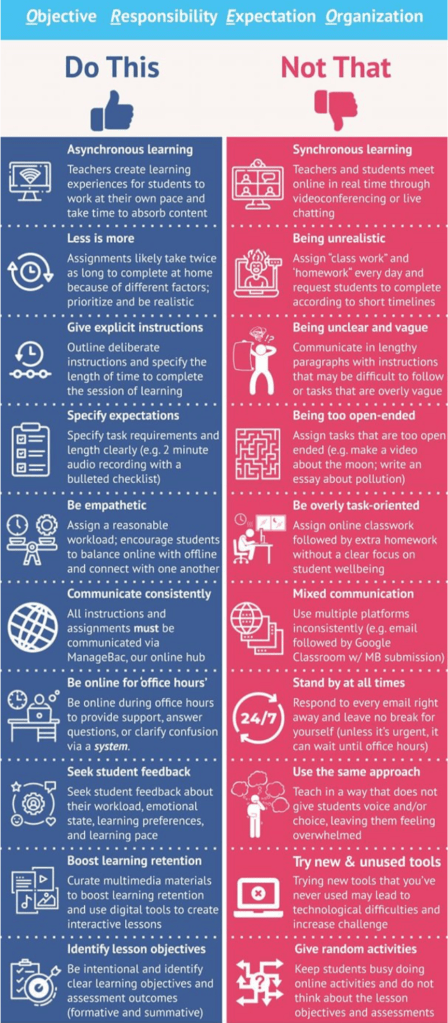
Of course a problem of the speed here is that people are “getting by” dealing with immediate needs – will organisations find time to breath and realize there are specialists available to help (such as online community managers)? I am torn here a little as I advocate simple solutions but also aware that there will be lots of bad practice – for example generating huge files, duplication of effort due to lack of sharing between organisations, eLearning that ignores accessibility standards, etc. For teachers this is rapid professional development and hopefully, as Donald Clark writes, they will be better teachers for the experience. This all said, it does feel like there are clear opportunities for learning technologists and other groups to help the overwhelming load of free offers and advice that is currently being pumped out (yes, including this article I know). For example, plenty in this image (that was shared with me this week) is debatable:
It is depressing that it has taken something like this to lead to a change for so many. For example a TES article describing this as a chance to start to experiment with flipped learning really got my eyes rolling – I was helping deploy such models at scale about a decade ago (and there are obviously plenty of practitioners with more experience than me).
Parents stuck at home with their children will hopefully also be more useful advocates for digital learning in the future – both for their children but also when back into their own workplaces. In addition, they will have seen many of the difficulties teachers face and we may have a better balance of teacher/parent expectations overall in global society.
Perhaps the real advantage for schools, universities and other education institutions is that this is offering something of a holy grail in education – control groups. We often hear that you cannot deprive learners of opportunities. Thus education research is difficult. Here we have a perfect opportunity to compare, at scale, data against previous years and those not impacted by closures as control groups. We should have some real data about what kind of models work, provided people have some time to number crunch!
Remote working
Remote leadership, willingness to delegate and trust are challenges that have long existed for those who are used to working in virtual teams. These are now ‘normal’ issues for many more people and we can reimagine work around outcomes, not time spent, and develop our online networking skills. Clair Lew and others have lots of great tips on what meetings can look like remotely and more.
Hopefully commuting will be increasingly seen for what it is (a waste of time and energy for many) and better ways of working will be established. Obviously this does not relate some of the wonderful people out there who will continue to be tied to their place of work in hospitals, shops and other fields. That said, interesting to see Microsoft’s new Teams offer to healthcare being launched at this point in history.
I have written before about my love of Teams and it seems, from browsing Twitter and other sources, that it does seem to have become the de facto platform for many. As Rachel Burnham says, Teams is now everywhere. This is where I would like to add a celebratory gif. Rachel hits a good point though that L&D teams seem to be reverting to thinking about Teams as an LMS. Similarly schools closed for Covid will think about “lessons”, “timetables” and more. These may be useful starting points but the platform can (and should?) be more transformational (of course many are firmly in the S stage of SAMR currently).
Saving the environment
Science fiction is full of examples where mankind has to face a major event to limit the damage it is doing to the planet, World War 3 in Star Trek for example. The virus so far has cut pollution in China and offers to cull airlines following the collapse of Flybe and US-Schengen travel. Many of us will have spent time in pointless or, at best, overly long meetings in the past and this might make us far more appreciate of the implications of travel.