Do you remember Harvard referencing and building lengthy bibliographies during your student days? If yes, did you find it time consuming? Yep, thought so, did you ever use the techniques again (presuming you’ve not continued in academia)? No? Didn’t think so.
Even if we’re kind to academic referencing it is, at best, a necessary evil to show the development of research skills and the correct representation of ideas (i.e. to avoid plagiarism). I’ve been to two events this week, the first on Adobe products will get a longer post but the second, on RefME, showed how a tool can go viral with users if it is really well targeted on solving an actual problem.
RefME has built a following of more than one million users quicker than Facebook or Twitter – all thanks to the humble citation! Why? Well those negative experiences of citation and bibliography building are now finally tackled through this very easy to use app.
When I studied there were some tools in this space, some institutionally backed, but none as easy as RefME appears from the demos at the #BLEevent. Overall, I took away a key message here – focus on your audience (whoever they may be) and their challenges/frustrations. If you are facing a lack of adoption with your corporate/institutional technology then it is probably fair to presume that it is (a) not easy enough to use and/or (b) not solving a problem that is felt keenly enough.
It will be interesting to see if any institutions opt to stand against it as a way of students ‘cheating’ by not having to spend hours formatting their own lists … not to mention all the librarians who will have another thing they ‘own’ taken away from them by technology.
The first session from this year’s GEC I have been able to attend. The GEC schedule is always hugely impressive and a great example of virtual tools being used to learn globally. However, it does not seem to attract huge audiences, at least live, with only 7 attendees (split between US, UK, Belarus, Nepal, Argentina and possibly elsewhere) for this session (with the presenter and moderator from Australia).
The presenter (Anne Mirtschin) talked about how she develops learner curiosity through global tools and collaboration. She connects with people globally with her countryside school in Australia talking to experts, community groups, other schools, etc. around the world to help learning be “far more effective than a textbook”. Using webcams, etc. also gives the students transferable skills, recognizing that people will talk via Skype, etc. in increasingly global workplaces, as well as with friends and families abroad. As well as synchronous sessions she has also used asynchronous tools, for example sending video recordings back and forth with US schools.
As well as her own activities can make us of globally organised events, for example, “International Dot Day”. Lots of good examples were run through, including using WeChat to communicate with Chinese students. She has had other educators contact her directly – finding her via Google – for example a rural Japanese school connected with them.
My take on all of this is it is amazing for cultural awareness and other learning opportunities.
About how the presenter has changed the perception of learning and L&D at Rentokill during 3 years at the company.
Have made the move away from L&D being the experts, controlling things through a center of excellence model. Looked critically at their setup, for example, was the LMS just there for L&D rather than there to facilitate and democratize learning? Partnered with a start up (Fuse[?]) to see what could impact on business, lead to creating community based platform to source and share knowledge. Have given subject matter experts content creator/recorder tools – would have been doing it anyway locally but ability to do it easily amplified this. Particularly powerful as do on mobile whilst doing job. Realize time for 40mins eLearning had gone, follow lead of YouTube.
Made use of other tools, including mobile assessments and reflective questions. Including observational assessment guidance for managers.
Need to assess UG content? No. Likes, shares, etc. will see cream rise to top. Similarly, advantages if previous misunderstandings are now being communicated out as those people can be corrected.
Put price on items to change mindset – give business choice of going to them or elsewhere. Made people realise the benefit for L&D. Show can provide value compared to external vendors, make it easier to increase headcount based on demand from business.
Measure total of ‘learning interventions’, measure of access to digital resources – like YouTube play counts. However, even existing content has had big increases in use – not just growth through chunking.
With good content, created a revenue generating external learning platform for customers. This is same Fuse platform. For bigger customers they provide content so they can deploy themselves via an LMS or other system.
Overall a fantastic presentation on how they have transformed learning, changing the approach to learning and the business relationship.
Linking Colleagues, Researchers, Industries and Investments Today – Dr. Mirzi L. Betasolo (GEC)
Joined but unfortunately the presenter had not made the session.
Love Sharing, Love Learning (LSG)
Presentation based on some of points from new booklet Charles Jennings has done with Cornerstone.
Opening question on how people are supporting learning and sharing – wide range of ideas and tools put forward by the audience, as you would expect.
Humans are a social species – talking about natural behaviors. Technology now driving how we do this.
New work environments emerging, as a result of digital and social for many organizations the “20%” is much bigger in the mix.
Conversation a key learning tool. Need to create the correct environments, with openness and sharing. Need trust, honesty, etc. Can use questions, for example, if a performance manager you should not be talking for the majority of a conversation – mention for US after action review process.
UGC, shared search, all mentioned as playing part in wider changes. L&D role can be in speeding up knowledge sharing, [step out of the way].
No longer information scarcity, world now is one of information abundance. Mention for Jarche with KPM/SSS and those skills important in new world.
One role of L&D to find what is not available on the Internet [i.e. the real USP knowledge of your organization] – but now have options to do that seeking/sharing quicker.
Survey of College & University Faculty Workplace Engagement (Inside Higher Ed)
This sounded like a really good session considering the current focus on engagement in the corporate world. The figures, from US Higher Ed, showed some very low numbers in terms of workplace engagement. Clearly work to be done in this space.
It was good to see a real recognition of the need for change at this year’s CIPD Conference Exhibition. There were some good points made by a number of people, a lot coming up in more than one session, my summary and internalization of what I picked up:
Neuroscience hugely important for HR, especially for L&D. This includes the need to play with emotions and help people from their ‘comfort zone’ to be able to stretch via learning. For example, when do we ever ask if people are happy approaching learning in a certain way? How far is pushing people out of their comfort zone (for example making them do role plays when they don’t like them) acceptable? Overall, we are emotional animals and L&D’s role is to tweak and nurture curiosity. One thing to avoid is creating anxiety by suggesting certain things are difficult, for example, by insisting people find public speaking and other activities nerve wracking it makes the next generation think the same. Dealing with anxiety is one of the many areas where ongoing, spaced, learning can help – not just about the forgetting curve. As well as skills and knowledge development think about confidence too. Stella Collins ran through 5 specific tips for L&D practice: Guessing is sticky/Curiosity is addictive/We ‘feel’ metaphors/Emotions are memorable/Context is king – just five of the areas where L&D practice is backed by science.
Easy to use tech can start to make HR less annoying. We all use mobile Apps to make life easier – time has come for internal processes to be as easy. This includes a certain amount of automation, for example, around identify one’s own profile versus possible future roles. Supposedly good ideas, such as keeping your workforce healthy, can be reinforced through the use of tech such as Fitbits and using that data to create leader-boards or other competitive elements.
Motivation. One presentation outlined this as a combination of beliefs, dreams and values. Yet research (and common sense) enforces the importance of line manager on employee engagement. The importance of managers living your values and acting consistently has never been greater.
The blend of organizational design, commercial imperatives and people needs to shift. Automation of boring work will help but HR needs to refocus on Humane Resources. HR was originally designed, in the industrial age, to help the workers – although worker ‘welfare’ now has negative connotations. HR needs to support efficiency through a better working environment. Negative impacts of change can be seen to include online application processes and other HR process work that has been dehumanized. Ultimately people think Google as a good place to work as it is seen, even if incorrectly, as fun. If you are after the top talent then the need to consider the nature of work and the workplace is imperative.
People now consider themselves parts of global groups by default – geographic boundaries are an artificial construct when globally connected. This will only accelerate but doesn’t have to be negative, for example, Nestle have reverse mentoring where junior people support more senior people, including on tech topics. RBS adoption of Facebook for Work example of implication in working practices for even the biggest organisations.
Tech changes allow for individual voices to be louder. However, we face major risks (such as global warming) and the collective voice needs to be harnessed better to lobby governments. Scope here for fundamentally changing business – I’ve mentioned Holocracy before, but other models too. Options in the future include the election of leadership teams based on actual people skills and representation of values, rather than length of experience or opaque targets/promotions.
Don’t forget about some existing tools that can be used to drive real change, for example, well implemented 360 feedback can shift behaviors. A lot of the success of this relies on push notifications to make activities routine – people expect these now, similar to notifications on mobile phones, etc.
Effectively a day split in four, with more general speakers in the morning followed by Learningpool specific user presentations in two streams, then three ‘strategy’ streams in the afternoon and finally closing keynotes. Around the day I took the opportunity to play around with their Totara LMS, Adapt Builder tool and took a look at some of their off-the-shelf eLearning modules.
My main interest was in looking at what is happening with Adapt as I really do think it ticks a lot of boxes of what learning technology should be doing: easy to use so it can be rolled out widely as an authoring tools, multi-device, etc. However, their new business resources were also interesting, not least as a lot of the content is similar to courses I have built myself in the past.
I have put some, high level, notes from the presentations below.
Opening
Padlet was used to capture some of what people were hoping for from the day (padlet.com/learningpool/live). This seems an increasingly common approach at conferences and other events although I am yet to see it really add much – anyone seen good examples?
David Meade (@davidmeadlive) – Mind Skills to Inspire Performance
Possibly the best start to a professional event I have ever been to (even though it started badly by showing the basketball bear – surely most people have seen that by now?). This mix of psychology, university lecturing, mind reading, magic and comedy immediately engaged the attendees. From a professional/corporate learning perspective there were a host of interesting points made, including:
We focus too much on what is on our desks – we have to take a step back to see the big changes.
We all too easily forget natural biases and other impacts – for example:
The recency effect means we tend to make decisions based on the latest information provided to us.
If pitching five ideas and you want a particular one to be picked, in what order should you present them? The evidence suggests option three is when you should present your preference. This relates to attention span and other science, elements of which will be familiar to those of us with an instructional design background but useful when put together like this.
When do you put across the bad news in a presentation? Actually best to have it up front, establish honesty and then go from there.
Should you ask for big requests first or start with the small? If requesting from a senior person then go large first. If asking for work from a junior then go with small, building up to big.
Focus on social learning in our organizational designs and development, this was a nice session which touched upon a lot of points I would agree with in my practice (indeed Perry admitted at the start that many people in the audience would deliver similar messages on this topic):
We are wired to learn and collaborate, indeed I would say this is the natural state and often the organization is better at supporting this when it ‘steps out of the way’.
As learning professionals we should be about empowering ways to learn, this is very much part of my ethos and I would agree that learning happens all the time (i.e. the 70/20) it is not that L&D is now creating that by recognizing there is life outside of the ’10’.
The difference now is that technology has amplified what is possible.
wired:glued:attuned, I liked this description of people using devices and especially liked Perry’s point that this is not a ‘millennials’ thing.
The takeaways were also sound: you need to think about yourself first: How social are you? How social is your content? How social are your learners already?
We need to realize work can only be done with ongoing learning and that companies can make work less mediocre through innovation and the development of communities.
Nikki Watkins – Swimming the Channel in Armbands
An interesting session, and certainly different to a lot of what you get at this kind of event. This was effectively a personal story of tackling a challenge (swimming the channel) through determination and personal learning plans.
In terms of theory there was a mention for Sue Knight’s Beliefs of Excellence, these were possibly new to me but are a good articulation of what many of us would no doubt believe in.
Overall, I took the message away that we need to take on the challenges we face with a 100% effort and a plan. I personally really like the job title she gave herself (Chief Evolution Officer) when setting up her own consulting company as a way of articulating her belief that we can achieve a lot if we get out of our own way.
—
Jury’s Inn – Empowering Knowledge Sharing
I liked this session as it showed how well a digital/online shift can be done when not creating lots of artificial silos. Effectively they have used a portal to support a more collaborative culture where L&D no longer “holds all the answers”. L&D are now focused on the curation of resources and the moderation of discussion.
They have broken content down, for example into short manuals, how-to-guides and have captured tacit knowledge via user generated content (including 30 second video clips captured via mobiles). Have also created prepopulated learning plans so it is clear how people might progress their careers and what is expected of more senior people.
To succeed they identified you need sponsors, appropriate face-to-face at key points, multi-device support, supporting structures and incentives.
All-in-all, they appear to have avoided a lot of the problems that are created when intranets, knowledge, information and learning start to find themselves in artifical silos.
Keele University – Get Awesome with Adapt
Having once been responsible for learning technology experimentation and adoption in Higher Education it was good to see a university presenting, especially as it was primarily on Adapt- my main interest in the day.
They have opted to go with LearningPool as their staff environment, away from the student facing Blackboard approach. I did not get chance to ask why the two approaches were adopted but its an interesting one as to why they have gone for two different sets of system.
Anyway, they were full of praise for their Learningpool solution as it has allowed for staff mandatory training to be handled with ease, online access has meant home nation staff working at partners in China and Malaysia are still connected with the campus, etc. Although it was highlighted that the time issue (i.e. do people actually have the capacity to spend time on it) is a concern for them and their colleagues.
In terms of Adapt itself, they have started to produce content, including through collaboration with the marketing department who are engaged and producing corporate branded templates.
In terms of getting staff engaged, they offered demos as well as a ‘tea party’ on campus where people could eat, drink and tech.
Devon County Council – Charting a Successful Adapt Journey
Long-term Learningpool users, they seem to have cracked their particular challenge over what L&D should be doing – “focus not on what you might know but on what you need to do”. This is within the (correct in my opinion) approach of focusing on organization specific elements – the rest can be left to Google and YouTube.
Adapt has fitted in as the way to allow people to do their own content, with high quality designs, to support their business goals.
Strada – Adapt Adoption
When the presenter joined, all the feedback she got was that eLearning was boring. Adoption of Adapt has aimed to change this.
Some examples were shown, before sharing some top tips: make use of different sources for images and material (for example take content from the corporate twitter account) and when adding media assets to Adapt ensure you tag them for easier reuse.
—
Introduction to Adapt: Changing the Face of eLearning
A broad brush introduction that did not add too much to what I had previously seen and read.
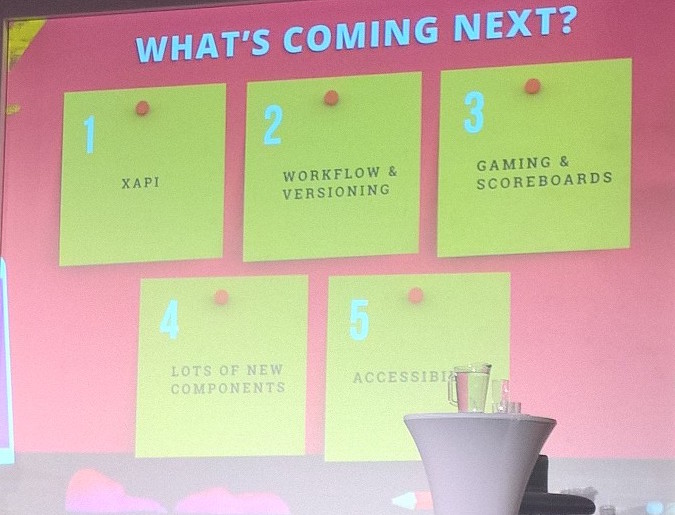
The more interesting elements were around some of the future plans, namely additional functionality components and xapi (see picture). Apparently there was a lot of interest in their recent DevLearn presentation on some of these points.
5 future improvements to Adapt
There was a useful demo to show some of the newer components – which again made me realise I really need to have a more detailed look at the authoring myself, beyond what I have done previously.
Support for Performance with Intelligent Tech
A session primarily focused on the Encore app. I really like the concept of Encore, time-spaced learning via mobile, in a similar way to how a lot of universities and FE colleges experimented with tools like Edutext in the past.
The forgetting curve, referenced in the presentation, is obviously the key challenge being tackled here. However, I think the key thing here is the coming together of specific bite-size learning with the previous idea of following up to reinforce learning.
New features were detailed, including ‘smart scheduling’ which is effectively a form of adaptive release based on past performance.
—
Donald Clark – Increase Performance Through Mind-Blowing Tech
This presentation will have been largely familiar to those who have seen Donald talk before. However, I always feel it is quite useful to have him remind us of a few things, such as:
If you work in learning your job is about the brain, do not forget this.
The elearningmanifesto and Learningpool are examples of groups breaking out from the old eLearning paradigm.
Some major tech changes coming up, especially Oculus Rift – VR though is about the medium not the gadget: make learning real.
Virtual reality ticking the boxes for effective learning
Algorithms are going to be increasingly important [although I would challenge him on how good Netflix’s recommendation engine actually is], AI offers sustainable change (i.e. innovation).
Sorry teachers, but you know number 3 is a problem!
Consumer tech offers a way forward, for example gamification shows value in breaking content down.
MBTI is a ponzi scheme, should aim to educate everyone uniquely – Cogbooks example of tech starting to offer this.
Competency models can be a less artificial construct for learning structure than courses.
Duolingo and other popular tools are doing adaptive learning already.
Spaced practice is obviously needed and is an easy win via mobile phones.
VR not really new learning approach – just price point changing: no longer restricted to flight simulators and high cost developers/simulations.
Aim to enfranchise people – universities and other structures hide learning.
Create experiences – for example, sexual harassment training can be really boring but via VR could be really believable. You could make people actually experience what disabilities are like as part of diversity awareness, etc.
Overall: everyone in L&D needs to embrace tech, play with it – resistance is futile.
—
The day finished with another amazing trick/display from David Meade (wont even attempt to describe it here!).
The scale of the report continues to impress, this year c.600 L&D professionals from 55 countries fed into the data set that has led to a 20 page report.
During the event’s presentations there were a lot of points made that were good to hear, including:
findings that learners are self directed but need support
the self directed nature of learners is not generation specific, this is not a ‘millennials’ thing
need a vision of the future for learning, lots of people have one but not getting there fast enough
the vision needs to focus on improving performance, L&D need to ensure business see this – it is not about course formats
silos within HR need to end, or at least have better working across them (to foster workforce engagement)
the ‘top deck’ of higher performers are increasingly enhancing performance through access to communities, content, technology and clear communications – all where and when they are needed
fundamentally, there needs to be an end to the logic of ‘business’/’learner’/’L&D’ silos [indeed the point was made that we are all ‘colleagues’ – something I’ve argued for a while].
None of the above points will really come as a surprise to people who have followed the thinking of previous reports and the move toward ongoing “maturity”. One nice new feature, however, is a section written in a way that can be given to business leaders to challenge them to better understand what learning should be and what they should expect from their internal learning professionals.
Overall, a great evening and another interesting report.



 Whose Education Is It Anyway?