CIPD L&D Show – May 2015: So out of touch with business that ‘VUCA’ is the buzz term

The opening session I attended at this year’s free exhibition considered how coaching can ‘stay ahead of the curve’.  This was quite an appropriate start to a day where my overwhelming feeling, from most of the sessions I attended and conversations I had around them, went something like “yes, obviously” and “we’ve been saying this for years”.

If there was a trend or buzz phrase it seemed to be VUCA; one session I attended specifically had VUCA in the title but at least two others referenced.  However, search online for VUCA and a HBR article shows it was a business buzz term in January 2014, yep, over a year ago.  Whilst it might be excusable to use such a term in formulations based on on ongoing research, such as Toward Maturity’s ‘a kaleidoscope of change’, it felt a little old hat (to me) for exhibition sessions.  This felt especially so when that coaching session started the day with the need for keeping ahead of the curve metaphor.  Towards Maturity’s L&D Evolving Roles, Enhancing Skills report highlighted some good practice in this area, including PwC’s internal L&D team that has “a dedicated research arm, so they can continually scan the horizon for new developments”.  However, I tend to look at this things from the learning industry perspective (rather than just L&D) and being aware of the latest trends was very much part of my learning tech and instructional design team’s remit back in c.2010.  Again, when it comes to workplace “L&D” something seems to act as a log jam.  Perhaps it is a tendency for deliberation rather than action, the coaching session mentioning that attempts to lock coaching down have failed as needs continue to evolve, including trying to understand a world that is too complex.  That said, from the show of hands of who had heard of VUCA in some of the sessions you suspect too many people are still not keeping their ears open for trends – attending a CIPD exhibition once a year is certainly not enough – and both CIPD and Towards Maturity were again stressing the need for L&D staff development to plug the skills gap.

I will not publish my full notes from the different talks here but in rough summary this is what I took away from them on the Wednesday (timetable here):

  1. 9.15 – Coaching – argued that attempts to embed coaching models have largely failed whilst other things, such as revisions to goal setting approaches and the rise of mindfulness have crossed over into the related space.  Overall, the suggestion was that coaching needs to be seen as part of the wider global value conversation.  The couple of enclosed images were fairly typical of lines which outlined some of the current state and future state propositions:
    Is your coaching heading down the wrong path?
    Is your coaching heading down the wrong path?

    Starting to see more...
    Some characteristics of more evolved coaching models
  2. 10.00 – How learning has changed, at the OU.  Coming from a background in HE I’m always interested in what the OU is up to.  This session considered developments at the OU (FutureLearn, iTunesU, Brainwave, OpenLearn, OUAnywhere) and argued L&D teams should be looking at similar for ways to scale [the counter argument presumably being that they’ve weakened their brand via multiple platforms and solutions].  Overall, there is increasing focus on breaking things down to short items allowing for “determine need in the morning and deploy in the afternoon” learning – and they are looking for more corporate accounts.  Large scale use is partly enabled by predictive analytics [although the examples given weren’t much more than what Starfish was doing about 10 years ago].
  3. 10.45 – Belbin for supporting innovation – what can we learn from start-ups?  Some interesting research from Belbin on their profiling of start-ups and what it means for the rest of us.  Basic argument was that it’s not enough to hire ‘plants’, you need to be able to implement too.  In reality, over time, the organization needs a changing skill spread from the initial founders through to getting more practical – so you need a mix of Belbin roles [nothing new in the message but pitched a little different to normal at least].  L&D can learn from this in helping to attract, nurture and retain talent needed to form a great team (and encourage innovative cultures without job title snobbery).
  4. 11.30 – VUCA world: Argued to clearly focus on value in the world we now face and for what the individual learner needs, organizing out of chaos wont work.  I would certainly agree with the three calls to action: develop self-directed learners (a learning org), ensure you master the fundamentals (get roadblocks out-of-the-way – including easy wins like meeting skills training) and develop digital skills.  I also liked one point which certainly was timely – imagine if your organization was as wrong as the pre-election polls: that’s why we all need to be smarter, including developing appropriate analytics.
  5. 13.00 – Organizational Development.  I recently had an interesting chat with someone around OD.  They had OD in their job title (amongst other things) and I expressed my interested in OD being that it is a topic where you can not clearly draw the boundaries.  The session I attended at the show considered the evolution of OD from just worrying about org charts to something more important, emotional not just rational.  Personally, I have always struggled with OD as a concept in that, with social media and electronic communications, any structure (and certainly a hierarchy) really only has a primary use of ensuring clarity and responsibilities.  Actual positioning within the organization, to me, should not really matter considering silos should be broken down if your culture encourages social media – the Towards Maturity skills report putting it as such for L&D professionals: “it doesn’t matter where you sit, alignment is king”.  This power of a social culture is what I was suggesting in this tweet and the session considered that we are moving through forms of OD digital maturity (see image) – toward autonomy and thinking beyond traditional structures. L&D’s role is to foster a mindset where people will collaborate, be prepared to fail and be agile.

    Suggested forms of org structure
    Suggested forms of digital org structure maturity
  6. 13.45 – L&D in a digital world.  Started down the ‘workplace learning is a switch off as it’s not as good as what you can do at home for free’ line [I’m fine with this but it’s not down to quality but the feeling you actually want to do something].  VUCA was again brought in to argue we need to evolve quicker, digital is everywhere and L&D departments can be ignored if people wish.  We need to think about digital in areas such as supporting communities of practice [and, yes, they actually encouraged people to get on Twitter].  CIPD explained that they have updated their qualifications and Home Learning College and other providers are delivering these via a better learning mix.
  7. 14.30 – author of Fire Free Workday.  Some useful suggestions for being more productive.  Rather nicely you could text to get a free PDF of the book.  It was a nice reminder to believe in yourself and motivate yourself to get things done appropriately.  The ’12 mins learning a day is 6 days worth’ is a useful message to take to business leaders [in my opinion].
  8. 15.15 – current state of the L&D professional.  Every year we consider that things are changing but we need to continue to drive that conversation – embrace change.  Focus on capability, not training hours.  Break down the barriers L&D artificially creates.  Challenge the business by saying “if you do this, then this will happen” – show the benefits!  We can no longer be custodians of knowledge – we need to be seen as beyond that.  Be partners with the business, including using their languages.  [All fair points but you’d hope people are aware of it by now!]

Without a budget to spend my time with the stalls was really just to glance at any changes, it was interesting to see:

  1. The coming together of intranet, LMS and other platforms in the shape of things like kokm – a model I’ve worked towards in the past and certainly would work for many orgs.
  2. SquaredOnline and Home Learning College, both from the Floream portfolio and both sounding like bringing high quality virtual experiences [not too dissimilar to what university students might be familiar with] into workplace learning.

Anyway, useful to check in on what people in the L&D space are thinking even if (like me) you might go to these kinds of things too often to get full value.

Reflections on Learning Technologies 2015 (#LT15UK)

#LT15UK was my first Learning Technologies winter conference, rather than the summer forum or winter exhibition.  I’ve always avoided the conference due to the cost but it was really useful to spend a couple of days thinking, high level, about the nature of workplace learning.

Even a few days after the conference, I am still contemplating what was discussed and trying to draw my conclusions.  To a large extent it has reaffirmed my belief that most learning professionals are failing their audience (school, higher education, workplace).  However, whilst I would be keen to rip up the existing models (see my virtual school post as an example) the pragmatist in me was looking for ways forward in the shorter term.  By attending the conference, rather than the exhibition, it was such shorter term trends I struggled to pick up on.  Messages from the conference, for me, were more around how learning needs to be overhauled to recognize new ways of working and changes to the key attribute it has always existed for – empowerment.  I would argue that, by thinking of learning as empowerment, we can better think about learning if we put it in the terms of productivity and engagement in the workplace.  Of course this is very much thinking about things from my perspective (including educational informatics) and I’m deliberately putting these notes together before reviewing the event’s back-channel in any real depth.  Additional posts might be forthcoming based on that review.

So, why do I feel we need more of an overhaul?  Here are some key points and reflections from the presentations I attended:

  1. A brave new world: how the cloud is revolutionising our learning, Professor Sugata Mitra.
    • An update on Mitra’s projects since the last time I heard him speak (the main development since then being his new style schools are up and running).
    • I totally agree with him that for a lot of learning the learner, with access to the Internet, can lead the learning (and that a facilitator can provide positive reinforcement and support).  I would challenge him over how to ensure motivation to learn exists and also that people can be trusted with the technology.  Whilst I love his presentation style as something of a utopian, alas we have probably all worked somewhere where learning tech kit has gone walkies.
    • To an extent, the self organized learning environment (SOLE) of his model is parallel, in my mind, to the ideas of a full ‘learning organization’.  Specifically, like traditional teachers adopting SOLEs, L&D teams need to realize they can not manage learning but can support it to be as efficient as possible.
    • Mitra talked considerably about dematerialization.  I would agree that learning as a process may dematerialize one day due to a download, implant or upgrade to the human body but for now lets focus on facilitating it as best as possible via making learners acknowledge it is for them and they should be in control.
  2. #T5S1 21st century enterprise learning, David Wilson and David Perring
    • An attempt to “recalibrate” the future of systems and LMS conversations to today.
    • The argument was that, ultimately, admin and compliance have led to the main use cases for an LMS.  In this model there can be huge value to a business, especially if legal compliance is a requirement to operate, but the value is not for the learner.  As the presentation put it “the LMS is not the center of the business, work is”, hence it is not the most important internal system.  Personally, I see this as about the nature of work, can work be done in the LMS?  If not, can the LMS present learning at the appropriate point of the workflow?  If we are simply using an LMS for compliance then do that and be honest about it.  Let’s not pretend that we are tracking all corporate learning in an LMS, as 70/20/10 reaffirms, that’s not the case.
    • The presentation mentioned the move by systems to cover more of the 70/20 – I suspect this is too little too late for many organizations and we need to consider social and collaboration as part of a wider digital enterprise, not just a talent ecosystem (the presentation seemed to suggest we’ve gone from L&D centric, to wider talent – surely the next step is to properly support the digital workplace?).  For the talent cycle see slide 8 of the below presentation:
    • The presentation focused on the importance of innovation and I liked the two circles of functionality that LMS elements can be compartmentalized within: “operational performance” and wider cycle “optimized future readiness”.  The argument was that an LMS is still needed but needs to do better at fulfilling these circles.
  3. #T1S2 – Does instructional design have a future? Patti Shank
    • Having completed an MSc that specifically called out ‘instructional design’ as a key component (the only course I could find that did in the UK at the time) this session was of interest to me!  Whilst Mitra might argue for facilitation and the need to create curriculum from questions to fuel learner self direction, Shank argued that ID needs to focus on performance issues and improvement (the two positions obviously not being mutually exclusive).
    • There were familiar arguments for supporting an end to ‘order taking’ L&D and being more challenging to our stakeholders.  In addition, there were attempts to clarify the differences from content development and graphic design, related but not synonymous fields.  I mentioned, after the talk, a recent article from India which perhaps showed the different mindset in the booming ID outsourcing market:
    • The conclusion was that IDs have a lot of the skills to deal with performance improvement in the ever increasingly complex workplace and the Instructional Design Competencies model helps as a framework.
  4. #T4S3 – Building smart scenarios for great learning, Cathy Moore
    • I think most people would agree that scenarios can help get a message across, especially in training.  This session really just showed some key steps to ensure scenarios are too boring.
    • Firstly, use scenarios when you’ve determined there is a learning need that requires judgment not binary choices.
    • Three rules for stem:
      1. Give characters names (depends on situation if one character should be ‘you’ or not)
      2. Show don’t tell (easiest via actual dialogue – avoids generalization)
      3. Include cues (setup the decision/quiz options in the text – easy way to tell if too much text is if its boring when you read it)
    • I liked a point made that we should learn more from related fields.  Interactive fiction was mentioned as an area where IDs can take ideas from, such as links to optional back stories to increase mystery and empathy.
    • Tips for question options – get common mistakes out of the SME before the correct answer, helps build out the conversation.  Don’t jump straight to correct responses.
    • Feedback best practice – keep the story going, intrinsic not instructive feedback as dialogue.
    • Information needed to answer question – don’t present as slides, instead focus on what need to know – other bits can go into job aids, etc.
    • Overall, I thought the presentation had a lot of very sensible stuff in it and the little checklists above are useful reminders to consider going forward.
    • Good tool to use: https://www.branchtrack.com/
    • Handout: http://blog.cathy-moore.com/learning-technologies-anti-handout-scenario-design/
  5. Day two: Keynote: The expanding mind, Professor Robert Winston
    • This felt a little rambling but, as you would expect from Winston, there were some hugely informative points and a lot to think about.  There were some commonalities in the presentation to others I have seen,  for example, he argued the most important technology has been the hand axe (akin to Donald Clark’s reminders that technologies have continually impacted on mankind) and the importance for L&D to consider neuroscience (as at BETT 2014 where Baroness Greenfield presented).

      Prof Whinston at LTUK15
      A packed conference on day 2
    • The key points with regards to learning included that, whilst learning can be difficult at first, we know that reinforcement and practice will bring results.  Indeed our environment, not our genes, impacts our exposure and ability to learn.  There were also mentions for some of the aspects that explain how we behave, for example I know I often unconsciously pickup phrases and actions from others – this is based on learning from others (so if we want people to learn values and correct behaviors we need to embody the values we expect people to develop).
  6. #T4S4 – Mobile delivery: putting the device in your hands to work, Geoff Stead
    • Information on Qualcomm’s use of mobile, including for learning (http://www.worklearnmobile.org/).
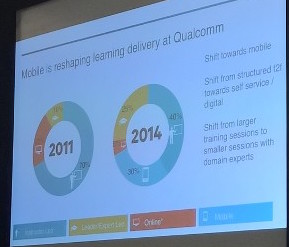
    • Overall, this really reinforced the need to get going with mobile.  The idea of ‘guerilla learners’ was discussed, realistically I wouldn’t say they are guerilla – simply working in a modern world where L&D can not be everywhere.  Again, there were figures for ‘learning delivery’ %s which, I would argue, can only cover some of what is happening:

      Percentage shifts towards mobile at Qualcomm
      Learning delivery at Qualcomm
    • I really liked their approach – have an app store portal to aggregate what is available (including apps they have built and ones available to the company – such as the FT and Harvard Manage Mentor).  Whilst I would normally presume ‘learning’ would be one app (usually delivered through an LMS app) this may well be a more sensible approach – acknowledging that a big company will have multiple apps and that it is easier to deploy them individually via a portal (as Geoff said, the toolbox approach can scale better than the army knife).  Their vision for learning is “almost like a library” and this is obviously akin to my own background and belief in learning.
    • A number of apps were shown, including video and games based.  The one that jumped out at me was Pathgather.  It sounds like this tool allows for crowd sourced learning paths – this sounds outstanding as allowing for L&D to create recommendations of learning journeys but also allowing subject experts to recommend things based on their experiences.  If we want to empower people to learn as part of a learning organization then such tools are an excellent idea, no one knows everything anymore and socially sharing and collaborating around work (and learning is work) is key.

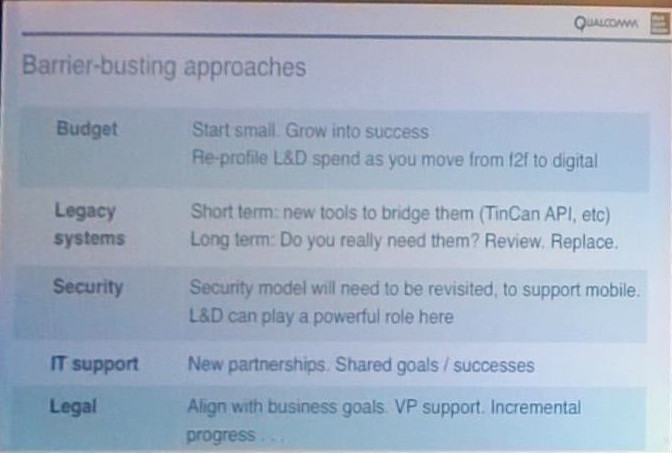
      Challenging budget, system, security, IT and legal blockers to mobile adoption
      Busting barriers to mobile
    • They are working with other organizations on ensuring SSO and other technologies are in place to ensure the system works the best it can for an organization.  They also tend to do web app first which I like as I’m still sure we do not need to build native applications for everything.
    • The presenter’s team is 50% mobile app developers – that is a really interesting one for everyone in learning I think in changing what we mean by learning (technology) professionals.
  7. #T1S5 – Mindfulness, learning and work, David Gelles
    • Mindfulness has been a hot topic for a while with David Gelles, of the New York Times, having brought a lot of attention to it.  It centers of giving people meditation time at work to improve well-being and performance.  This is often coupled with eating regimes and exercise, such as yoga.
    • Whilst I would not argue with his facts and figures, the evidence of improvement, from such schemes I would, however, say there are some underlying elements.  If these are implemented, without the ‘mindfulness’ aspects of meditation, I would expect them to still bring about some of the results – items such as ensuring people take breaks, don’t get made to feel stressed by their managers, given a chance to reflect and pause, etc.

      Mindfulness as a route to a less stressed, healthier, focused workforce
      Mindfulness benefits
    • The “being right here, right now” element is the aspect I need to look up more about as, if anything, I feel I do that too much and don’t plan ahead enough.  This is partly as my to-do lists tend to go out the window due to the work of others and that complexity is the challenge of the modern environment.
    • I also need to look up a suggested easy first step – the Headspace app.
  8. I skipped over the final conference session to spend some time in the exhibition and catch up with some old colleagues.

If we accept that the conversations here equate as evidence of best practice, the worrying thing would be that you see many manager/director posts in L&D that seem to be based around delivering training – not about wider talent, empowerment or engagement.  Indeed the number of organizations willing to empower learning by allocating time to it is probably not much greater than those willing to support the ‘mindfulness’ movement through meditation.  I know I tend to revert to Jarche on this site but I’m going to do it again in that a lot of my takeaways really reinforce my view that we need to be looking at learning much in the way outlined in this deck:

Overall, the conference has clearly got me thinking about how I would drive an organization forward (at least how I can push certain viewpoints from my role) and it was a much more pleasant way to attend the Olympia event (with lunch, coffee, places to sit, etc) than a day or two in the exhibition.  However, for keeping up-to-date with tools and the technologies themselves I would say a day or more in the exhibition and free seminars are possibly the better route – especially if I had money to spend on new tools and needed to attend demos and training sessions.  Perhaps the best of both worlds is attending the Summer Forum exhibition and then the winter conference.

The month in Learning Technology: January 2015

Following on from my suggestion that a ‘news’ podcast for learning technology could be both informative and entertaining, I thought I would start a new series of blog posts where articles and links I find useful get a home on this site.  The posts will be updated as a month progresses and include a certain amount of aggregation from my shared items on the Old Reader and Twitter.  I will try to add some thoughts alongside the links as a form of reflection and maybe, one day, I’ll extend that out to audio.

  1. The UK press have started 2015 as they mean to go on, by being obsessed with the general election.  The education discussion continues to center around money and the provision of places, rather than quality of learning: http://www.bbc.co.uk/news/uk-politics-30981137
  2. Learning difficult processes fun through play and gamification: Wikipedia’s gamification orientation – sounds like a great idea to an on-boarding that was really always overly complicated in my opinion.
  3. The Learning Technologies 2015 conference was my first LT winter conference, rather than just attending the exhibition.  Backchannel links are here.  Lots to think about and longer posts to follow.
  4. One theme for me at LT15 was the move to bigger talent issues than simply learning, as talked about in this NetDimensions press release.
  5. The other big event in January is always BETT, although I did not make it this year there were some good headlines coming out.  Items catching my attention included MUV Interactive’s ‘Bird’ (great name too) which is a new approach to interaction in the classroom.
  6. Another consistent factor for early in the year is the Blue Eskimo survey of learning professionals, no real surprises this year:
  7. A challenge for the LMS/VLE has always been finding a position within the organization as a tool people actually want/need to use.  One problem often articulated, especially in Higher Ed, is that the VLE becomes a file store as people still live/produce content in Office.  A new integration between Moodle and Office365 might offer a way forward.
  8. Citrix and the Internet Time Alliance recently published Jay Cross’ latest views on “Why Corporate Training is Broke and How to Fix it“.  Hard to disagree with a lot of the article – not least that the terms L&D/trainers use don’t help and make the business see L&D as out of touch and out of date.  The stress on “getting things done in the collaborative organization” is really centric to my views on trying to work learning into the wider aspect of having the organization develop in a way people actually want to work within (Cross identifies culture, infrastructure and motivation alongside learning in this).
  9. Personalization (including via big data).  Various developments in this space are continuing along, INSEAD’s YouTube covers some developments (in the below video).
  10. Global Edtech Investment Swells to a Record $2.3 Billion in 2014 – pretty crazy when you can argue if learning/ed tech is needed at all.  Fears of a bubble, especially around China, seem fairly valid.

Report season #KineoInsights and Brightwave #TotalLearning events

We have hit the pre-Christmas reports, awards and events rush in UK learning and development circles, a number of which lead to new developments and analysis at the big post-Christmas events such as BETT and Learning Technologies.

Awards in ‘the Learning Industry’

Personally I have never really been into industry awards, yes I can see the point of celebrating success but I am always suspicious of back patting that doesn’t directly come from your customers.

Recent reports/events

My involvement in all of this has really being limited to attending two events in the last week or so – some notes and reflections below…as always apologies to the presenters for any misunderstandings.

Recent events 1: #KineoInsights

The first of two events I attended really focused on three reports:

(1) Kineo’s “Learning Insights” Report

Report: http://resources.kineo.com/learning-insights-report-2014-download

The presentation specifically focused on the report and ran through the 10 tips identified from the 35 contributing L&D managers.

The context for the report was explained as an increasingly digital one, quality of experience and appropriate mix of solutions are essential in this environment – mobile/digital/online/in person banking given as an example of an industry which has evolved quicker than L&D.

One line of argument was that Learning now has to prove value above and beyond compliance. Personally I wonder if the trick there is if compliance needs to prove its value beyond “we have to do this” – if we can crack that then other learning will immediately be recognized as more important?

I will not list the points from the report as, as you’d expect, the managers highlighted a number of current themes in L&D thinking as well as reinforcing many of the points that have been as around for a long time (work with the business, learning should be in the workflow, more mature blends, etc). I was pleased to see a general thread of decentralization from L&D in the highlighted report items through, for example, making learning more open including the use of peers (there was a plug for a new social tool coming to Totara) and managers/leaders/learners all being better embedded in workflows.

The main issue identified, and discussed a lot through the day, was the skills gap between L&D teams and what they need to offer. Marketing and communication are now very important but not key skills for most L&D staff, whilst the lack of CPD for our L&D teams was highlighted as a major issue. Personally I don’t always understand the CPD question, sure, there might not be a great podcast and courses (such as the one I did which has since been cancelled) are few and far between but we have plenty of blogs, events, etc to learn from.

Finally, there was a suggestion that L&D teams perhaps need to be bolder, stress the value of in-house standards and seek a quality balance between in-house teams and vendors.

(2) Towards Maturity’s annual report

Lot of data in the slides: http://www.slideshare.net/kineolearning/learning-insights

A similar, albeit larger, report to Kineo’s. Key themes in their received responses included the need to really kick on with actions towards modernizing learning whilst still often having to do more with less (although this year 33% reported they have an increased budget and will be recruiting).

Personally, I had seen quite a lot about the report including this LSG webinar, already but one interesting aspect was this year’s focus on the top performing 10%. Most organisations can now be seen as sharing three goals:

  1. Respond faster
  2. Build performance
  3. Continuous learning embedded in culture

Interestingly, when people are asked what the barriers to L&D supporting these three are there seems to be a blame culture of ‘aint us guv’ – with costs, user/learning skills and IT the top three scapegoats (this seemed pretty amazing to me considering user/learner skills is something L&D should be directly able to influence).

Items of emerging importance include better use of data in decisions making, with business leaders expecting analytics to review, leading to improvements and better decisions. However, the data shows only 32% of respondents work with business leaders on KPIs for learning. I am somewhat torn on this as whilst KPIs have been something of a ‘holy grail’ for business in the past I would rather work with a business leader who recognizes learning as something that should be fully embedded in the culture of the business and thus difficult to measure without looking at wider issues, not least engagement.

Lessons from the top performers included that learning need not present solutions, but understand learner preferences and act from there. In addition, learning has to be part of the wider talent agenda. Skills diagnostics, content curation, 70/20/10, micro-content and linking learning to career development are all useful but achieved by few organisations. In other words, L&D departments have aspirations to move the agenda on but only “the top deck” is achieving many essential elements. Some of the ways they have achieved this were mentioned, including L&D driving BYOD policies where mobile/social have been a success, having a communications policy in place and business agreed KPIs.

I asked if there were specific organizational traits that could be seen in the top performers, hinting towards my concern that ‘corporate universities’ have pushed L&D down a narrow focus. The response from the presenter was that top performers can be seen as those organisations that successfully foster strong networks for L&D professionals and often best performance is where L&D report into business units rather than an L&D/HR silo.

(3) Kineo’s onboarding/induction report

Slides: http://www.slideshare.net/kineolearning/learning-insights-live-nov-14-blends-that-work-for-onboarding-induction

Report: http://www.kineo.com/resources/papers-and-guides/induction/onboarding-for-results-best-practice-guide

I’d read this report before so there wasn’t too much new for me in here but the figures on turnover and related costs from new joiners are amazing and really backs the argument for ensuring a good induction.

The idea of balancing ‘empathy’ for new joiners with ‘efficiency’ was a nice idea, i.e. value joiners as people, in balance with all the boring compliance stuff you have to enforce on them. This can include giving them a voice, for example at BP they have new joiners write a presentation on the future of the organization, senior people come to the event and answer questions the participants have. At Tui they have a just-in-time information focus on their eLearning platform, the idea being that it is a source of information for sales people which goes beyond what you can find on Google – making the use of information is what makes the sales people better for customers than booking online.

I particularly liked one idea that was mentioned – send a welcome card, signed by team members, to a new joiner before your first day. I would suggest extending this to LinkedIn invites so new starters can get to know who’s who, faces at least, and more detailed CV information too.

After this presentation, and in a number of other discussions on the day, there was a feeling of “only do eLearning it it’s good eLearning”. I think this is a valid point in that eLearning has become the standard approach for many L&D teams but is often unpopular with learners, however, I would say this is really based around SCORM packages rather than bespoke eLearning blends to solve the problem. eLearning courses in higher education, combining resources, remain ahead of the L&D SCORM-centric debate in many ways here. Interestingly, there was little talk of Tin Can which, I would argue, can have a place in Induction as we can get new joiners to develop an approach to reflection on the job which is more difficult for those who have been at a company a long time.

(4) Gamification at McDonalds

The third presentation on the day, prior to the onboarding presentation, was one looking at Kineo’s award wining gamification solution to McDonalds’ new till training. Interesting for me in that:

  • It was not massively advertised, going viral from the intranet.
  • Leaderboard technology wasn’t worked in, so teams could develop the level of sharing they were happy with – in store, by franchisee, by region, etc. This was interesting to me as I always remember the unpopularity of till speed tables at one of my early (supermarket) employers, the Kineo tool working in customer service questions to ensure it is not just a speed test.
  • Nice articulation of the essential gamification elements: goals, rules, challenge and interaction.
  • There is no set score for getting correct answers, it uses a more complex algorithm with ‘show me’ option if you get stuck.
  • Part of the success was that it offered a safe environment – a familiar theme to the old ‘walled garden’ argument for having VLEs/LMS.
  • I wasn’t horrendous at the game when volunteered to test it out in front of the audience J

Recent events 2: #TotalLearning

Introduction

The Brightwave event started with Charles Gould commenting that many clients still look for eLearning solutions similar to what Brightwave encountered when he founded the company 12 years ago. His call to action was that L&D professionals need to better exploit the opportunities provided by technology.

David Smith (Global Futures)

Not happy to just point out where L&D are behind the times, the event started with a keynote speaker (https://twitter.com/davidsmithgff) who outlined many of the changes society at large may see in the near future. This was a whistle-stop tour and, like with my futurist of choice Gerd Leonhard, no doubt only some of this research will come to fruition. As someone pointed out over lunch, 30 years ago we might have heard ‘are you ready to be living on the moon?’ Yes there has been huge change, but technology has only really been universal where there is money to be made.

Some of the main points were certainly valid though:

  • We tend to do old things with new technology, takes time for real transformation.
  • Sourcing skills is changing, old ways of work are disappearing, and not least as the growing world population cannot be maintained by traditional corporations alone.
  • For organizations to be a success they need to develop a ‘talent cloud’ around the network’s skills.
  • We should be moving to the post email era, with new collaborative technologies and ‘work swarms’.
  • Oculus Rift, virtual reality, an example, of a tech that has taken time to become monetized.
  • We need learning organizations to adapt to pace of change, not least new mediums of data (Internet of Things, etc)

Kim George (Getty Images)

A great example of an L&D team that appears to be fully embedded in helping their organization develop and achieve better results. The presentation focused on the ‘fastest path to value methodology’ which Getty’s technology teams adopted to be more agile but has spread, not least to the L&D team. Ultimately it was explained that their team’s approach boils down to: #get****done (which I love!).

Four key elements to fastest path:

  1. Immediate progress. Start now.
  2. Focus on learning.
  3. Fastest path to customer.
  4. With a focus on frequent, small, releases.

There were two projects presented as examples to how this was achieved, the second being a new SharePoint intranet which sits within L&D responsibilities, recognizing that all material has a learning purpose (although formal L&D material does sit on an LMS).

Overall their L&D team seems to be nicely positioned as internal performance consultants, beyond simply offering courses.

Nancy Kinder (Feverbee)

I had heard of Feverbee’s community consultancy work before and it was good to get a bit more detail on the way they recommend communities are built, measured and maintained.

In relation to measurement it was argued that you can analyze learning communities/communications in terms of increased revenue and reduced costs (including calculation of work time savings – for example, using answers as a knowledge base resulting in less help-desk tickets). People value comes in increasing the sense of belonging, greater influence of global teams and ease of upskilling.

Argued that, to successfully accelerated learning, you need three things:

  1. People
  2. Process
  3. Technology

People is the tricky bit and delegates in the room pointed to familiar barriers including billable hours and commission as blocking people wanting to get involved in such activities. The presenter argued that fear is the key barrier; the culture needs to be in place to support use.

A workflow for establishing the community can be:

  • Research objectives to meet
  • Analyze your people
  • Coach and let members influence success.

Processes for learning acceleration can include working in reminders around the fun stuff; ultimately it is all about relationships. The sense of community can be tested via survey and other quantification approaches.

I find the ideas around Communities of Practice within learning fascinating. Having been involved with them for a while including presenting at a conference on their possible irrelevance as well as being a keen supporter for CILIP Communities, on which I co-lead the ‘eLearning’ subject. However, as the presentation mentioned there is something of ‘critical mass’ and I suspect CILIP never managed that and the community manager on the initial project was missed once gone.

There was a nice three-step summary:

Research > Relationships > Report

In other words, know your audience/challenge(s), develop relationships and report the benefits. For reporting and other elements Feverbee make free help resources available on their website.

LearnerLab: How strong is your learning brand?

This was one of those conference/event sessions where I wanted to jump in at multiple times with challenges and questions. I didn’t but in, partly as some of the issues were dealt with in the presentation and I expected others to be tackled in the following session.

Overall, this was talking about how to get L&D advertised internally to promote the value of learning. The argument was that L&D needs to learn from digital experiences to improve learner engagement. L&D teams needing better communication to build the brand, drive purpose and engagement.

My concern was that this was very L&D-centric. I wondered how much, such a brand building activity would be for L&D staff to feel more valued rather than delivering better business benefits.

That all said, I would agree with a lot of the points made:

  • You need to know your stakeholders and plan for engaging with them.
  • Learning brands are easily marred by bad experiences, building trust is harder than destroying it, you have to be consistent in doing what you say you are doing.
  • Brand is an experience, not a logo. The users own the brand.
  • Mentioned learning needs to be ‘frictionless’ (although I’d query if brand is needed if you make learning totally frictionless and just part of day to day work).
  • Amplify stories to motivate, recognize successes and strategic contribution.

For me, there was one point though that really helped save the presentation – “Focus on outcomes not activities”. Overall we should not be selling courses/resources but rather what they mean for the learner/organization afterwards, this message should be inline with the corporate strategy.

Finished with a summary argument, that you need to “set your stall out” via clear communication to sell L&D internally.

TescoBank

This session focused on the award winning success of Tesco Bank, developing a learning culture to support their growth.

The presenter was excellent in arguing key aspects, a number of which challenged the ‘learning brand’ session:

  • Department exists for the business, not learning for the sake of it.
  • Knowledge does not equal power; is about an ability to find information via your personal networks.
  • People coming in need to be allowed to decide on what to learn.
  • Need a colleague brand, not learning, learning is just part of deal for colleagues as part of the organization’s nature.
  • HR need to act as marketers, have a Head of Employee Experience to tackle the challenges posed by desirable workplaces such as Google. Even if you can never tackle the physical environment.
  • L&D/HR need to be: business consultants, colleague experience support, storytellers, workforce planning (big data), digital adoption and facilitating access to information.
  • Need an agile environment in everything you do.
  • “Inspiring great performance” is the brand for their colleague proposal.
  • What you produce needs to be as highly quality as what you offer external customers (I would challenge this as I think quick and dirty is often actually best).
  • Don’t come up with your own metrics, use the ones business leaders use.
  • They do have an online ‘academy’ but it is for curation of external material. Tesello is used separately for graduate onboarding.
  • Recorded 12 “why learning matters to me?” videos as part of communication – tell stories!
  • Ultimately about abolishing ‘learning’, just something you do in the workflow. He has never written an L&D strategy – act faster (obviously a challenging point but I would agree, to some extent, that the end game is to have a pervasive learning culture where everyone can contribute).

I asked if compliance (considering the banking industry) breaks the model of people being bought into such a learning everywhere culture. The answer was that people know they have to do a certain amount, transparency about this stops other things being devalued, but they are starting to think about compliance in a different way.

Q&A Panel

I wont cover this in full but I liked one line – L&D need to be facilitators in a much broader sense. I thought this was an excellent point and really takes me back to my hinterland of the interplay of learning, tech and information (educational informatics) to achieve personal/organizational outcomes. This may mean the organization has to give up more time to ‘learning’ but you should be aligned enough for them to realize this importance.

Tesello at Unison

A brief presentation which showed quite nicely how well a CoP website can succeed. Using Tesello’s technology meant that organizational and personal development were both served via sharing tools and Learning Record Stores. One small point I thought was interesting was that they referred to their tiles as the ‘organising library’ – a nice wrap up from the futurist suggesting that we use new tech in old ways but also something of a confirmation for me that my ‘librarian’ background certainly still has relevancy today – after all curation is nothing new.

Summary

The blend organizations can now implement to develop the knowledge and skills of their people is far more complex (and as I’ve mentioned before doesn’t need to be size orientated) than even 10 years ago. The two events just really highlighted the different approaches L&D departments are taking to learning culture/communities and support for new ways of working beyond a focus on traditional approaches. In many ways neither day really discussed anything new, just reinforced (for me) that its better to drive change than to allow it to happen to you.

Moving beyond an LMS to support an ecosystem of learning (as recently covered by the eLearning Guild), be that McDonald’s Intranet based game or Brightwave’s Tessello, makes sense and is really about better supporting learning at large. We have never been able to ‘manage’ all workplace learning but we should at least be able to put in place processes and technology to help our people.

Overall, I would see this as an interesting time where there appears to be growing interest in workplace learning, as part of talent policies, as leaders fear the implications of attrition and global competition. Indeed such is the potential for change that we are seeing big money flowing into L&D (for example Xerox’s purchase of Intrepid Learning) in a similar way to the venture capture that has flown into education. Therefore, there is real potential for L&D professionals to seize the opportunities and put themselves in a position where they offer their organisations something valuable.

Whatever happened to ‘Edutainment’?

Couple of things that have got me thinking in the last week or two….

  1. A post on the Learning and Skills Group Forum which asked the question of how technology is changing the (workplace) learning paradigm.  Are instructor led training, computer based testing and web based training on their way out?  “Is mobile learning ready to receive the baton” or is there a need for “new instruments”?
  2. A colleague querying what music I was listening to when they spotted me on my commute.  The answer, that my phone does not have music on it only podcasts, seemed to have surprised them.  I looked at the LSG Forum for some learning related podcasts but I could only find an old post from 2010.  As a result, I thought I would throw out on Twitter [400th tweet btw] what learning (or learning technology) podcasts people would recommend:

Whilst this got a RT [thanks @Andrew] and seems to have encouraged some new followers [*waves*] no one actually replied (as yet) with an answer.  Now, if we are going to be serious about the use of technology to appropriately support learning outcomes surely there should be a podcast which helps professionals keep on top of what is happening?  Well, perhaps not.  There are, after all, lots of webinars (not least from the LSG), newsletters (for example from ALT), Brandon Hall events, etc.  Lest we forget the conferences… lots of conferences.

Paradigms for learning tech

Anyway the above two points got me thinking, once again, about the nature of a professional identify in learning technology.  I will not go over old ground here, and there have been some good recent posts from the HE perspective (including this one).  However, there is a key point in that HE-orientated post that I think is the crux of the issue where learning technology falls down in the corporate world (at least based on conversations I have had at CIPD, LSG, etc events):

Curious[ity]

Now I think most people I have met in corporate L&D are curious about new paradigms.  However, and unlike in HE in many places, hands are tied by corporate red tape to apply this into practical solutions (see my response to E.Masie on this topic).  For example, IT systems will be more risk adverse so you can not encourage wide spread adoption of (say) mobile apps.  I can look at my personal experience for plenty of examples; when working in FE/HE I could see something worth investigating and work it into a program (through discussion with a tutor or instructional designer) immediately, or at least into our own learning tech training, in the corporate environment scale and other issues often work against you.

A greater shift in paradigm would be to look to influence culture first and deliver ‘solutions’, to training needs analysis that we can easily quantify, second.  Again, the obsession with length and tracking, often inflicted by professional certification agencies and governments, does not help but we also need to be far more flexible if we are to recognize the ’70 and 20′.  Let us wear curiosity on our sleeves in L&D, a badge to be proud of and worry about tracking later.  There are, of course, many paradigms that can be enabled by ‘learning’ technology to mix up workplace learning and make it more varied – including virtual reality, virtual classrooms, games, etc.  Let’s aim to entertain, not to just record high smiley sheet scores, but to deliver valuable outcomes.

Podcasts, the ultimate edutainment?

I learn a lot from podcasts.  They also entertain.  They often combine the best of ‘anytime anywhere’ learning with interesting narratives (normally via discussion and other radio techniques) and hosts.  However, we don’t seem to have a stand out example for learning technologists to learn from?

The British Tech Network or the US-based TWIT (The Week In Tech) will cover you for technology topics including Mac, Windows, corporate tech, Google, security, gaming, mobile and web design.  Perhaps the issue is that learning technology crosses over all of these, we use software from a range of areas to produce outputs to solve learning needs.

The lack of a podcast leader for learning technology certainly is not for lack of action in the direct field though.  The Adapt Framework, for example, retrofits functionality familiar from (Flash) web based training interactions into a HTML5 tool.  Now, I’m excited about Adapt and have been attending webinars about it.  Do we need an independent podcast to follow this kind of development free of bias from the developers?  Just look at the money, for example $2000, for independent views of LMS systems!

Now, there are some podcasts (my listening list is here) and I have done some research in the last week or so and added some new things to listen to but I have still not been able to find a news-orientated show to offer a view across the profession(s)/industry.  That said, search for EdTech podcasts (for example in iCatcher my app of choice) and you do go get a lot of results (indeed I have followed EdTechTalk on YouTube for a while) so maybe my ‘holy grail’ is out there but I am missing it.  Perhaps it is just me and other professionals keep up-to-date well enough via their RSS and other feeds?  Certainly across blogs, LinkedIn, etc there are plenty of people doing good ‘curation’ roles for industry news.

Personally though, I would argue that, there seems to be a space for a podcast to cover:

  • learning technology related news
  • panelists’ views (with a mix of K-12/school, FE/HE and workplace)
  • the week ahead (webinars to look out for etc)
  • panelists’ picks (something to try this week)

For example, recent stories that could be covered in ‘news’ would include:

Would love to say I could host such a thing (even though I acknowledge it would be a LOT of work) but I have a terrible voice for radio/podcasting 😉