Report season #KineoInsights and Brightwave #TotalLearning events

We have hit the pre-Christmas reports, awards and events rush in UK learning and development circles, a number of which lead to new developments and analysis at the big post-Christmas events such as BETT and Learning Technologies.

Awards in ‘the Learning Industry’

Personally I have never really been into industry awards, yes I can see the point of celebrating success but I am always suspicious of back patting that doesn’t directly come from your customers.

Recent reports/events

My involvement in all of this has really being limited to attending two events in the last week or so – some notes and reflections below…as always apologies to the presenters for any misunderstandings.

Recent events 1: #KineoInsights

The first of two events I attended really focused on three reports:

(1) Kineo’s “Learning Insights” Report

Report: http://resources.kineo.com/learning-insights-report-2014-download

The presentation specifically focused on the report and ran through the 10 tips identified from the 35 contributing L&D managers.

The context for the report was explained as an increasingly digital one, quality of experience and appropriate mix of solutions are essential in this environment – mobile/digital/online/in person banking given as an example of an industry which has evolved quicker than L&D.

One line of argument was that Learning now has to prove value above and beyond compliance. Personally I wonder if the trick there is if compliance needs to prove its value beyond “we have to do this” – if we can crack that then other learning will immediately be recognized as more important?

I will not list the points from the report as, as you’d expect, the managers highlighted a number of current themes in L&D thinking as well as reinforcing many of the points that have been as around for a long time (work with the business, learning should be in the workflow, more mature blends, etc). I was pleased to see a general thread of decentralization from L&D in the highlighted report items through, for example, making learning more open including the use of peers (there was a plug for a new social tool coming to Totara) and managers/leaders/learners all being better embedded in workflows.

The main issue identified, and discussed a lot through the day, was the skills gap between L&D teams and what they need to offer. Marketing and communication are now very important but not key skills for most L&D staff, whilst the lack of CPD for our L&D teams was highlighted as a major issue. Personally I don’t always understand the CPD question, sure, there might not be a great podcast and courses (such as the one I did which has since been cancelled) are few and far between but we have plenty of blogs, events, etc to learn from.

Finally, there was a suggestion that L&D teams perhaps need to be bolder, stress the value of in-house standards and seek a quality balance between in-house teams and vendors.

(2) Towards Maturity’s annual report

Lot of data in the slides: http://www.slideshare.net/kineolearning/learning-insights

A similar, albeit larger, report to Kineo’s. Key themes in their received responses included the need to really kick on with actions towards modernizing learning whilst still often having to do more with less (although this year 33% reported they have an increased budget and will be recruiting).

Personally, I had seen quite a lot about the report including this LSG webinar, already but one interesting aspect was this year’s focus on the top performing 10%. Most organisations can now be seen as sharing three goals:

  1. Respond faster
  2. Build performance
  3. Continuous learning embedded in culture

Interestingly, when people are asked what the barriers to L&D supporting these three are there seems to be a blame culture of ‘aint us guv’ – with costs, user/learning skills and IT the top three scapegoats (this seemed pretty amazing to me considering user/learner skills is something L&D should be directly able to influence).

Items of emerging importance include better use of data in decisions making, with business leaders expecting analytics to review, leading to improvements and better decisions. However, the data shows only 32% of respondents work with business leaders on KPIs for learning. I am somewhat torn on this as whilst KPIs have been something of a ‘holy grail’ for business in the past I would rather work with a business leader who recognizes learning as something that should be fully embedded in the culture of the business and thus difficult to measure without looking at wider issues, not least engagement.

Lessons from the top performers included that learning need not present solutions, but understand learner preferences and act from there. In addition, learning has to be part of the wider talent agenda. Skills diagnostics, content curation, 70/20/10, micro-content and linking learning to career development are all useful but achieved by few organisations. In other words, L&D departments have aspirations to move the agenda on but only “the top deck” is achieving many essential elements. Some of the ways they have achieved this were mentioned, including L&D driving BYOD policies where mobile/social have been a success, having a communications policy in place and business agreed KPIs.

I asked if there were specific organizational traits that could be seen in the top performers, hinting towards my concern that ‘corporate universities’ have pushed L&D down a narrow focus. The response from the presenter was that top performers can be seen as those organisations that successfully foster strong networks for L&D professionals and often best performance is where L&D report into business units rather than an L&D/HR silo.

(3) Kineo’s onboarding/induction report

Slides: http://www.slideshare.net/kineolearning/learning-insights-live-nov-14-blends-that-work-for-onboarding-induction

Report: http://www.kineo.com/resources/papers-and-guides/induction/onboarding-for-results-best-practice-guide

I’d read this report before so there wasn’t too much new for me in here but the figures on turnover and related costs from new joiners are amazing and really backs the argument for ensuring a good induction.

The idea of balancing ‘empathy’ for new joiners with ‘efficiency’ was a nice idea, i.e. value joiners as people, in balance with all the boring compliance stuff you have to enforce on them. This can include giving them a voice, for example at BP they have new joiners write a presentation on the future of the organization, senior people come to the event and answer questions the participants have. At Tui they have a just-in-time information focus on their eLearning platform, the idea being that it is a source of information for sales people which goes beyond what you can find on Google – making the use of information is what makes the sales people better for customers than booking online.

I particularly liked one idea that was mentioned – send a welcome card, signed by team members, to a new joiner before your first day. I would suggest extending this to LinkedIn invites so new starters can get to know who’s who, faces at least, and more detailed CV information too.

After this presentation, and in a number of other discussions on the day, there was a feeling of “only do eLearning it it’s good eLearning”. I think this is a valid point in that eLearning has become the standard approach for many L&D teams but is often unpopular with learners, however, I would say this is really based around SCORM packages rather than bespoke eLearning blends to solve the problem. eLearning courses in higher education, combining resources, remain ahead of the L&D SCORM-centric debate in many ways here. Interestingly, there was little talk of Tin Can which, I would argue, can have a place in Induction as we can get new joiners to develop an approach to reflection on the job which is more difficult for those who have been at a company a long time.

(4) Gamification at McDonalds

The third presentation on the day, prior to the onboarding presentation, was one looking at Kineo’s award wining gamification solution to McDonalds’ new till training. Interesting for me in that:

  • It was not massively advertised, going viral from the intranet.
  • Leaderboard technology wasn’t worked in, so teams could develop the level of sharing they were happy with – in store, by franchisee, by region, etc. This was interesting to me as I always remember the unpopularity of till speed tables at one of my early (supermarket) employers, the Kineo tool working in customer service questions to ensure it is not just a speed test.
  • Nice articulation of the essential gamification elements: goals, rules, challenge and interaction.
  • There is no set score for getting correct answers, it uses a more complex algorithm with ‘show me’ option if you get stuck.
  • Part of the success was that it offered a safe environment – a familiar theme to the old ‘walled garden’ argument for having VLEs/LMS.
  • I wasn’t horrendous at the game when volunteered to test it out in front of the audience J

Recent events 2: #TotalLearning

Introduction

The Brightwave event started with Charles Gould commenting that many clients still look for eLearning solutions similar to what Brightwave encountered when he founded the company 12 years ago. His call to action was that L&D professionals need to better exploit the opportunities provided by technology.

David Smith (Global Futures)

Not happy to just point out where L&D are behind the times, the event started with a keynote speaker (https://twitter.com/davidsmithgff) who outlined many of the changes society at large may see in the near future. This was a whistle-stop tour and, like with my futurist of choice Gerd Leonhard, no doubt only some of this research will come to fruition. As someone pointed out over lunch, 30 years ago we might have heard ‘are you ready to be living on the moon?’ Yes there has been huge change, but technology has only really been universal where there is money to be made.

Some of the main points were certainly valid though:

  • We tend to do old things with new technology, takes time for real transformation.
  • Sourcing skills is changing, old ways of work are disappearing, and not least as the growing world population cannot be maintained by traditional corporations alone.
  • For organizations to be a success they need to develop a ‘talent cloud’ around the network’s skills.
  • We should be moving to the post email era, with new collaborative technologies and ‘work swarms’.
  • Oculus Rift, virtual reality, an example, of a tech that has taken time to become monetized.
  • We need learning organizations to adapt to pace of change, not least new mediums of data (Internet of Things, etc)

Kim George (Getty Images)

A great example of an L&D team that appears to be fully embedded in helping their organization develop and achieve better results. The presentation focused on the ‘fastest path to value methodology’ which Getty’s technology teams adopted to be more agile but has spread, not least to the L&D team. Ultimately it was explained that their team’s approach boils down to: #get****done (which I love!).

Four key elements to fastest path:

  1. Immediate progress. Start now.
  2. Focus on learning.
  3. Fastest path to customer.
  4. With a focus on frequent, small, releases.

There were two projects presented as examples to how this was achieved, the second being a new SharePoint intranet which sits within L&D responsibilities, recognizing that all material has a learning purpose (although formal L&D material does sit on an LMS).

Overall their L&D team seems to be nicely positioned as internal performance consultants, beyond simply offering courses.

Nancy Kinder (Feverbee)

I had heard of Feverbee’s community consultancy work before and it was good to get a bit more detail on the way they recommend communities are built, measured and maintained.

In relation to measurement it was argued that you can analyze learning communities/communications in terms of increased revenue and reduced costs (including calculation of work time savings – for example, using answers as a knowledge base resulting in less help-desk tickets). People value comes in increasing the sense of belonging, greater influence of global teams and ease of upskilling.

Argued that, to successfully accelerated learning, you need three things:

  1. People
  2. Process
  3. Technology

People is the tricky bit and delegates in the room pointed to familiar barriers including billable hours and commission as blocking people wanting to get involved in such activities. The presenter argued that fear is the key barrier; the culture needs to be in place to support use.

A workflow for establishing the community can be:

  • Research objectives to meet
  • Analyze your people
  • Coach and let members influence success.

Processes for learning acceleration can include working in reminders around the fun stuff; ultimately it is all about relationships. The sense of community can be tested via survey and other quantification approaches.

I find the ideas around Communities of Practice within learning fascinating. Having been involved with them for a while including presenting at a conference on their possible irrelevance as well as being a keen supporter for CILIP Communities, on which I co-lead the ‘eLearning’ subject. However, as the presentation mentioned there is something of ‘critical mass’ and I suspect CILIP never managed that and the community manager on the initial project was missed once gone.

There was a nice three-step summary:

Research > Relationships > Report

In other words, know your audience/challenge(s), develop relationships and report the benefits. For reporting and other elements Feverbee make free help resources available on their website.

LearnerLab: How strong is your learning brand?

This was one of those conference/event sessions where I wanted to jump in at multiple times with challenges and questions. I didn’t but in, partly as some of the issues were dealt with in the presentation and I expected others to be tackled in the following session.

Overall, this was talking about how to get L&D advertised internally to promote the value of learning. The argument was that L&D needs to learn from digital experiences to improve learner engagement. L&D teams needing better communication to build the brand, drive purpose and engagement.

My concern was that this was very L&D-centric. I wondered how much, such a brand building activity would be for L&D staff to feel more valued rather than delivering better business benefits.

That all said, I would agree with a lot of the points made:

  • You need to know your stakeholders and plan for engaging with them.
  • Learning brands are easily marred by bad experiences, building trust is harder than destroying it, you have to be consistent in doing what you say you are doing.
  • Brand is an experience, not a logo. The users own the brand.
  • Mentioned learning needs to be ‘frictionless’ (although I’d query if brand is needed if you make learning totally frictionless and just part of day to day work).
  • Amplify stories to motivate, recognize successes and strategic contribution.

For me, there was one point though that really helped save the presentation – “Focus on outcomes not activities”. Overall we should not be selling courses/resources but rather what they mean for the learner/organization afterwards, this message should be inline with the corporate strategy.

Finished with a summary argument, that you need to “set your stall out” via clear communication to sell L&D internally.

TescoBank

This session focused on the award winning success of Tesco Bank, developing a learning culture to support their growth.

The presenter was excellent in arguing key aspects, a number of which challenged the ‘learning brand’ session:

  • Department exists for the business, not learning for the sake of it.
  • Knowledge does not equal power; is about an ability to find information via your personal networks.
  • People coming in need to be allowed to decide on what to learn.
  • Need a colleague brand, not learning, learning is just part of deal for colleagues as part of the organization’s nature.
  • HR need to act as marketers, have a Head of Employee Experience to tackle the challenges posed by desirable workplaces such as Google. Even if you can never tackle the physical environment.
  • L&D/HR need to be: business consultants, colleague experience support, storytellers, workforce planning (big data), digital adoption and facilitating access to information.
  • Need an agile environment in everything you do.
  • “Inspiring great performance” is the brand for their colleague proposal.
  • What you produce needs to be as highly quality as what you offer external customers (I would challenge this as I think quick and dirty is often actually best).
  • Don’t come up with your own metrics, use the ones business leaders use.
  • They do have an online ‘academy’ but it is for curation of external material. Tesello is used separately for graduate onboarding.
  • Recorded 12 “why learning matters to me?” videos as part of communication – tell stories!
  • Ultimately about abolishing ‘learning’, just something you do in the workflow. He has never written an L&D strategy – act faster (obviously a challenging point but I would agree, to some extent, that the end game is to have a pervasive learning culture where everyone can contribute).

I asked if compliance (considering the banking industry) breaks the model of people being bought into such a learning everywhere culture. The answer was that people know they have to do a certain amount, transparency about this stops other things being devalued, but they are starting to think about compliance in a different way.

Q&A Panel

I wont cover this in full but I liked one line – L&D need to be facilitators in a much broader sense. I thought this was an excellent point and really takes me back to my hinterland of the interplay of learning, tech and information (educational informatics) to achieve personal/organizational outcomes. This may mean the organization has to give up more time to ‘learning’ but you should be aligned enough for them to realize this importance.

Tesello at Unison

A brief presentation which showed quite nicely how well a CoP website can succeed. Using Tesello’s technology meant that organizational and personal development were both served via sharing tools and Learning Record Stores. One small point I thought was interesting was that they referred to their tiles as the ‘organising library’ – a nice wrap up from the futurist suggesting that we use new tech in old ways but also something of a confirmation for me that my ‘librarian’ background certainly still has relevancy today – after all curation is nothing new.

Summary

The blend organizations can now implement to develop the knowledge and skills of their people is far more complex (and as I’ve mentioned before doesn’t need to be size orientated) than even 10 years ago. The two events just really highlighted the different approaches L&D departments are taking to learning culture/communities and support for new ways of working beyond a focus on traditional approaches. In many ways neither day really discussed anything new, just reinforced (for me) that its better to drive change than to allow it to happen to you.

Moving beyond an LMS to support an ecosystem of learning (as recently covered by the eLearning Guild), be that McDonald’s Intranet based game or Brightwave’s Tessello, makes sense and is really about better supporting learning at large. We have never been able to ‘manage’ all workplace learning but we should at least be able to put in place processes and technology to help our people.

Overall, I would see this as an interesting time where there appears to be growing interest in workplace learning, as part of talent policies, as leaders fear the implications of attrition and global competition. Indeed such is the potential for change that we are seeing big money flowing into L&D (for example Xerox’s purchase of Intrepid Learning) in a similar way to the venture capture that has flown into education. Therefore, there is real potential for L&D professionals to seize the opportunities and put themselves in a position where they offer their organisations something valuable.
Whatever happened to ‘Edutainment’?

Couple of things that have got me thinking in the last week or two….

  1. A post on the Learning and Skills Group Forum which asked the question of how technology is changing the (workplace) learning paradigm.  Are instructor led training, computer based testing and web based training on their way out?  “Is mobile learning ready to receive the baton” or is there a need for “new instruments”?
  2. A colleague querying what music I was listening to when they spotted me on my commute.  The answer, that my phone does not have music on it only podcasts, seemed to have surprised them.  I looked at the LSG Forum for some learning related podcasts but I could only find an old post from 2010.  As a result, I thought I would throw out on Twitter [400th tweet btw] what learning (or learning technology) podcasts people would recommend:

Whilst this got a RT [thanks @Andrew] and seems to have encouraged some new followers [*waves*] no one actually replied (as yet) with an answer.  Now, if we are going to be serious about the use of technology to appropriately support learning outcomes surely there should be a podcast which helps professionals keep on top of what is happening?  Well, perhaps not.  There are, after all, lots of webinars (not least from the LSG), newsletters (for example from ALT), Brandon Hall events, etc.  Lest we forget the conferences… lots of conferences.

Paradigms for learning tech

Anyway the above two points got me thinking, once again, about the nature of a professional identify in learning technology.  I will not go over old ground here, and there have been some good recent posts from the HE perspective (including this one).  However, there is a key point in that HE-orientated post that I think is the crux of the issue where learning technology falls down in the corporate world (at least based on conversations I have had at CIPD, LSG, etc events):

Curious[ity]

Now I think most people I have met in corporate L&D are curious about new paradigms.  However, and unlike in HE in many places, hands are tied by corporate red tape to apply this into practical solutions (see my response to E.Masie on this topic).  For example, IT systems will be more risk adverse so you can not encourage wide spread adoption of (say) mobile apps.  I can look at my personal experience for plenty of examples; when working in FE/HE I could see something worth investigating and work it into a program (through discussion with a tutor or instructional designer) immediately, or at least into our own learning tech training, in the corporate environment scale and other issues often work against you.

A greater shift in paradigm would be to look to influence culture first and deliver ‘solutions’, to training needs analysis that we can easily quantify, second.  Again, the obsession with length and tracking, often inflicted by professional certification agencies and governments, does not help but we also need to be far more flexible if we are to recognize the ’70 and 20′.  Let us wear curiosity on our sleeves in L&D, a badge to be proud of and worry about tracking later.  There are, of course, many paradigms that can be enabled by ‘learning’ technology to mix up workplace learning and make it more varied – including virtual reality, virtual classrooms, games, etc.  Let’s aim to entertain, not to just record high smiley sheet scores, but to deliver valuable outcomes.

Podcasts, the ultimate edutainment?

I learn a lot from podcasts.  They also entertain.  They often combine the best of ‘anytime anywhere’ learning with interesting narratives (normally via discussion and other radio techniques) and hosts.  However, we don’t seem to have a stand out example for learning technologists to learn from?

The British Tech Network or the US-based TWIT (The Week In Tech) will cover you for technology topics including Mac, Windows, corporate tech, Google, security, gaming, mobile and web design.  Perhaps the issue is that learning technology crosses over all of these, we use software from a range of areas to produce outputs to solve learning needs.

The lack of a podcast leader for learning technology certainly is not for lack of action in the direct field though.  The Adapt Framework, for example, retrofits functionality familiar from (Flash) web based training interactions into a HTML5 tool.  Now, I’m excited about Adapt and have been attending webinars about it.  Do we need an independent podcast to follow this kind of development free of bias from the developers?  Just look at the money, for example $2000, for independent views of LMS systems!

Now, there are some podcasts (my listening list is here) and I have done some research in the last week or so and added some new things to listen to but I have still not been able to find a news-orientated show to offer a view across the profession(s)/industry.  That said, search for EdTech podcasts (for example in iCatcher my app of choice) and you do go get a lot of results (indeed I have followed EdTechTalk on YouTube for a while) so maybe my ‘holy grail’ is out there but I am missing it.  Perhaps it is just me and other professionals keep up-to-date well enough via their RSS and other feeds?  Certainly across blogs, LinkedIn, etc there are plenty of people doing good ‘curation’ roles for industry news.

Personally though, I would argue that, there seems to be a space for a podcast to cover:

  • learning technology related news
  • panelists’ views (with a mix of K-12/school, FE/HE and workplace)
  • the week ahead (webinars to look out for etc)
  • panelists’ picks (something to try this week)

For example, recent stories that could be covered in ‘news’ would include:

Would love to say I could host such a thing (even though I acknowledge it would be a LOT of work) but I have a terrible voice for radio/podcasting 😉

Learning and Skills Group Summer Conference

Some thoughts on the Learning and Skills Group Summer Forum below – there was a sense of being critical of current practice throughout the day so I’ve tried to add in some of my own commentary [in square brackets] alongside the main points of what happened.


Donald Taylor introduced the Summer Forum with a call to action for the day: take the opportunity of coming together to be critical of the profession.  He asked the delegates to consider where they were with their goals from January.  A couple of the usual issues were garnered from the audience:

  • Don’t let technology drive the agenda [I am never sure on this one, I have come into L&D from the Learning Technology side and would say that I am happy for my practice to at least be inspired by technology]
  • Don’t just be order takers for learning events (response = just say ‘No!’)

He quickly led on to the opening keynote:

Open – how we will work, live and learn in the future from @davidpriceobe.

This started with a video summary of his book:

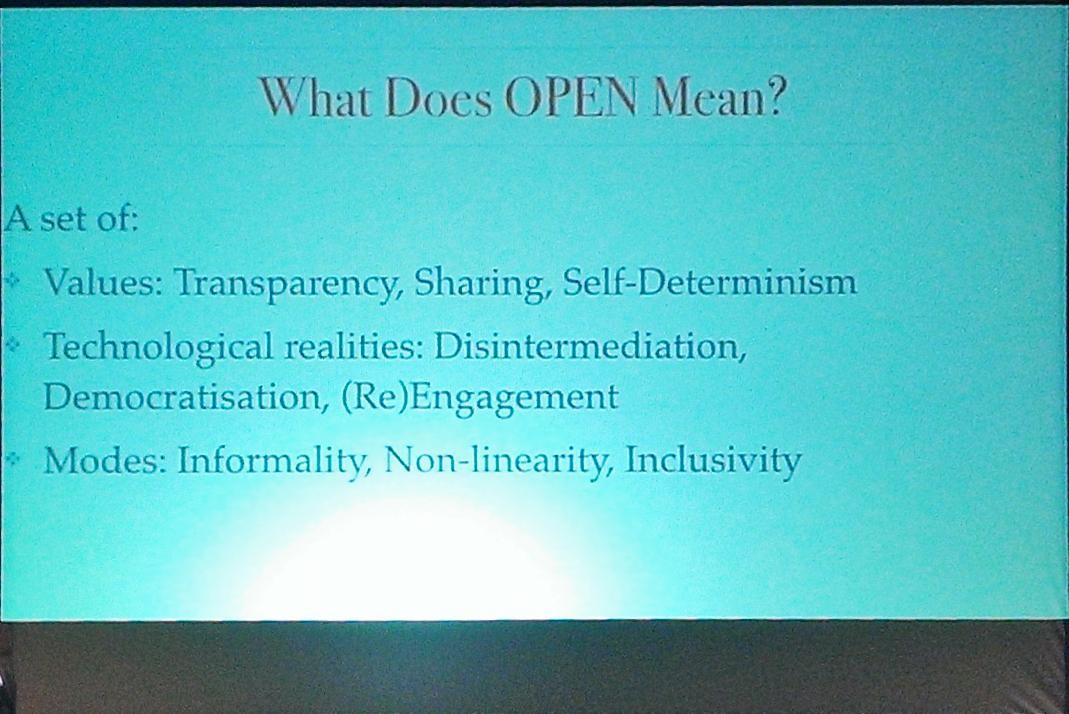
His take on ‘Open’ being as in the picture, a set of values, technological realities and modes.

Open definition
What Does OPEN Mean?

There was then a bunch of stats for the negative impact disengagement is having on economies due to productivity, increased numbers of sick days, lack of innovation (direct correlation), etc.  [This line of argument will be fairly familiar to anyone following the business press,] the insinuation being that organizations do not match up with the open and social way we now live our lives.  [I would say this is partly true but there are plenty of others who have argued tangentially about disengagement – for example, the idea that university education for more has simply raised expectations whilst work has become less interesting, the rise of human-computer interaction over person-to-person, etc.]

Disintermediation was looked at as a destroyer of jobs, with the economic value of knowledge declining although the social value increases.  [Again this can be questioned as an argument, yes the music industry has reformed but now bands make money from concerts and royalties over actual sales, journalists work independently or found blogging dynasties, etc.] The recent anti-Uber movement among London taxi drivers can be seen as just the latest of a whole raft of these disrupted industries [of course the impact on education/learning has been talked about for a while too, disintermediation being a key part of the keynote at ALT-C 2011].  We all now live in a world where we need to make sure everything is not equal, otherwise our work will go to the lowest bidder on Elance.com or be lost in some other way [he mentioned his children are working in the IT industry via sites such as Elance].

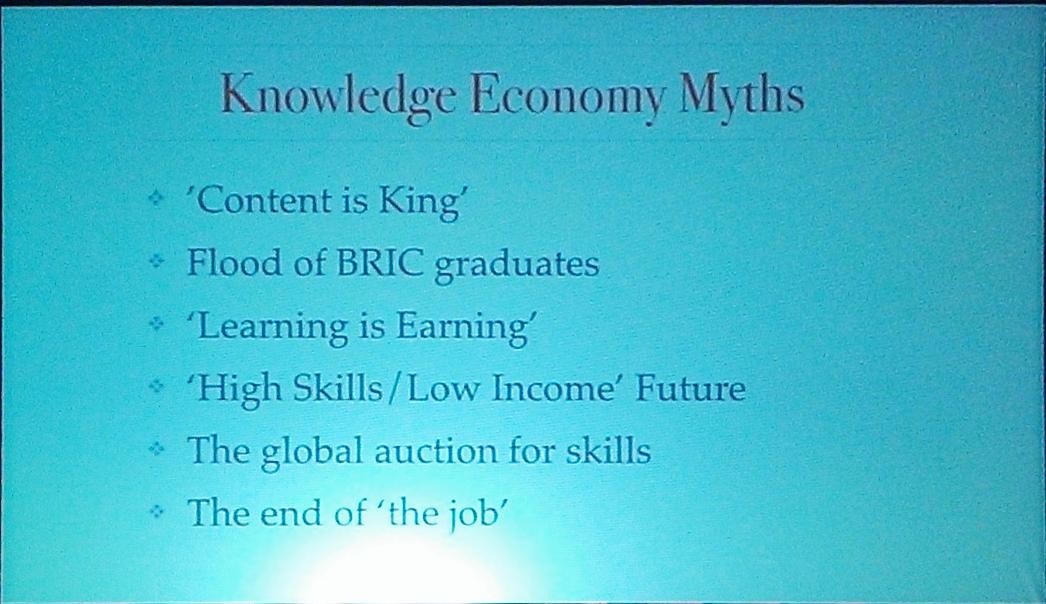
6 'myths' not to emerge from the 'knowledge revolution'
The world is not turning out as promised

Implications for L&D include a need to make work placed learning more powerful to tackle disengagement and consider the implications of disintermediation, for example do less induction with a base upskilling followed by a focus on the job (and less on corporate/L&D centric content).  At the same time learning is becoming more democratic via social and disintermediation, ‘6 Imperatives of Social Learning’:

  1. do it yourself (autonomy).
  2. do it now (immediacy) [including a mention for the quick hit dopamine rush you get from responses on social media, which were a theme at BETT2014].
  3. do it with friends (collegiality) – meet-up around MOOCs, importance of community and communication, etc.
  4. do it for fun (playfulness) Hard Fun idea – games are only fun if they are challenging, learning needs to remember this.
  5. do unto others (generosity).
  6. do it for the world to see (high visibility) change from ground up – do not ask permission (example of ‘change day’ in the NHS and the related ‘School for Healthcare Radicals’ [i.e. you can change big organizations via the power of their people]) also examples of putting up bad practice to show power of good practice.

The audience was asked how many of these six we actually support in our L&D efforts [I suspect not many in most cases].

He then went into an entertaining story about ‘The Claw’ and the power of social media.  The basic gist being that a car thief (‘The Claw’) was caught via social media and use of web tools, the story also allowing to show a certain amount of the creativity of web, meme, culture and misinformation via Wikipedia.  Here’s somewhat sensationalist coverage from CTV (misuse of technology terms in traditional media and all).

This all happened at a speed the police could not operate at, the implication being that the web has sped up communication and we need to take on that challenge. [However, it was another example where it sounded like his kids had flagged the story to him.  This is fine, but a few stories only really illuminate what is possible – such as another of his examples where he had met a young Indian golf prodigy who had self taught via YouTube videos of Tiger Woods].

The implication of all of this for learning is about ensuring that you/your organization can learn faster than competitors, this is the only sustainable competitive advantage.  Answers to many questions will be in the network, need to support this internally [presumably via Enterprise Social Networks, etc] and help staff develop their external networks [I would argue this really hinges on Information Literacy which most organizations ignore].  The argument was made that the really successful companies, as featured in his book, have ‘open learning environments’, characteristics of which include:

  1. hierarchies and silos replaced by machine shop culture
  2. unorthodoxy and diversity are encouraged (e.g. Valve’s induction manual including cartoony pictures)
  3. learning via tinkering
  4. social and horizontal (hackathons etc)
  5. learners free to roam (3m had free time % at work long before Google – results included the birth of the post-it note via two unrelated bits of independent research)
  6. free to fail (WD40 banned word “fail”, “learning moments” shared instead)

[it is difficult to challenge too many of these points but, in a corporate environment, there is of course an implication that this would take major change for many organizations].

The talk finished with a quote from Jefferson which amounted to a call for action on openness in learning, [personally I preferred his preceding use of the original World Wide Web logo to remind everyone that it has now developed to allow people to fulfill that early hope]:

World Wide Web logo
Early WWW logo

Session 1 Three tech trends that could change learning forever (Donald Clark)
[The last time I saw DonC at a conference the person who sat next to me walked out in disgust at the volume of swear words, it doesn’t offend me in that way but his ‘angry man’ persona was on show again during this session]

He started by criticizing the comment made in DonT’s opening session, arguing that only in education/learning conferences do people say “it’s not about the tech, it is about the” learning.  His argument is that tech dominates all industries, not least learning, for example Google has transformed how everyone learns [true but, of course, Google wasn’t the first decent search engine].  The suggestion was that academics, in particular, snear at what they do not know, but you should only be able to criticize what you know about [fair to an extent but everyone criticizes things they ‘think’ they know about, just look at the 1000s of comments posted to the Web from armchair fans everywhere during the World Cup].

Instead of this anti-tech stance the argument was that, from axes to mobile phones, humankind has always loved the latest technology [again a fair point in general but education has had its fingers burned more than once by tech white elephants, not a problem if we had unlimited budgets but even corporate L&D would struggle to spend money on everything we would like these days].

Donald Clark on stage at LSG Summer Conference 2014
Donald Clark lets rip

He then ran, very quickly, through 2500 years of learning theory.  His overall point being that ultimately nothing has changed…we still lecture like Plato’s Academy [yes, but there is plenty of good non-lecture stuff happening too].  His website has holistic coverage of the theorists and influencers he mentioned – http://www.planblearning.com/Articles/Learning_theorists/.  [There were some valid points but more could have been said on who he things we should still hold in esteem (Dewey for Learning by Doing, for example) rather than so much time on the charlatans, especially those ideas which have already been well debunked like ‘learning styles’.  Ultimately the takeaway, for me, was that there remains no real answer – when I studied education in my two masters courses it was clear to me, even then, that some of the theory was very much of its time and some just rubbish.  However, everyone is different and some structures (I still like Blooms taxonomy) are there to really just help formalize the world (but I would agree that there needs to be more serious research along the lines of psychology and neuroscience).]  He criticized the use of anecdotes as evidence [including the open keynote’s Indian golfer example] and that we have also adopted aspects of theory badly, like including learning objectives on everything [personally I find them useful as a learner if they are well written but I take his point] and Gagne’s nine steps which when used for eLearning just make it boring [I would say that really depends on the ‘eLearning’, a SCORM package maybe – a collection of resources potentially less so].

Overall he was largely critical of the importance given to social in the opening keynote [whilst I would agree that solo learning and independent study can be great the keynote was as much about the loss of the middle man (teaching yourself via YouTube, etc) as it was social].  From his 2500 years history he picked out three ideas that seem true (and three related technologies):

  1. Personalized learning.
    • Google is a pedagogic shift for the species, answers to questions when you need them.  Hyperlinks are key and are ignored by most page-turning eLearning.  Technology trend that is offering the potential solution is Adaptive Learning. A lot of rubbish data in learning (and where it is, like PISA, its tweaked for certain purposes).  However, starting to learn from web companies to make better use of algorithms – Cogbooks given as an example [which actually looks very good as a tool starting to deliver the long talked about promise in this area] of an adaptive learning system (includes ability to know where you’ve been and get you back on track when needed).
  2. Lifelong learning.
    • MOOCs will not replace universities but they will be open and demand led [I think I noted this correctly, it is obviously contestable how ‘open’ they are and many are currently ego led rather than demand led, although I acknowledge that should change over time].  High dropout rates do not matter, it is the ‘drop-in’ that counts – social of limited importance, more about content delivery than discussion boards [totally agree, people can take out what they want or simply ignore the course if they find they are too busy with other things – this is how I use MOOCs, ‘resource not course’].  MOOCs – L&D teams should be using them as a free source of content and to identifying high performing, self motivated, learners.
  3. Learning by doing.  Power in simulations.
    • Oculus Rift.  More expensive acquisition for Facebook than Google buying YouTube, noticeable that Facebook’s press release had educational uses as one reason behind the purchase.  For $300  have the potential to make existing simulations far more realistic, examples already being built for safety training, a full 3D care home simulator, etc. [The presentation title, of course, included ‘could’ and I wonder if the Oculus will really stop the work of Caspian Learning and other companies being niche or becoming more mainstream.  However, there is certainly potential for a shift for publishers from text to simulations and augmented reality.  Is a virtual world of much more value if you are ‘in’ rather than ‘accessing’ it?]

So “How weed out bull* from profession?” – he argued against the CIPD, such organizations being part of the problem in reinforcing existing problems (including in train the trainer courses, lecturing people in PGCE courses, etc.)  Anecdotes in opening session only about tiny number of people [again this was a little bit off as the golf example was that anyone could do something similar in terms of self motivated learning], need to enable learning at scale via tech not about getting people into a room.  Need to break number focus, mentioned HSBC internal conference where he almost walked out before his invited presentation as the opening session included the number of dinners served on training courses [hilarious if true but I can believe it considering the numbers/justification game that seems to obsess support services].  Real change comes from managers, [that is who need to use as conduit].  Need to identify the expertise in your L&D team and back it with meaningful data.  Training around compliance, ethics, etc has had no impact in banks (as so many collapsed/proved corrupt) – how can we justify ourselves in this world?  Need training to actually make an impact.  Get on with the change, stop looking for reasons to do something.

Session 2 – Transforming organizational learning or Small changes to modernize the Workplace Learning Environment from Jane Hart considered how we can modernize learning to catch up with the changes that have come from the web.

The 100 tools for learning survey has shown patterns and change over time.  Results largely about ‘social’ tools, people use them to find solutions for professional learning [yes but I also use things like Google Drive in very private ways, tools which have social elements should not be presumed be ‘social solutions’ all the time].

There were various questions via Poll Everywhere to have the group reflect on how things have changed for them.  My long text response was that learning is now “anytime, anywhere” and this is what we have to support.

When we use informal and social tools to learn something, such as Youtube, we do not want to study the problem, we do not need a test, we do not (often) need to remember the solution as can come back to it as needed.  Therefore, why do we still inflict such constraints on our learners [my answer would be that because L&D is dominated by ‘trainers’ rather than people who consider the operational and organizational use of information]?  Result is that people build professional personal learning networks (often first point of call) rather than relying on traditional sources of ‘learning’.

There was a poll for how important learning types are and company training/eLearning trails learning from others and keeping up-to-date via the web [I would argue this is about information and literacy as much as traditional L&D and this is too often ignored], we need to recognize this. This was backed up with stats from the Learner Voice research showing the disconnect between learners and L&D departments.

The concept of ‘Trojan Mice’ was introduced [which I really liked] of little changes which can be made without big noise, and can always be called a ‘pilot’ if they then created negative repercussions.  6 features of change we could tackle when back into the day job:

  1. autonomy (people like choice)
  2. small and short (not huge events)
  3. continuous (recognize that when away from formal workplace learning we are still learning, including without realizing it)
  4. on demand (access at point of need)
  5. social (from people without the ‘authorative voice’ with balance for knowledge sharing and other voices)
  6. anywhere on any device.

[a little like some of the points in the opening keynote these make sense but I have wondered how many L&D departments have ended up digging themselves into a hole of big course branding via the ‘Corporate University’ branding approach.]

Jane captured thoughts from the group via http://padlet.com/jane_hart/smallchanges for changes people could make.  She then ran through a number of suggestions (here are the slides) which were difficult to disagree with [but, as the talk’s title suggested, would be difficult to get any buyin from many organizations – hence the mice].

Session 3 – Design Thinking

I’ve heard a lot about Design Thinking as an approach to problem solving so this workshop was a useful introduction. Some of the key takeaways for me:

  • we are labeled as ‘creative’ or not at an early age, this is a real problem and we should encourage everyone to nurture their curiosity (including embracing experiments and being willing to fail)
  • design thinking is about bringing the creative/experimenting mindset into processes (although it does mean different things to different people)
  • throughout the process you need to flick between divergent and convergent thinking
  • need to think about the environment a problem exists in – empathy
  • iterative process [steps themselves not that different to ADDIE and other models] but largely about the mindset
  • come up with ‘how might we?’ questions to solve identified problem statements
  • there were a number of points around how best to come up with ideas (‘brain writing’ best to avoid ideas being shouted down in ‘storming’ sessions). Key is deferring judgment and encouraging wild ideas
  • be curious – borrow, adapt, re-purpose (including a nice example of hospitals learning from F1 pit crews to improve close-quarters working and communication)
  • evaluate prototypes via ‘I Like’, ‘I Wish’ and ‘What If’
  • http://www.scoop.it/t/big-idea.

The session used this guide from Stanford as a resource throughout: http://dschool.stanford.edu/use-our-methods/the-bootcamp-bootleg/

Value of support services

My thoughts have continued to develop, since a previous post’s conclusion, around the topics of workplace change and the influence on organizational design.  My latest thought is – perhaps we all need to take some responsibility for organizational design?  Every day, by interacting with someone in a work capacity or a colleague in a social environment, you are influencing the culture.  In your own big/small way you are influencing ‘how things are done round here’.

This came to mind again after attending a recent ‘Demonstrating your Value’ presentation, organized by CILIP’s Commercial, Legal and Scientific Information Group (CLSIG).  When I was in the session I know I was nodding along thinking ‘yes, very sensible’.  However, on reflection after the tube/bus ride home I thought again.  The feeling that overwhelmed me was how submissive the whole event felt.  Let me explain, firstly, by looking at some highlight notes from the presentation itself…

  • value = greater value add than your cost (depends on culture of organization and the credibility of your service)
  • credibility = utility (fit for purpose) / warranty / meets expectations
  • can influence credibility needs of organization
  • use user audits, ask people in detail what they need and how you are achieving it – ask ‘what else should I do?’
  • align headcount to roles, focus on wider value rather than niches
  • build story around budget, accurate numbers not enough
  • promote your value in language akin to firm’s advertising
  • learn from other support departments, scope for shared metrics, etc.
  • actively fill roles where the firm has previously used external consultants.

What came from my pork pie-fueled (appropriate for the venue) reflection/insight was that this all suggests support services are answerable to their masters and not enough influencers upon them.  This is of course understandable, as one presenter pointed out there are actually very few UK professionals left in areas such as legal research due to outsourcing, off-shoring, etc. but surely this is part of the problem.  I do not want to add to the stereotype of the ‘mousey librarian’, indeed most support staff leaders I have met over the years (including in library and information services) have tended to be outspoken.  Therefore, is there a better way to measure value?  User audits may identify what a business wants from its support services but not necessarily give the services scope for shifting expectations, as the support professionals pick up and develop ideas for the future of work.  Perhaps the below (aiming to be applicable to any support service):

  • A culture change survey: “In the last year my opinion of the x service has improved” (score out of 10, + to -).
  • An awareness survey: “Name of team member/service/offering” (worked with/used through to unaware).
  • An influence survey: “I have learned something from team member/service/offering this year” (agree through to disagree).

By all means, measure your service in financial terms but let’s not forget that every business is only as strong as its people and people need to influence the organization toward somewhere they would like to work.  That will change over time and simply working toward existing cultures won’t help move you forward.

What to call teachers and learning events?

Various things of late have got me thinking again about the nature of learning and the value of different terminology to guide behavior.  Some quick notes, for my reference, below.

This address by Bill Clinton highlights some useful examples of education schemes from around the globe, with the focus being on the impact of education upon poverty and opportunity.  A key thread in his argument is the need for young people to be exposed to at least one ‘great teacher’.  This grates slightly due to my dislike of the idea of ‘teaching’ in a connected environment where there are many kinds of learning event.  Does the facilitator’s title have to be driven by the nature of the learning event and, as such, ‘teacher’ may be perfectly valid in a remote African classroom?

Thinking back to the variety of event types that now exist, as discussed on a previous blog, we are seeing more and more formats emerge, often based around what a specific tool (such as Google Hangouts) can do.  One term I did not list was ‘Festival’ but the once-upon-a-time JISC Conference (which I attended a number of times) is now the JISC Digital Festival (although they do host an online conference too).  How can we best leverage subtle changes such as naming conventions, room design, catering, etc. to engage attendees of all types to develop a better formal/informal learning experience?  Can we best label ‘delegates’ and ‘teachers’ to maintain a sense of respect (where needed) but also shift the responsibility for (all) learning toward the learner and their network?  I personally do not think we should see this is as age related where we expect the young to respect their ‘teachers’ but the name for the role being less important in other age groups.

In the above I am seeing conferences and other events as learning opportunities, perhaps one trick is to have conference delegates agree to certain expectations in the same way you may have a student, in a formal education environment, sign up to a ‘charter’ or other form of learning contract?

Overall, I would like to see different names for facilitators of learning based on the nature of the event, this would help people be clear on the expectations.  For example, a webinar presenter is one thing whereas a classroom facilitator does something very different.