Coursera meet LinkedIn – LinkedIn meet irrelevance?

An email today alerted me to a new option for easily adding Coursera module completions to your LinkedIn profile:
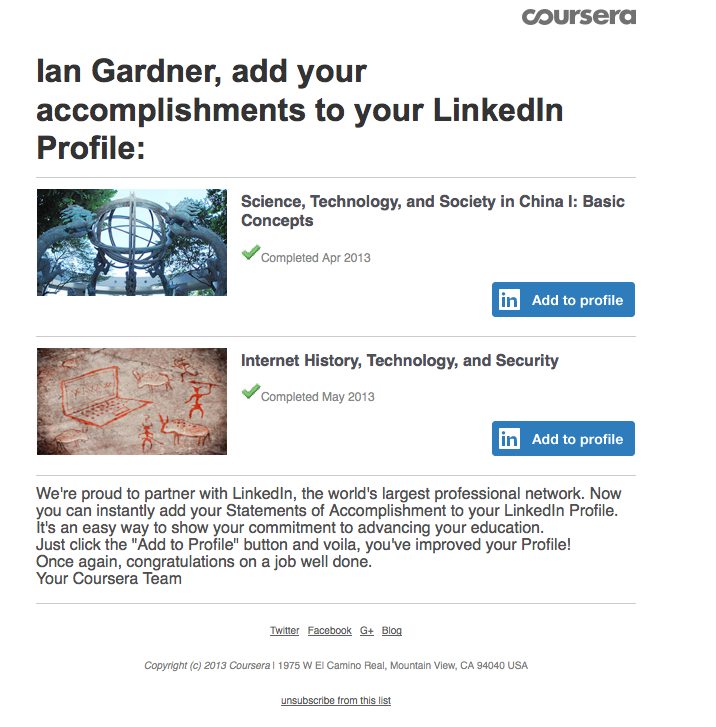
LinkedIn Coursera Email

I have complained before about some of LinkedIn’s functionality but I thought I would give it a go.  Indeed, I do like LinkedIn for what it has done to transform business communication and have been impressed with the company, not least that they were one of the first to develop cross-platform mobile apps which actually made best use of mobile use cases.  Here is what the Coursera content looks like when added to my profile:
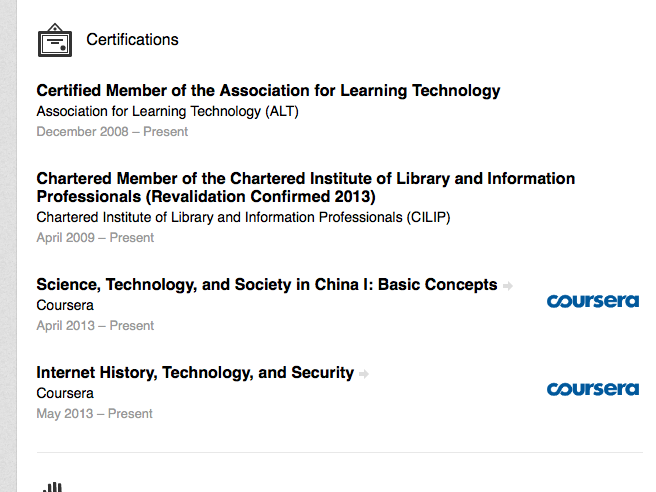
Coursera on LinkedIn

A little odd that this seems to be presuming that completion of a Coursera short course is ‘certification’ rather than education, especially when the business model for many contributors is potentially tied to issuing university credits.  It also seems odd that when MOOCs are proving the value of short courses (without the disproportion high costs of many short courses) they represent these with individual listings on LinkedIn, I doubt anyone lists every short course they have done.  This becomes especially problematic when you think of the full range of informal learning that someone can do, is a Coursera certification more valuable than a Tweet of praise, a positive Slideshare comment, etc?

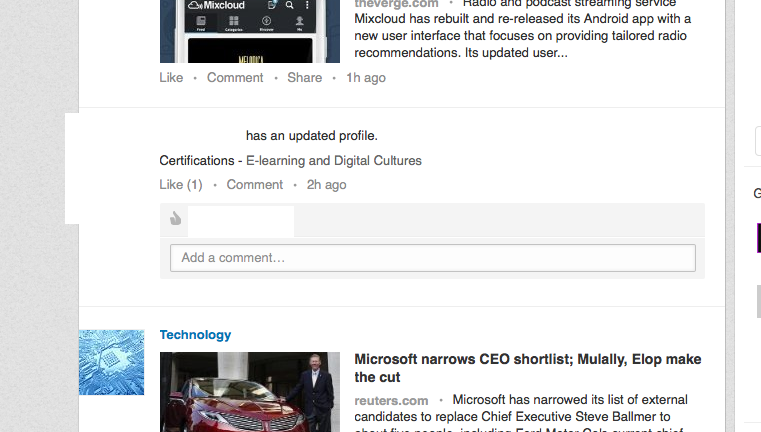
This then makes you think they are likely to be an advertising piece for Coursera.  However, thankfully, this does not seem to be the case as they appear as non-descript certifications:
News feed of contact's Coursera-ing
News feed of contact’s Coursera-ing

However, this comes with problems as they seem relatively random updates.  Potentially you could appear certified in “Archaeology’s Dirty Little Secrets” without any context.

So, how could they be better?  Well Tin Can and/or Open Badges might offer a solution in feeding to LinkedIn selected development activities that you want to present.  These could appear in their own section rather than forced into certifications.  Indeed the problem I am having with these changes is perhaps that they are leading to ‘scroll of death’ on profiles, would it not be better to link out to a store such as a Tin Can LRS profile, much in the same way you have ‘personal website’ links to allow you to show reflection on your blog?

Presumably Coursera is just the start (or might not be and I just have not realized this already existed) and LinkedIn will be looking to aggregate, in place of Open Badges, work done on other platforms.  Overall, a riveting development but another which threatens to put too much information into LinkedIn profiles and create barriers to career-centric conversations.

Social media in history

A number of webinars and blogs have, of late, considered where social media fits within the wider landscape of innovation.  Some of the conversations have been fueled by Twitter’s flotation, as one put it, the self-proclaimed town hall/pubic square is becoming a shopping mall, everyone will be there but you will have to pay for a space.

An episode of the Economist podcast called upon the idea of earlier ecosystems for sharing ‘on the wall’, including the impact of previous technologies/resources such as slave labor in Rome, the printing press, etc.

ELESIG’s recent webinar, meanwhile, considered the Internet as the global Coffee House, which were once described as ‘penny universities’ as you could talk with, and learn from, some of the great minds of London.  These conversations leading to, amongst other things, the London Stock Exchange.

Overall, as so often, it is useful to learn from history and realise the latest technologies are not the end game.  Beyond communicating with other planets, what else might we expect to see which will help foster better collaboration, communication and innovation?  Here are some ideas:

  1. Mind controlled/powered computers, ideas captured in real-time.
  2. Better translation, as the web is still being dominated by English-writing power.   China and other locations will start to export research and ideas more prominently.
  3. Openness to continue to spread, including (hopefully) participatory ownership (including government).

A 4th and final option might be for the web to become cleverer, for example, if I start to describe an existing theory in a blog post then the system recognizes that and suggests I read the original first.  Some systems exist in this area but tend to link blog posts by the terms used, they do not try to minimize the information overload by being clever enough to actually recognize new ideas from old – due to all the difficulties of processing language in that way.

Are we all information professionals now?

The ongoing arguments about CILIP’s name change, to “Information & Library Professionals UK”, include the negative impact of the proposed name shifting “Chartered” to the tagline (the one thing I said in my survey response should not happen).
 
For me, this raises the questions of if all “knowledge economy” workers can consider themselves “knowledge professionals” and thus engage with CILIP.
 
The fuzziness of who is an information professional (in the ‘knowledge professions’ as ILPUK would put it) is one of CILIP’s greatest challenges.  Once members could be identified by working in a library – how do professionals such as myself now associate themselves?  There have been valid arguments made that CILIP would be better scaling back to ‘Library Association’ focus in ensuring a defined purpose.
 
Of course libraries are changing too, from paperless public libraries to supporting free online resources in academia.  Both Sage and Taylor Francis have recently tried to argue libraries can continue to curate in a non purchasing world:
Perhaps the point here is to scare librarians into thinking, actually the paid for content is what is keeping us going?  Certainly I have been to at least one presentation by publishers where the message seems to be, to librarians and researchers, ‘let Amazon win and we all lose’.
 
One issue is that traditional Library Management Systems do not always serve web resources very easily, thus it is increasingly of use for others to curate themselves.  I have mentioned before the increasing discussion within L&D circles that curation is now an L&D role, for example:
Perhaps the future of the information professionals (UK or not) is in hybrid roles acting as the ILP for their team in a wider circle  – just as RSS opened up current awareness (a service offered by many information teams) to the individual, perhaps bagtheweb, scoop.it, etc may now do the same for personal ‘libraries’.

I am the 83 percent

http://www.perforce.com/product/commons/i-am-83-percent

It may well just be me, but there seems to be more and more going on online about the issues caused by poor working practices around collaboration, in particular around documents.
This is interesting as it follows a presumption a few years back that, with Google Apps and new versions of Office, these problems were set to disappear.  As always, technology implementation without good change management has led to problems for some and what seems to have instead emerged are a complicated picture where:
  1. Some companies have failed to adopt new technology.  The imminent death of XP may drive laggards into reviewing practices and supporting improvements through tech.  For now, people are continuing to face challenges and wasting time due to inefficient IT.
  2. Some have adopted office solutions, badly.  I am increasingly of the belief that what is needed is ‘possibilities’ training in the tech sphere.  There is no point throwing people in to hours of, say, Excel saying training when what they actually need is for someone to look at what they do and offer possibilities for improvements.  For example, I wonder what percentage of the world’s population uses Excel everyday but do not know Macros even exist, never mind how to author them.  Sitting down with someone to spot where efficiencies can be made and identify the small differences in application understanding can, ultimately, add up to big efficiency savings.  This works across the board, for example I often sat down with people to show them how to do something with learning management systems only to end up asking ‘why do you do that?’ about how people operate in Office and other software.
  3. Some feel the need to look further afield.  I guess the outstanding question is if Office, Google and other major players are actually what you need.  The video above is a nice example of the problems identified by a company looking at alternatives whilst the likes of Huddle offer what can be seen as simpler but more effective solutions.

It is then of interest to see iCloud finally step up to the plate and potentially try to fill the enterprise-sized gaps in Apple’s offerings.

Cheerio Google Reader

So I’ve taken the opportunity of a long holiday weekend to jump ship from Google Reader.

My final solution has been to move:

  1. most audio subscriptions to iTunes.
  2. other RSS to The Old Reader – this seems fine so far, a little annoying that imports come in as unread but otherwise not too bad.  The mobile version (on my Windows 8 phone) seems good enough.

For the record, my Reader stats were:

  1. 1682 subscriptions (The Old Reader said it imported 819 so I’m hoping that is ignoring dead ones rather than losing any)
  2. 42 tags/folders
  3. Over the last 30 days I had read 629 items, clicked 54 items, starred 0 items, and emailed 12 items.
  4. Since April 12, 2007 I had “read” a total of 178,020 items
  5. 8 starred items:
    1. Eradicating the Stigma: HR’s Future
    2. Rethinking Human Resources in a Changing World
    3. How Poor Leaders Become Good Leaders
    4. Nine Rules for Stifling Innovation
    5. Student Loans – sale of ‘mortgage-style loan book’
    6. What is a private university?
    7. The ePortfolio Idea “Forking”?
    8. A comment I made on a blog