Microsoft Sway: first impressions and possible uses

I first mentioned Sway back in October when I requested access.

Well, I’ve had access for a week or so now and have been able to spend about an hour on it.  First impressions:

Pros

  • it does what it is says it aims to, being an easy design tool for authoring/converting documents into a more appealing format
  • the inclusion of options to import Creative Commons licensed media are nice – it might be of most use for schools in keeping pupils away from images they should not be copying
  • offers a more web friendly format than the traditional document (to Flash) conversion tools, Yudu having been my tool of choice in the past
  • options between document forms (one of the promoted examples here) and more of a pinboard style (my first Sway embedded below).

Cons

  • private/public limit for published content realistically limits corporate use beyond marketing or personal use for presentations
  • still beta speed at times whilst it searches, imports, etc.
  • advanced search options would be appreciated when looking for content
  • clearly is deliberately limited in options, to the point where you suspect “oh that’s a Sway” will be a phrase that becomes as common as “well its a Prezi just for the sake of it”
  • my one attempt of an import (from an old PPT file) doesn’t seem to have worked very well – although there would be scope for tidying it up it seems like text and imagery should be imported separately
  • I have been using it on a Mac where you have other options such as iBooks – there’s no doubt a full comparison piece to be done, albeit it a tricky one as Sway develops.

Overall, yet another example of a tool the industry would see as ‘productivity’ (the excellent Mary Jo Foley’s thoughts are here) but certainly has capacity for learning uses.
https://sway.com/s/OP4b1UXKafYRJqFx/embed

Whatever happened to ‘Edutainment’?

Couple of things that have got me thinking in the last week or two….

  1. A post on the Learning and Skills Group Forum which asked the question of how technology is changing the (workplace) learning paradigm.  Are instructor led training, computer based testing and web based training on their way out?  “Is mobile learning ready to receive the baton” or is there a need for “new instruments”?
  2. A colleague querying what music I was listening to when they spotted me on my commute.  The answer, that my phone does not have music on it only podcasts, seemed to have surprised them.  I looked at the LSG Forum for some learning related podcasts but I could only find an old post from 2010.  As a result, I thought I would throw out on Twitter [400th tweet btw] what learning (or learning technology) podcasts people would recommend:

Whilst this got a RT [thanks @Andrew] and seems to have encouraged some new followers [*waves*] no one actually replied (as yet) with an answer.  Now, if we are going to be serious about the use of technology to appropriately support learning outcomes surely there should be a podcast which helps professionals keep on top of what is happening?  Well, perhaps not.  There are, after all, lots of webinars (not least from the LSG), newsletters (for example from ALT), Brandon Hall events, etc.  Lest we forget the conferences… lots of conferences.

Paradigms for learning tech

Anyway the above two points got me thinking, once again, about the nature of a professional identify in learning technology.  I will not go over old ground here, and there have been some good recent posts from the HE perspective (including this one).  However, there is a key point in that HE-orientated post that I think is the crux of the issue where learning technology falls down in the corporate world (at least based on conversations I have had at CIPD, LSG, etc events):

Curious[ity]

Now I think most people I have met in corporate L&D are curious about new paradigms.  However, and unlike in HE in many places, hands are tied by corporate red tape to apply this into practical solutions (see my response to E.Masie on this topic).  For example, IT systems will be more risk adverse so you can not encourage wide spread adoption of (say) mobile apps.  I can look at my personal experience for plenty of examples; when working in FE/HE I could see something worth investigating and work it into a program (through discussion with a tutor or instructional designer) immediately, or at least into our own learning tech training, in the corporate environment scale and other issues often work against you.

A greater shift in paradigm would be to look to influence culture first and deliver ‘solutions’, to training needs analysis that we can easily quantify, second.  Again, the obsession with length and tracking, often inflicted by professional certification agencies and governments, does not help but we also need to be far more flexible if we are to recognize the ’70 and 20′.  Let us wear curiosity on our sleeves in L&D, a badge to be proud of and worry about tracking later.  There are, of course, many paradigms that can be enabled by ‘learning’ technology to mix up workplace learning and make it more varied – including virtual reality, virtual classrooms, games, etc.  Let’s aim to entertain, not to just record high smiley sheet scores, but to deliver valuable outcomes.

Podcasts, the ultimate edutainment?

I learn a lot from podcasts.  They also entertain.  They often combine the best of ‘anytime anywhere’ learning with interesting narratives (normally via discussion and other radio techniques) and hosts.  However, we don’t seem to have a stand out example for learning technologists to learn from?

The British Tech Network or the US-based TWIT (The Week In Tech) will cover you for technology topics including Mac, Windows, corporate tech, Google, security, gaming, mobile and web design.  Perhaps the issue is that learning technology crosses over all of these, we use software from a range of areas to produce outputs to solve learning needs.

The lack of a podcast leader for learning technology certainly is not for lack of action in the direct field though.  The Adapt Framework, for example, retrofits functionality familiar from (Flash) web based training interactions into a HTML5 tool.  Now, I’m excited about Adapt and have been attending webinars about it.  Do we need an independent podcast to follow this kind of development free of bias from the developers?  Just look at the money, for example $2000, for independent views of LMS systems!

Now, there are some podcasts (my listening list is here) and I have done some research in the last week or so and added some new things to listen to but I have still not been able to find a news-orientated show to offer a view across the profession(s)/industry.  That said, search for EdTech podcasts (for example in iCatcher my app of choice) and you do go get a lot of results (indeed I have followed EdTechTalk on YouTube for a while) so maybe my ‘holy grail’ is out there but I am missing it.  Perhaps it is just me and other professionals keep up-to-date well enough via their RSS and other feeds?  Certainly across blogs, LinkedIn, etc there are plenty of people doing good ‘curation’ roles for industry news.

Personally though, I would argue that, there seems to be a space for a podcast to cover:

  • learning technology related news
  • panelists’ views (with a mix of K-12/school, FE/HE and workplace)
  • the week ahead (webinars to look out for etc)
  • panelists’ picks (something to try this week)

For example, recent stories that could be covered in ‘news’ would include:

Would love to say I could host such a thing (even though I acknowledge it would be a LOT of work) but I have a terrible voice for radio/podcasting 😉
The inevitable backlash to ‘curation’

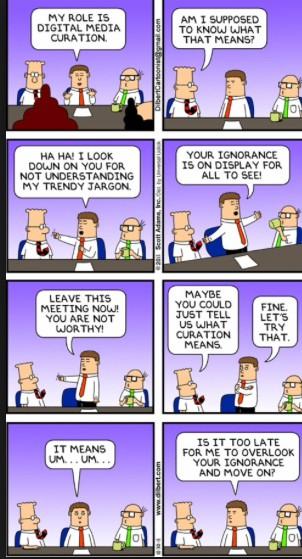
One of the popular terms of the last eighteen months or so, both on the wider web and specifically in L&D circles, has been ‘curation’ – indeed I mentioned it back in August 2013.

Well, inevitably the backlash has begun:

What does Curation mean?
Source: https://pbs.twimg.com/media/BzPoCRHIIAAQ0mD.jpg

or at least the backlash against people who “don’t get it”.  Ultimately my take on this has not really changed…

Curation is nothing new.

Directories drove the early web until search improved.  We now see ‘live’, largely automated, directories aggregating content on an ongoing basis – albeit at the risk of rehashing old ideas and not moving the conversation forward.  Quality curation is one way to raise, above the noise, genuinely new insight, research, data, etc.

Information skills are essential to any non-automated approach and there would certainly be an argument that where ‘time is money’ some level of automated curation (as part of a personal learning and information system) could be supplemented by people focusing on information management/curation and distribution in your organisation (rather than the potential for duplication of effort, etc by everyone spending time managing their own).  However, I see two major challenges:

  1. Personal network versus “supported learning network”.  The inevitable problem for any kind of internal awareness, communication or learning curation will be that it has already been captured by an individual’s personal system.  For example, a colleague may share something on my team’s internal social tool which I have already engaged with via Twitter.  We have moved past restrictions enforcing only ‘work tools on work time’ so how can we balance this without boring ourselves and our audiences via multiple sharing/discussion streams?
  2. ‘Human touch’ curation capabilities are limited.  The cutbacks of recent decades to information-related teams mean that the focus is more likely to fall on the individual, supported by groups such as internal communications (for distributing key messages) and knowledge/record management (for longer term curation).  I see the recent focus of L&D on curation, to capture quality content and share appropriately as one area where my information background and learning technologies crossover – quality content has been the core reason for libraries and now we are seeing transformation of learning away from ‘our stuff’ to recognizing the value in UGC and integration with 3rd party materials.  Ultimately we would want everyone’s daily work to be built around a single company virtual space which can do everything we might need around learning, sharing, communication, etc.  The challenge is that this system realistically does not exist and, in all probability, existing businesses face fragmentation and silos.

So I would say lets strive to ensure our organizations appropriately curate but recognize it will have failings and is not the solution to every form of learning/content need.

Microsoft publishing redux?

I recently reached out to the ALT-members list to see if anyone had had chance to use OfficeMix:

This followed a tweet which received a reply from Techsmith:

Surprisingly no one on the ALT (Association of Learning Technology) list replied, which might be a sign that MS are struggling to keep UK Higher Education clients (or at least keeping them on the latest versions).  Someone at my work did though say they have tried it and are very impressed.  My main interest is in distribution models considering the potential use for this kind of output in eLearning.

Hot on the heels of all of this is the release of this video on Sway:

I have requested beta access to Sway.  Whatever happens with these two tools, kudos to Microsoft for trying to reimagine publishing – let’s face it, the Word and PowerPoint domination has not been very helpful for creativity in business.  Microsoft’s approach with these tools seems to be to aim for cross-device web accessibility in the publishing (and app based authoring), in contrast to Apple’s app future via iBooks (which is probably the nearest thing?).

Personally I’m more of a web than App fan so I’ll be looking forward to that Sway invite coming through 😉  It will be interesting to see if OfficeMix picks up most use (via the PowerPoint user base) or people can be swayed to a different tool (and Sway will finally be the death knell for Publisher?).