What am I using: March 2018 Edition

Four years on from a similar post, this is a recap on my current tech use and how that impacts my professional practice and work/life balance.

Home machine:

Home use is still my iMac – now about 10 years old it’s going strong after a recent hard drive failure and replacement.  Kudos to aamac for the work saving the data and transferring everything over.

Phones:

My biggest recent change is that 12 months into my 24 month phone contract I’ve given up on my Microsoft handset and instead switched back to Android, with a Moto G5.  My employer previously switched us from an earlier (not great) Moto to an iPhone so I was a little hesitant about all the glowing G5 reviews (for example it made it into The Guardian’s top tech items of 2017) but the low price (£150 on offer at John Lewis) meant it was a sensible move.  The final push away from my Windows phone was it constantly dying on me whilst I was away from home visiting family.  Vodafone had offered to send it away for possible repair but it would work fine for a week and then have a week off, where it would only work plugged in. These technical issues combined with the dying support from Microsoft (including the LinkedIn app’s removal from the Windows Phone store) meant I was pushed back to Android (even with my previous concerns).  I would say I still prefer the Windows Phone interface over Android (even with the Microsoft Launcher I have installed) and iOS but with Continuum failing to live up to my expectations there isn’t much to be lost by going back to Android.

Websites: still really the same as 4 years ago.  Trying to use Twitter more – especially handy for when waiting around in the yard for the dogs to finish doing their rounds!

BETT2018

Unusually I was quite looking forward to BETT this year.  The usual trepidation ahead of fighting through slow-moving crowds perhaps tempered by knowing I wasn’t doing “the new year double-header” with Learning Technologies:

The positive vibes for BETT were perhaps also coming from some hope regarding a new ‘learning space’ in our HQ that would need fitting out with appropriate tech.  So, whilst I used to always ignore the ‘physical’ classroom stuff at the show, this year I found myself drawn to wipe clean glass desks, chewing gum resistant tables and laptop trolleys.  All in all it was quite an eye opener checking out some stuff that I’ve only really had a passing interest in over the years.

There were only a few seminars I had earmarked as worth attending so it was to ExCeL I went with the usual expectation that making it around the show floor would take most of the day – the particular sessions I did attend are reflected on below.  Also some general notes from the floor:

General thoughts from the floor

One of the major criticisms of BETT is that it is the hungry pigs at the trough of school spending/funding.  So soon after the Carillion collapse this perhaps stood out even more this year – with Capita and Microsoft probably having the biggest stalls to show quite how much of a “market” education now is.  Of course this is a little harsh on Microsoft who are often playing the long game in getting kids and uni students used to their tools on the cheap so they then query employers as to why they are still using Excel 2010 and/or Apple and/or Google.  I’m totally one of those suckers…

…pretty sure I said something similar about discussion boards in c.2004.  There’s also plenty of big ‘learning’ players at BETT – working across BETT (for schools), HE, workplace and more – such as Techsmith, Kaltura, Canvas, Claro, D2L, McGrawhill and 3M.

I attended a few bits and bobs on other stalls, including a good one on the Microsoft stand considering PISA and the future competencies learning professionals need to be supporting:
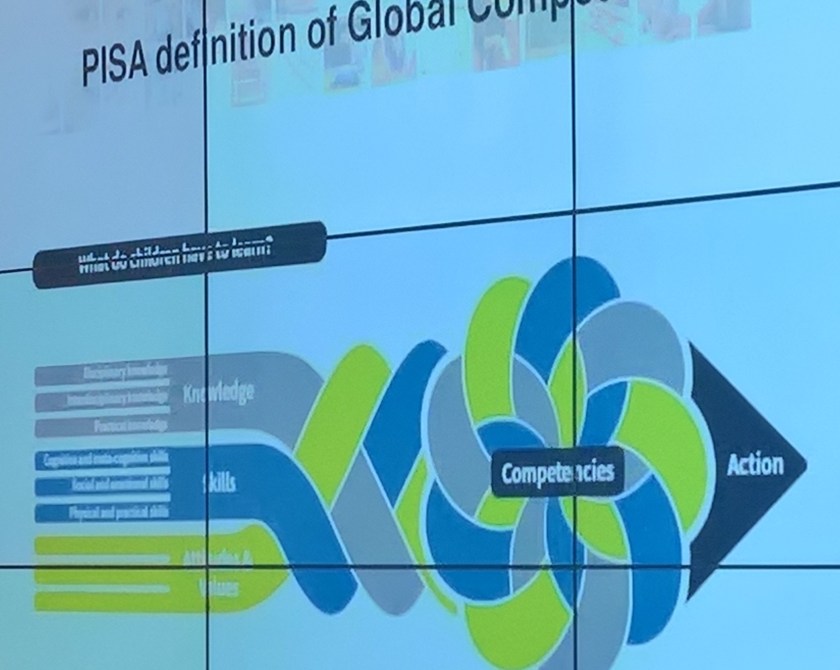
wp_20180125_14_22_27_rich.jpg

Anyways, whatever your political persuasion and thoughts on capitalism’s influence on the classroom its likely you would still look twice at the presence of the Russian, UAE and other nations’ stalls.  They seemed more pronounced (to me at least) this year but I probably think that every year.  That said, the French stall had a few interesting startups and a pleasant amount of stereotyping in the branding:

WP_20180125_13_32_20_Rich


Overall I fleetingly pass stalls when in BETT, in part as I don’t have a particular budget I’m looking to spend, some reflections from this year’s wander:

  • Whiteboards, screens, etc – 4K seems to have given this area a boost although a session I started to watch (facilitated by two wonderfully confident early teens) soon turned into the usual Smart farce when the software wasn’t working properly.  Still feels like a software-lite solution is best in this space so one less thing can go wrong (even if Tango and others seem to have nice additional software) – one of the worse inventions ever was the Smart TV turning a previously immediate boot device into something that has to ‘load’, update and crash.  I was though intrigued by a few claims related to “eye care tech” built into devices.
  • Laptop safety – as mentioned above, device security is potentially going to be of interest to me in coming months so it was interesting to see how the tech in this space has developed with an array of tablet-friendly lock and charge systems – as well as wireless/contact less charging.  Wireless charging remains, for me at least, still slightly magical yet the sowed it is very much deployed and ‘in the real world’.
  • GDPR was out in force with some data regulation, hosting/protection suppliers having (literally) stuck it on as an additional to their stall’s advertising.  The impact on education was also in a number of magazine and flyer takeaways.  Presumably, as with other industries, there will be a lot of people failing to prepare for this and others cashing in on the general misunderstandings and malaise.
  • VR seems to be developing along but still seems of most use where there are clear experiences to be gained – the idea of experiencing a WWI trench in VR sounded intriguing and akin to the use for highlighting the issues Syria faces: http://www.360syria.com/intro .  I’m torn on if we would ever want ‘rapid’ VR authoring or if that will open the floodgates to awful VR in the way PPT to SCORM converters did for eLearning.  Although templated AR might be useful?
  • LMS.  You would think in a school environment that the LMS/VLE would be a central tool.  However, you still get the feeling that Google for Education and Office 365 are central (on the authoring and deployment side) with student information systems the data coal face.  Perhaps due to budgets, it is seems increasingly that another (LM) system isn’t a priority – perhaps as schools will also be face-to-face focused in the first instance.  Also there seemed to be growing numbers of add-ons to 365 (such as https://www.livetiles.nyc/ that do some of the job).
  • Mobile: Nice to see that, at least some, classrooms and taking advantage of students carrying powerful devices with them by leveraging them in the pedagogy – for example with: https://www.wooclap.com/ and https://nearpod.com/
  • https://www.iridize.com/ (for context sensitive employee performance support on systems) and a few others looked less ‘BETT-y’ and perhaps more suited for the LT show.  TootToot for feedback/safeguarding would also have uses outside of the target school models and they are apparently working on an enterprise version.  Similarly Derventio’s performance management tools were clearly suitable outside of the school market – but, as always, do you want integrated HRM or multiple systems?
  • Furniture: a few worthy mentions for interesting products – Mirplay, Learniture, Freedesk, Folio, Wall Art and, surprising to see at the show, John Lewis (for Business).
  • AI: wasn’t as obvious as might have been expected.  No doubt many of the publishers (even Britannica who were celebrating their 250 anniversary) are working this in and there are other products out there like https://www.tassomai.com.
  • As well as the usual programming, robots and other cool stuff:

WP_20180125_14_19_12_Rich

Talk 1: National College for High Speed Rail on the 4th industrial revolution

Didn’t really feel like it went anywhere this one (perhaps ironically considering the home org of the presenter).  Useful I guess if people were not aware of the ‘IR4’ buzz/argument but with little direct applicability beyond a call to the attendees to be innovative.

Basically argued that the college is set up, via apprenticeships and innovative approaches, to tackle modern workplace challenges.  Yet I thought that whilst it is all well and good that this new style of college exists to “disrupt” – the use of new tech in “everything we do” sounds a little like setting itself up to fail (or at least retract when budgets are cut in the future).  Interesting bits like their use of Azure for combining data didn’t sound like they were too ‘new’ – instead leading to early warning indicators like Starfish and other solutions have in the past.

Talk 2: Leading a digital learning strategy

An impressive school turnaround story from a headteacher who put digital at the heart of the school approach.  Really a rare cultural success story with a successful 1-2-1 device programme.

Tips for success were not surprising but good to see a success story for once:

  • Sustainable, not one-off investment
  • Don’t expect tech to make life (i.e. teaching) easier: just different
  • Tech rich, not paper free: still room for outdoor learning, physical science, drawing, etc.
  • Used what was right for them: Chromebooks and GSuite
  • Staged roll-out: staff with pupils so learning together over a three years (not a complete ‘big bang’)
  • Used distance learning software and techniques when relevant (and when needed like school snow days):  including having people collaborate in the same room but at different desks, i.e. get pupils used to workplace digital collaboration style remote working
  • Google Sites for ePortfolio allows for parents to be more involved with the demo of work and outcomes
  • Continuous feedback on teachers via Google Forms to allow iterative improvement.

What was pleasing was the trust evidently put in pupils, with low-level web filtering and pupils allowed to ‘own’ their device.

Still clearly a way to go – for example, they are looking at audio feedback (even though that was well embedded when I worked in HE c. 10 years ago).  I hadn’t seen the immediate feedback available in the education version of Duolingo which looked quite good.

Overall, inspiring and the point made that a lack of IT teacher/department hasn’t held them back – and has probably helped as it means shared ownership in their culture – is probably as revealing about failed projects elsewhere as anything.

Talk 3: GDPR

A decent session that made the point that GDPR is a major issue for schools and that one reason why it is tricky is that it is really made up of three equal parts: cyber security, data protection and information governance that had, previously, been developing separately and experts find difficult to cut across.

Unfortunately were in a world of pretty terrifying stuff – like one school who were targeted by a phishing attack and parents then lost £150k in paying fraudsters a fake school charge.  A key point here being that the processing activity is key – e.g. it’s not IT’s responsibility but rather the user (such as HR teams as they hold personal data).

Getting onto Windows 10 was identified as an easy step to improve compliance and that everyone needs to be clear where they are on meeting requirements – with a way forward plan by the introduction in May – rather than compliant from day one.

Talk 4: Digital transformation

More a summary from the Ludic Group on changes in the last 20 years and some ongoing trends:

WP_20180125_15_51_58_Rich.jpg

WP_20180125_16_08_38_Rich.jpg

Nothing major here unless, perhaps, people entered disagreeing with his “digital changes everything” mantra and had their heads turned or, indeed (and this is a possibility as the Q&A question was “what is blended learning?”[!!]), eyes opened.

Kineo Connect: Exploring your learning platform’s potential

A couple of really good sessions* at this Kineo client day.

In the same week as the UKeIG event this looked at the digital transformation of L&D and, therefore, the future of workplace learning.  The event took place alongside the availability of Kineo’s “Time to Transform” guide.

The guide is a nice summary of the state of the ‘learning landscape’ and, I would presume, the kind of developments most L&D teams are working on.  That said some of the points, such as “look ahead and promote the resource-based approach”, are not very ‘transformative’ (although I appreciate my background means I don’t have the ‘course first’ mind-set that still plagues the industry IMHO).

* Couple of good sessions:

  1. Time to Transform states “arguably at the heart of all digital transformation of L&D will be the role of data” and the session on xAPI was great.  I made a rather rambling point/question at the end of this, what I was basically saying was xAPI is always talked about in the same way as SCORM – i.e. to track things.  What this session actually pointed out, to me, was that xAPI is instead a standard to help aggregate data.  Using it in this way stops the risk of L&D, or at least an LRS, being a silo and thus largely pointless – indeed the red herring I warned about.  However, this was one of those sessions where I thought, “this is great BUT only really if you happen to be doing it first in your organisation”.  Where organisations are already data warehousing, managing metrics, etc. the Tin Can approach would seem to not add as much value.
  1. “Meeting MABLE from Mitchells & Butlers”, this session felt similar to the xAPI one in that your learning platform can be a fantastic, a ‘go to’ place, but it really only works when you aggregate on it and drive traffic – i.e. you do not have other silos, Intranets, etc. stealing time and attention from your colleagues.  M&B’s presentation showed how their advertising and culture is clearly fantastic and the value in L&D tram’s bringing in external advertising and branding support. The take-up of the platform and clever creation of a persona for the platform (including use of Facebook) – always referred to as “she” not “it” – is clever and in line with some of the cleverer characterisation of other services (such as museum communications via Walrus and library management via ‘cuddly’ penguin).  I also liked M&B’s #learninghero campaign through Totara Social to recognise who had helped colleagues to develop and grow.  This is part of an impressive digitisation, including the carving up of numerous training days into 1-hour Adobe Connect sessions.

The other sessions I attended initial results from LMS platform research – presentation here, nothing really surprising and a session on credentials which will be familiar to users of open badges and related approaches.

UKeIG: Digital Literacy in the Workplace

This day workshop really ended up getting me thinking and my thoughts (as articulated below) are probably still not very tidy.

What does being ‘digitally literate’ even mean?  What does digital literacy look like?  What does it mean to different industries/sectors?  How does it compare to Information Literacy?

Perhaps predictably for a CILIP group event the first couple of presentations were quite focused on Information Literacy [in the SCONUL kind of sense] and the day did continue to think a lot about electronic resources and e-information.  This said, it did highlight how different people have different views on DL, for example mine would be more in line with the Belshaw model than how information professionals might consider the topic [note I tend not to call myself an info pro anymore!].

Key activities related to the topic were included in the day’s presentations, my interest in attending being particularly around the training of ‘clients’ (although a number of delegates made the point of not calling it ‘training’ to increase engagement), to up-skill staff and students (the latter for the large number of delegates working in education).  The “don’t call it training” advice will be well known by L&D folks and Wendy Foster’s session on the City Business Library made the point perfectly: it should be outcomes/WIIFM focused, i.e. not “database training” but “creating business to business contacts”.  eLearning was also mentioned as increasingly important for library/information professionals – and I made the point on Twitter that some of us have moved away from the ‘traditional’ profession via this route:


Personally, when I think about digital literacy, I’m thinking digital competency and capability.  This includes how people can be encouraged to be open to technological change, continue to develop their knowledge and skills within the requirements of their role and for possible future needs.  Indeed in the initial brainstorm of what it meant for us, I made the point of saying that it really can mean anything and everything.  I continued by arguing a need to “get on with it”, more than worrying about definitions, in a similar way to how L&D faffed about with what “coaching” meant only for people to go ahead and crack on with it (in various guises).

The different perceptions, semantics and language used around the topic continued to come up throughout the day and I couldn’t help but feel that businesses have adopted “digital transformation” as a buzzword, largely via IT Services, whilst a lot of professions have been left behind.  This is an interesting one for libraries/information considering eLib was a very ‘early’ series of service transformations (again for education – and a key part of my MA dissertation) that arguably (at least in my dissertation) was not followed through (or at least maintained).  eLib, however, is largely the cause of the LMS language divide between workplace LMS (learning) and UK higher ed (library – and use of VLE over LMS).  Anyways, I’m getting waylaid by semantics and history (which I tend to be)…

The day considered various pieces of research such as the ‘Google Generation’ which got me thinking about the laziness, ‘buzyitus’ and other factors which might be as important as UI/UX decisions:


A couple of sessions referenced Information Literacy in the Workplace by Marc Forster.  I don’t think I’ve ever looked at this [at c.£50 (it’s a Facet book after all) I’m unlikely to] nor the also referenced Information Literacy Landscapes by Lloyd.  Overall there remained a feeling that we were talking about a narrow subset of the digital skills I would consider people need.  I quite liked this model when reflecting on the day and Googling alternatives and, for workplace’s aligning to the apprenticeship standards, perhaps functional skills frameworks are the standard to be applied.

The JISC session nicely considered the wider issues (Flexing our digital muscle: beyond information literacy) but, unsurprisingly again, was very HE orientated – their model of “digital capability” however could be flexed for other environments.  Is the model of creation, problem-solving and innovation (in addition to an information focus) the way to go when thinking about digital skills – i.e. should they just be embedded at appropriate (Blooms taxonomy?) levels of technical capability?

Overall, there is a huge impact on productivity from information overload, a lack of digital skills and related issues.  If we (as in our organisations and the UK overall) are to improve perhaps we need to recognise this and invest in people for longer term impact and improvement.  Whilst one session, correctly, pointed out that work is about “KPIs not coursework” it is also an oversimplification.  As required skills are changed by technology the knowledge, skills and behaviours will change and be reinforced.  In terms of quick wins, the start point may well be developing some shared vocabulary within your own organisation to then support people with.

Reflecting on: “Here’s why you’re failing to create a learning culture”

Another great article from Laura Overton and the Toward’s Maturity team got me thinking this week.  The article considers “five common mistakes” that can stifle a learning culture.

Below are some of my reflections on these points – both from my own experience and what I’ve read, seen at shows, conferences, etc.

  1. You don’t trust staff to manage their own learning
    • I totally agree that everyone needs to own their part in continuous improvement and the part learning plays in that.
    • We are doing a lot to empower managers to coach and facilitate their team’s development.  The challenges I see are two fold:
      1. is that people feel they are too busy to take this on.  I tend to feel people are ‘doing this already’ and do not perhaps realize but…
      2. how can the ‘day to day’ learning can be amplified?  The amplification across silos being a particular challenge.
    • The “trust” point is an interesting one as I wonder how many L&D organisations are happy to trust the individuals in what they need (with the risk of verging into solution-centric models rather than analyzing issues) but not in how to spend money.  In some ways this is fair as it is where L&D have a governance role to play – consistency, economies of scale and consistent outcomes with controlled pilots/innovation, etc.  However, there is the risk of being a blocker…
  2. You are stifling staff contribution
    • “91% of learners like being able to learn at their own pace and they are more than capable of searching for the information they need” – my experience would suggest people generally struggle to search and retrieve (information skills are limited and overload a problem).  This is where information systems are key, L&D needs to be embedded with coms and KM, architecture is all important and it largely depends around what is already in place for having an online internal profile – for example, ESNs.
    • I would though agree with the main points: it is all important to get people to share what they find and user generated content is part of this – so too is getting people to feedback after external training or conferences.  The latter examples have been known issues for a long time and remain issues, I presume, in most organisations from what I have seen and heard.
    • Perhaps the issue here is with “personal development planning” and career development more generally.  Yes, it is a personal journey and one which will be more personalized via analytics, customization and technology like Filtered.  However, the fundamental point why an organisation wants to invest in you (be it funding or just funding your time away from work) is to see a performance improvement now or in the future (see Degreed for a definition of learning culture) so do we drop the “personal” to stress that it is a co-investment?  We could say “performance improvement plan” but that sounds rather draconian and as if people are on their “final warning”.  Anyone out there got a better name?  Really “plans” just needs to be dropped altogether for ongoing small scale development?  Then what about required accreditation (where they are not going away any time soon)?  Lots of issues here for the workplace in general beyond L&D departments – for example, how do you budget for these more flexible requirements.
  3. Your content is inaccessible
    • Yep, a real problem with the traditional model of hiding things from search via SCORM, etc.  This ties in with some of what I’ve written under ethos about trying to change L&D to an open web approach – do we really need to hide behind logins?  Often its about having everything in one place but that is, in part, due to poor architecture and a lack of hyperlinking
    • There remains, to me, a question over how much the best content is inaccessible.  Yes, the open web hosts enough to get by on most topics but do we still need to licence from vendors larger libraries of nice solutions like getAbstract?  I would say yes, even if many publishers have gone to the wall in the digital age.  The challenge then remains what it has been for probably 20 years or more – federated search across multiple resources.
  4. You take learning away from work
    1. Again my ethos page stresses the need to consider learning as work and work as learning.  I ran a session last week for people in my organisation who have formal “learning” responsibilities in their roles.  The interesting outcome of the session, which was the first such event and therefore deliberately navel-gazing about how we work (via me picking various articles and thought pieces from Jane Hart, Donald Taylor, Saffron Interactive and others), was our consideration of where we are on some of these spectrum.  Effectively a bench-marking reflection exercise for the wider group.  I still doubt many organisations are actively giving people such time to reflect on external learning and bring it back in a productive way to influence behavior.
    2. The growing importance in the UK given to apprenticeships is in some ways reinforcing problems here but also targeting learning at the workplace performance.  It remains to be seen if the government’s approach with the Levy can survive the Brexit fallout and other challenges.
  5. You don’t reward learning
    1. Agreed, this can be a major problem.  I’ve previously left organisations frustrated at a lack of opportunities to make use of my skills and I suspect many many others have had this problem.  I recently spoke to a colleague who had even been through a formal development programme only to not have a role to go into at the end – again apprenticeships should help here with the formal development options leading to rewards.
    2. Sharing success can be driven via internal coms channels and we’re also using a combination of Open Badges and competency models to drive recognition.

Overall some really interesting points to reflect on and try to tackle going forward!