The inevitable backlash to ‘curation’

One of the popular terms of the last eighteen months or so, both on the wider web and specifically in L&D circles, has been ‘curation’ – indeed I mentioned it back in August 2013.

Well, inevitably the backlash has begun:
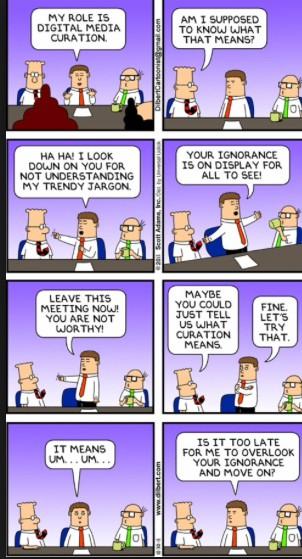
What does Curation mean?
Source: https://pbs.twimg.com/media/BzPoCRHIIAAQ0mD.jpg

or at least the backlash against people who “don’t get it”.  Ultimately my take on this has not really changed…

Curation is nothing new.

Directories drove the early web until search improved.  We now see ‘live’, largely automated, directories aggregating content on an ongoing basis – albeit at the risk of rehashing old ideas and not moving the conversation forward.  Quality curation is one way to raise, above the noise, genuinely new insight, research, data, etc.

Information skills are essential to any non-automated approach and there would certainly be an argument that where ‘time is money’ some level of automated curation (as part of a personal learning and information system) could be supplemented by people focusing on information management/curation and distribution in your organisation (rather than the potential for duplication of effort, etc by everyone spending time managing their own).  However, I see two major challenges:

  1. Personal network versus “supported learning network”.  The inevitable problem for any kind of internal awareness, communication or learning curation will be that it has already been captured by an individual’s personal system.  For example, a colleague may share something on my team’s internal social tool which I have already engaged with via Twitter.  We have moved past restrictions enforcing only ‘work tools on work time’ so how can we balance this without boring ourselves and our audiences via multiple sharing/discussion streams?
  2. ‘Human touch’ curation capabilities are limited.  The cutbacks of recent decades to information-related teams mean that the focus is more likely to fall on the individual, supported by groups such as internal communications (for distributing key messages) and knowledge/record management (for longer term curation).  I see the recent focus of L&D on curation, to capture quality content and share appropriately as one area where my information background and learning technologies crossover – quality content has been the core reason for libraries and now we are seeing transformation of learning away from ‘our stuff’ to recognizing the value in UGC and integration with 3rd party materials.  Ultimately we would want everyone’s daily work to be built around a single company virtual space which can do everything we might need around learning, sharing, communication, etc.  The challenge is that this system realistically does not exist and, in all probability, existing businesses face fragmentation and silos.

So I would say lets strive to ensure our organizations appropriately curate but recognize it will have failings and is not the solution to every form of learning/content need.

Value of support services

My thoughts have continued to develop, since a previous post’s conclusion, around the topics of workplace change and the influence on organizational design.  My latest thought is – perhaps we all need to take some responsibility for organizational design?  Every day, by interacting with someone in a work capacity or a colleague in a social environment, you are influencing the culture.  In your own big/small way you are influencing ‘how things are done round here’.

This came to mind again after attending a recent ‘Demonstrating your Value’ presentation, organized by CILIP’s Commercial, Legal and Scientific Information Group (CLSIG).  When I was in the session I know I was nodding along thinking ‘yes, very sensible’.  However, on reflection after the tube/bus ride home I thought again.  The feeling that overwhelmed me was how submissive the whole event felt.  Let me explain, firstly, by looking at some highlight notes from the presentation itself…

  • value = greater value add than your cost (depends on culture of organization and the credibility of your service)
  • credibility = utility (fit for purpose) / warranty / meets expectations
  • can influence credibility needs of organization
  • use user audits, ask people in detail what they need and how you are achieving it – ask ‘what else should I do?’
  • align headcount to roles, focus on wider value rather than niches
  • build story around budget, accurate numbers not enough
  • promote your value in language akin to firm’s advertising
  • learn from other support departments, scope for shared metrics, etc.
  • actively fill roles where the firm has previously used external consultants.

What came from my pork pie-fueled (appropriate for the venue) reflection/insight was that this all suggests support services are answerable to their masters and not enough influencers upon them.  This is of course understandable, as one presenter pointed out there are actually very few UK professionals left in areas such as legal research due to outsourcing, off-shoring, etc. but surely this is part of the problem.  I do not want to add to the stereotype of the ‘mousey librarian’, indeed most support staff leaders I have met over the years (including in library and information services) have tended to be outspoken.  Therefore, is there a better way to measure value?  User audits may identify what a business wants from its support services but not necessarily give the services scope for shifting expectations, as the support professionals pick up and develop ideas for the future of work.  Perhaps the below (aiming to be applicable to any support service):

  • A culture change survey: “In the last year my opinion of the x service has improved” (score out of 10, + to -).
  • An awareness survey: “Name of team member/service/offering” (worked with/used through to unaware).
  • An influence survey: “I have learned something from team member/service/offering this year” (agree through to disagree).

By all means, measure your service in financial terms but let’s not forget that every business is only as strong as its people and people need to influence the organization toward somewhere they would like to work.  That will change over time and simply working toward existing cultures won’t help move you forward.

Steam Tags – crowdsourcing the shopping taxonomy

Steam have just launched a beta option for ‘steam tags’ a way for their community (75m users) to apply bespoke categorization on titles in their vast store.  Tags used regularly by users will find their way to becoming ‘Popular Tags’ that can be used by others to discover content via browse and new filtering options.

This will all sound familiar to organizations and institutions who have opened up intranets, library/learning management systems and other platforms to such crowd sourcing methods. Indeed it is not dissimilar to the ‘categories’ approach of this and other WordPress sites.

The FAQs resolve a number of the questions that always crop up with such approaches, such as “what about swear words?”, what about “different languages?” and if the content/game owner can alter the tags.  In all three cases the answers are predictable; swear words will be filtered out (Steam having plenty of experience of hosting complex user discussion boards), you will see tags from users of the same language group as you and customers’ tags will appear no matter what the designer/publisher thinks.  The latter is interesting in that it could show a disconnect and one might expect it opens up some publishers to looking elsewhere, for example, Ubisoft might find lots of “Excessive DRM” tags which they probably will not like and there is room for blatant hate campaigns.  As for the language point, it seems a little disappointing that the expense has not been spared on some kind of automatic translation, yes it might not work well but, at least it would break down some of the cultural/geographic barriers.  Overall, this is another community tool for a platform which, of course, has big plans.

I love the tag idea, thinking about it from my education perspective, I wonder how many organizations would genuinely open their Learning Management Systems to such tagging?  We’ve seen ratings (5-star) approaches for a while and so often see the extreme 1 or 5 star feedback scores, as tends to be the case in the Apple and Google stores too.  This more qualitative approach could be a big help toward sorting through vast content as systems grow and discoverability does seem to be the driving force.

More on content curation for learning

Considering the current interest in content curation, as mentioned in posts including the GOSH event report, it was great to see a Learning Solutions article attempt to clarify what this means for instructional design.

I personally have a real interest in curation as my background (in terms of my MA and MSc at least) straddles the value of information (re)sources and learning design.  Indeed if you look at it from a HE perspective, content curation is not really new, it is about the valuable resources which support and enhance any learning from colleagues and/or experts.  The article points out that designers already do sift through source materials in other contexts too.

Therefore, why is ‘curation’ now becoming such a big issue in workplace learning and development?  I would suggest it comes from a number of factors, including:

  1. L&D departments realizing they can not ‘do it all’ – this is a response to the information revolution and a delayed response to the ‘1990 challenge’ outlined at that GOSH event.
  2. A late realization of the capabilities of Learning Management Systems to deliver resources and support communication/collaboration, not just SCORM-packages.  This change being partly fueled by the move of LMS systems for ‘training’ beginning to use/include the features previously more common in ‘education’.  Most noticeably, Moodle has spread into the in-house training sector (either vanilla or as Totara – partly helped by the cloud) as well as a realization of the possibilities via the functionality of SharePoint and other tools.  The Learning Solution article correctly identifies this as moving away from the ‘single-learning-event’ training model.
  3. Democratization of digital production.  Unfortunately, training providers got hung up on the ‘rapid’ development of SCORM packages a few years back rather than looking at the wider ecosystem.  This has in many cases, I would argue, led to a loss of control over related issues such as tacit knowledge management and social learning as well as some misconceptions.  Unfortunately, the Learning Solutions article echoes one of these misconceptions by arguing that ‘lower production values’ means low quality of learning.  It clearly does not, and if your learners argue they can not learn from something because it does not look nice then you are failing to sell them the learning’s purpose.

Bar my criticism in the above point 3, I would say the article highlights a useful way forward for many training providers in 2014 – the key message being to learn to consider a joined-up curriculum rather than silos of those ‘single-learning-events’.  What else could be done?  Below are some tactics which I have not seen much comment about:

  1. Leverage the sources of content curation directly from the SMEs – browser bookmarks, links currently hidden away on team sites, books in their offices, etc.
  2. Leverage the sources of current awareness – aggregate lists of recommended reading (email subscriptions, RSS reader exports) from SMEs and the training’s audience.

And if we consider what is happening in HE and elsewhere I might suggest three other bits of work for L&D in 2014:

  1. L&D professionals as the organizational ‘guinea pigs’ – spend time test driving MOOCs and other resources prior to recommending to their audiences.
  2. Audio/visual solutions – iTunesU type in-house solutions, Mediacore, etc.  I know a lot of organizations will have this already but I doubt many fully allow for upload/download flexibility across device and with appropriate curation tools (commenting, ratings, categories, etc).
  3. Data and semantics – many of the opportunities of ‘curation’ emerged from Web 2 (wikis, social media, etc).  This video does a good job of summarizing that data, analytics, semantics, etc will bring the next set of opportunities.

The Value and Importance of Repositories

These are notes from the above CILIP in London evening meeting…I was asked to write the event up for the newsletter so thought I might as well post the longer version of my notes here.

Speaker: Nancy Pontika, Repository Manager, Royal Holloway College, University of London

Nancy gave us a taste of life working with scholarly communication repositories, including challenges within the current Open Access (OA) and copyright environment.

She began with a history of the OA movement, starting from the Budapest Open Access Initiative.  Whilst OA seems simple at first, being materials available at “no cost to the consumer”, the presentation focused on the complexity that exists in different OA journal models (‘gold’ OA) and the implications for institutional and subject repositories (‘green’ OA).

Much of the talk concentrated on the difficulties in populating repositories.  Repository owners are not in a position to perform quality reviews and are, therefore, reliant on the existing journal’s peer-review models.  What repository managers can do is ensure their systems correctly implement the available OA metadata harvesting protocols to ensure transparency to search engines and, therefore, avoid the creation of silos.

What repository managers are allowed to deposit depends on copyright.  This can be very complex as different publishers have different rules over issues such as the length of the embargo period between publication and deposit, versions of documents that can be deposited (very rarely the formatted PDF of final publication) and the copyright applied (normally publishers desire all rights reserved).

An interesting point from Nancy was that she thinks we need to talk about copyrights not copyright.  Such a shift in the language enables easier discussion over which rights a publisher or author seeks to keep.  OA advocates have pushed for this so that people can apply the Creative Commons (CC) licence they find appropriate, for example, not opening their work to commercial use.  It was argued that in many ways the most important element of CC licences is that, by being machine readable, they allow information to pass between systems including ensuring they comply with Google’s advanced search filters.  A template[1] allows researchers to easily set out what they want to maintain in terms of copyrights in digital distribution prior to seeking publication.

There has been hope in the OA community that research funders might help swing the arguments away from continuing subscription based journal models.  However, there was disappointment with RCUK who pushed out a gold OA/journal-centric OA policy that depressed the repositories community.  Problems with this include that there are not many big OA journals outside of medicine and that it does not give any encouragement to academics to change their practice as career progressions remain based on prestige and, in most subjects, this means subscription journals (including those who ‘double dip’ by also charging the author processing fees).  The RCUK providing funding to pay for processing charges but it was not enough to cover the costs.  Overall, it was argued that RCUK had left most sides in the process disappointed as this lack of funding is then forcing universities to go down the repositories route while publishers disliked their demands for the CC-BY licence to be applied.  HEFCE meanwhile are supporting an OA future for the Research Excellence Framework but with a focus on repositories over journals, complicating matters even further for those seeking funds from RCUK.

The Q&A session following the talk expanded the discussion to consider how repositories can be used beyond peer-reviewed journal articles.  There was discussion over the value of repositories hosting learning materials and under/postgraduate research papers, could they be used more as a storage backbone to Virtual Learning Environments with the VLE software adding the collaboration and assessment elements of a course?  There was also some discussion around the statistics available from repository platforms, and the resistance to expose these in case it makes repositories or particular academics look underused.  The challenges in managing data in place of, or in addition to, text based research papers were also outlined.

As for the future, the message was very much that things will continue to change and there remains scope for further experimentation.  Nancy’s personal take being that repository owners ideally need a balance of good OA and subscription journals, but the expense of the latter may not make this feasible.  Overall, the talk provided an extensive background to OA and repositories past, present and future.  This was timely as, later in the same week, Creative Commons called for further reform to copyright[2].  Slide basis of the presentation available at: http://www.slideshare.net/NancyPontika/cilip-27241430