Thoughts on L&D Recruitment 2 of 2: Applying

As a follow up to my previous post, now some thoughts on my job hunt.

It’s over two years since my last job search, this time self-inflicted rather than redundancy driven.  I had gone very ‘eggs in one basket’ for a role in an organisation I am really keen on (but have heard today they do not want me for a second interview).  That said I have a couple of other applications ‘out there’ that would also be fantastic.

So let’s think about roles in a bit more detail…

Like when in that career gap last time (see Why I Work in ‘Learning’) it is a time of reflection and consideration.  The challenge is that my primary driver remains the same – I enjoy help[ing] people better themselves in the context of their organisation/environment.  This should, you would you think, leave plenty of room for opportunities aligned to my past experience and education – traditional L&D, digital learning, research, libraries and information management, operational support, etc.  However, I worry this is perhaps too vague a driver?  I suspect being ‘generalist’ (working across the ‘lifecycle’ of ADDIE-esque work for example rather than just instructional design or digital development) and keen to continue to adapt my sector expertise (having worked in FE, HE, professional services and healthcare) goes against what employers (myself included in that first post) look for, i.e.:

Someone to hit the ground running.

Rather than consider experience from other sectors and that it probably demonstrates adaptability in combination with the correct knowledge and skills too many recruiters, it seems, have an inflexible idea of what they want.  This is primarily articulated in my personal bugbear, the bloody “10 years of experience” line, when you could do nothing for 10 years or so and (in that model) be a better candidate just because you are in the correct industry.  I would argue, and it is the case with my experience, you could have experience across sectors/industries where you have achieved consistently – moving your organisations’ learning approaches forward every time – which is far more valuable than sitting on your hands in industry x for 10 years or more.

Yes, this is in some ways contradictory to my first post – I’m more than aware I’m not drinking my own champagne here in the balance of looking for a capable, experienced and reliable candidate.

…and me

Inevitably you also start to worry if personality is the issue.  I remember being given a talk ‘to one side’, when others were on a coffee break, in my post redundancy outplacement support that I didn’t seem enthused by the mock-interviews and doing our ‘elevator pitch’ type prep.

This is because I wasn’t, I feel the process tired and out of date.  I generally don’t like the introvert/extrovert dichotomy as I think it all depends on context but it is incredibly difficult to portray a personality in an interview and, as a person applying and a recruiter, I need to keep that in mind.

…and organisations

Part of my rather fuzzy ethos is that opportunities should be open to all.  However, there are many reasons why people have traditionally got by with ‘who you know not what you know’.  This is where I feel we can all improve upon this now – there is a very real opportunity to express an interest and allow that organisation to say “okay, let’s take a look” – online portfolios, twitter, LinkedIn, etc, etc. will give you a picture of their expertise and personality.  This is far greater than what can be perceived in an interview, although I would agree that the face-to-face or virtual meeting skills should still come across that way.

I wanted to give a shoutout here to https://www.smartrecruiters.com/ which seems by far the smoothest application process I have come across – express an interest backed up by your social links and ask for a call/email back if they are interested in you.  A great idea.  This also keeps things personal, unlike some of the recruitment systems out there, certainly when I was applying for this a couple of years back many of these just seemed to be tests of patience/willing.

Sure, if you get 100s of applications you probably need some automatic filtering but keep things personal to some level. Please!  For example, one role I applied for in late July still has my application status as “application received” two months later.  I’ve tried following up via a contact at that company (no reply, so okay, bad sign) but there is not even a generic ‘careers’ email, never mind a bot of live chat for me to say “hey, I’m still interested – what’s going on?”.

Dear Hiring Organisations,

look, I know you are looking to fill quickly and easily but remember many of your applicants (like me) will have been in that position too.  Think about how your recruitment makes you seem in terms of personality, transparency, etc.  I’d also say this may well be hidden away from most hiring managers so, hey, Recruitment teams – sort it out!

Flexibility

One thing I have looked at in detail this time is remote work.  This would be my preference just due to locations and personal circumstances (I am splitting my time between countries and due another house move in a few months).  However, whilst the business press, L&D (via webinars and collaboration), etc. all talk a lot about this there are virtually zero roles.  Some learning designers are home based but many will include that all important “regular visit to Brighton, London, Nottingham, etc” in the text.  We seem to lack a truly global approach to recruitment even in big organisations – again, you wonder why when organisations say they have multiple unfilled vacancies and are stymied by skills shortages they remained locked to physical locations.  Talent is everywhere, businesses remain locked to location with Brexit, GDPR and other trends just seemingly reinforcing old mindsets.

At the conference I presented at last year, there was a discussion where the room considered future talent needs.  I made the point that employers can’t continue to complain about skills gaps when they remain so inflexible.

It is in this research on virtual/remote work that I’ve come across Rodolphe Dutel who has some excellent resources and advice.  He is also, possibly, the first person I’ve come across who genuinely replies to emails from people subscribed to his newsletters so kudos to him too.

For now

I continue to support my old team and will keep my eyes open for that next new role!
Thoughts on L&D Recruitment 1 of 2: Hiring

I have recently been involved in a bit of a departmental rejig – with me contributing to a couple of new job descriptions that would split my responsibilities as I transition out of role:


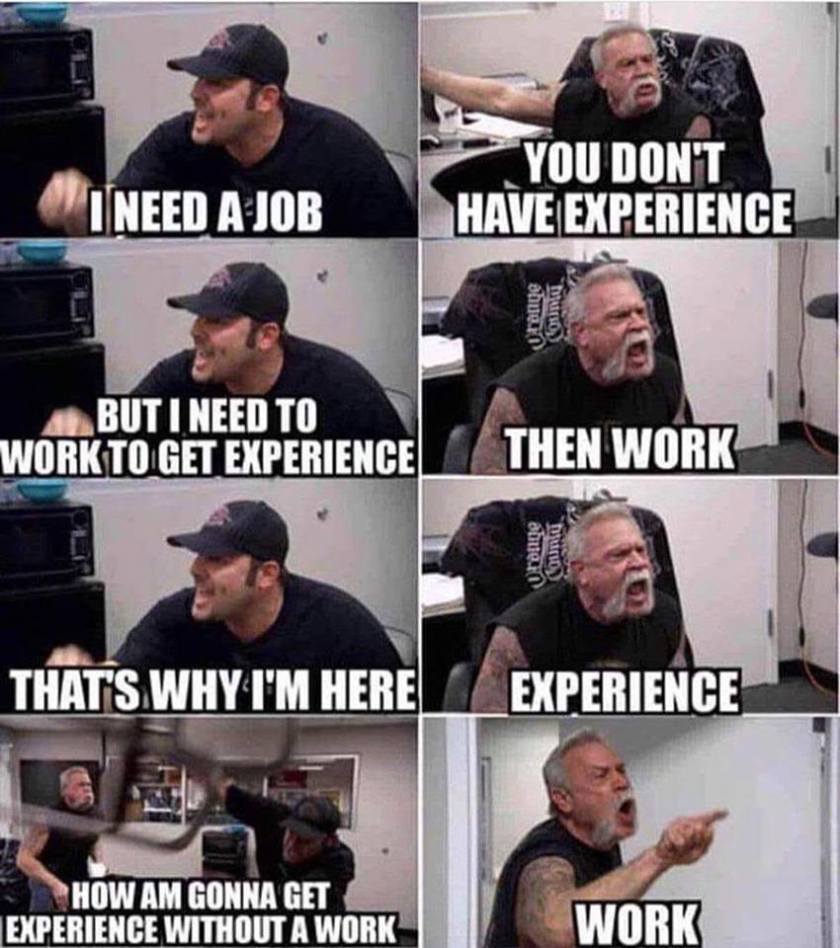
The recruitment process is always an interesting one.  Yet again I found myself falling into some familiar traps, such as the focus on experience – as one of my friends recently posted on Facebook:

40658246_10216739354573802_8419779597029081088_n.jpg

This is particularly troublesome considering my professed belief in the growing importance of values based recruiting and, if I was to follow the logic in my Strengthscope certification, recruiting for strengths.

The thing that really shone through in the process was how varied (and in many ways wonderful) “we”, as an L&D community/profession, are – we had excellent candidates who brought with them a huge variety of experience and personality.  Some candidates had clearly been focused on leadership/management development, some on digital learning, some on establishing learning in organisations whilst some were focused on the delivery or design.  Qualifications to have developed (or certify existing) skills and knowledge varied enormously.  No one had the joy of two learning related masters (like me) but there was a full gambit from masters to, basically, no qualifications.  Arguably ‘we’ don’t do ourselves any favours with this wide church, and it contributes to the idea that anyone can ‘do’ learning so it will be interesting to see what comes of the new apprenticeship standards as a de facto standard:


Thus recruitment can quickly become about apparent personality combined with experience with qualifications (for now at least) reduced in importance (compared to most industries).  This is an issue for me which I’ll post about in my second post on this topic…

Time to stop the snobbery in L&D

L&D departments need to support their organisation in valuable ways.  Simples.

Yet I increasingly feel that the L&D industry takes a snobbish approach to the world of work – far too often talking about what we might actually call ‘knowledge workers’ or, at least, office work.

Yes knowledge work is obviously a large part of the workforce, however, this focus ignores the large numbers of UK PLC working in hospitality, healthcare and other areas where the workplace and workforce are relatively ‘low tech’, ‘low skilled’ (in the traditional graduate workforce kind of sense) and unfortunately often low paid.

Part of the problem seems to be that multiple traditional support departments (IT, KM, L&D and more) all seem to be running for a middle ground around productivity – which is largely as identified by the DWG’s 2018 research agenda:

Digital Workplace Group (DWG) embarks on an exciting research programme to deliver focused insights across both intranet and digital workplace good practice….

1. Collaborating in the digital workplace: how to have and to measure impact
2. Taking a strategic approach to the digital workplace: teams, structures, methods
3. Office 365: a detailed look at the wider suite
4. Digital literacy in the workplace: how to raise the organization’s digital IQ
5. Successful intranet migrations: strategies, approaches, tactics
6. The intelligent DW assistant: what teams need to know now about artificial intelligence
7. Digital workplace trends, themes and statistics: insights from DWG research and benchmarking.

The above list is pretty close to the buzz in L&D circles – at least if you swap out intranet for LMS or other system.  The reality on the ground for L&D professionals – especially in those low paid sectors mentioned above – is instead apprenticeships, post-Brexit skills agenda, basic skill training (even JISC are saving ‘citizen’ resources from closure) and more.  The positive is that at least via mobile, AR and VR we are seeing some practical workplace L&D buzz away from the knowledge workers who are tied to a desk and Outlook.

Yes, digital workplaces exist and many support departments will be made up of digital-first workers (even if their parent market or industry are not).  However, let’s not forget everyone else.

After starting this post I then, when catching up with TJ podcasts, hit upon the Donald Clark interview from Online Educa that really hits many nails on their heads.

Unleash18 London

I took a different approach to Unleash than my normal focus at events – instead of making lots of notes, to  reflect on later and blog from, I tweeted throughout most sessions (each session a different Twitter thread) with a view to save links to the tweets here with a few reflective notes.  All slides from the event are here.

Looking back at the tweets I’ve realised I didn’t stick to my own approach of adding comments in [square brackets] or after >>> marks.  Anyways, hopefully they were some use for the twitterverse and in capturing key points from what, in the most part, were pretty quick fire 20 minute presentations.

The day after Unleash I needed to update a paper that I last updated in April 2017.  My main point in that paper last year was that someone needed to decide on the Digital Employee Experience and what that might look like.  If I take the call of the conference, to be “unleashed”, then deciding and implementing that experience is an action for me…

Day 1

Opening and other MC/intro duties

A tough gig for the always excellent Deborah Frances-White – trying to get a crowd going after long registration and cloak room waiting on day one.  I for one, sans coffee, was far from in the mindset I think the organisers were going for with the very loud, movie trailer start (“Let’s make a better place to work and live…unleash your people”.  As MC for the keynotes DFW mixed some new (to me) content and some of what I have seen used before – for example at LearningPool’16.  I did like the call to “presume inclusion” – i.e. dont wait to be invited or asked to do something, be like a kid at kindergarten: introduce yourself and get involved.

Opening keynote: How do you DISRUPT and Change the World of Work?

Lots of naughty words and pretty controversial ideas from Jonas Kjellberg.

By his own admission people are quick to want to get rid of him but he’s clearly a disruptor who has had a lot of hits (like iCloud and Skype) and misses.

As I tweeted (outside of the above thread) I did love the beaver – i.e. reward people for being willing to take the chainsaw to old ways of doing things:

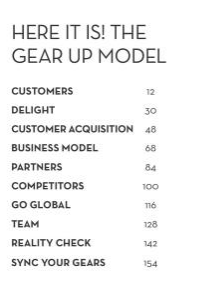
As a way of signifying the disruptive mentality of this role I might well have to have a look at the ‘Gear Up’ book’s approach too:

Gear_Up.PNG

Future of Learning: PA Consulting

Pretty broad content here, which was perhaps deliberate in opening the learning stream (one room) of the conference.  Nothing too earth shattering or revolutionary but a fair summary of current thinking.

I did like the concept of the course > resource > guidance > automation paradigm to explain how automation can fit in:

“Best Practice Evaluation and Transfer of Learning” project at Icon PLC.

A decent example of showing a fairly traditional blended leadership programme could be evaluated.

“Build an Employer Brand in 100 days”

Really energetic presentation this one – I always like when consultants, rather than selling directly, give up some ‘secrets’ from their methodologies – definitely one where the slides are worth picking up.

“Assessing future leaders digitally at Royal Bank of Canada”

Moving from standard psychometric testing in graduate recruitment to a more bespoke assessment.  Overall, sounded good and potential to move it away from the focus on graduate centric approaches to existing staff.  Makes me wonder again what the best way of judging potential is for internal candidates to our own programmes/talent management.

“Empathy in Action”

On reflection, a more challenging session, focusing on the need for workplaces to be more empathetic.  Whilst it’s difficult to argue people should be more empathetic I’d also be tempted that it’s not something that is naturally energising to everyone – as Strengthscope states empathy is a strength where:

“You readily identify with other people’s situations and can see things clearly from their perspective”.

Brexit as an Opportunity for Business

A quick run through of Brexit history, current situation and possible solutions.  As always with this topic there were some things you could agree with and other bits where that was less the case.  Overall it really just highlighted that many things are still up in the air and that overall, from a country-wide workforce perspective, things really have not been managed very well at all.  For a session that was supposed to be the ‘opportunity’ from Brexit it was pretty depressing.

Brexit and GDPR started day two so I skipped for time on the trade show floor although that then did mean lunch on day two dragged a bit.

Day 2

Lloyd’s of London’s “Bigger than the business”

Good example of corporate L&D team offering services to the ‘extended enterprise’ and becoming a profit centre as a result.

“Virtually Learning”

Possibly the best example of VR in workplace learning I’ve seen – a clear productivity gain by moving a practical session from ‘real’ to ‘virtual’.

Mazars U on LinkedIn Learning launch

A session that would be familiar to the library and information world – trying to get external content providers embedded into culture and systems, *spoiler*: it’s tricky.

“It’s our time are we ready”- event close

A deliberately challenging session to finish.  I did comment more on the presentation as it went (below thread).  Overall I’d say digital is pervasive and I agree the ‘waiting for IT’ excuse is growing old, however, whilst I always remember an old conference presentation from BBWorld in the US that said “tech should just work” in reality (as with Mazars above) things are more complicated.  Coming to this conference not from a ‘classic HR’ background probably impacted on my view of the talk of digital, experiences, performance and collaboration – i.e. that a lot of this was really a call to action that could have been made a number of years ago in many ways:

General comments on conference:

The “Unleash” themed seemed to fall a bit flat with the dancing aliens (or whatever they were) and loud music not really getting the crowd going.  Perhaps a cultural thing and the North American crowd, in Vegas, would be more into it than those isolated in the always rather isolated ExCeL?

The event app was good for tracking the agenda but I remain as having two notifications that would not shift during the show even though it shows as having cleared everything.  Really not sure what was going on there – perhaps an issue in using the work iPhone rather than my Android?

Why I’ve changed my mind on award nights

In the past I’ve been quite snobby about award nights in the HR/L&D field.  I’d argued the only real recognition you should need is from your board/c-suite that you are doing a good job.  However, I’m increasingly being won over as award nights for a number of reasons.

My new found enthusiasm includes that (well organised and robust – not like these) awards are one of the few times that we see robust evaluation of L&D.  For example, I was quite shocked to see how Brandon Hall asked the second of the below questions in their “Learning Measurement 2018” survey.  In my opinion the third option may be perfectly valid, i.e. “not all our…initiatives get measured” – this can be perfectly fine as evaluation requires resourcing (like other activities) and the ‘top’ two options wouldn’t necessarily be correct in that context:

thumbnail

Awards are also increasingly important in sharing best practice in what has become a more transient environment – we’re not realistically seeing books or journal articles on good practice but shorter format blogs, tweets, conference presentations, etc where an award can act as a stamp of quality based on people taking the time to be reflective and analytical of their practice.

There is also the bonus that L&D teams can be too often firefighting problems.  Taking the opportunity to reflect, on actually solving a workforce or performance issue, can be a positive benefit in line with the “celebrate achievement” piece of good team building.