An email today alerted me to a new option for easily adding Coursera module completions to your LinkedIn profile:
LinkedIn Coursera Email
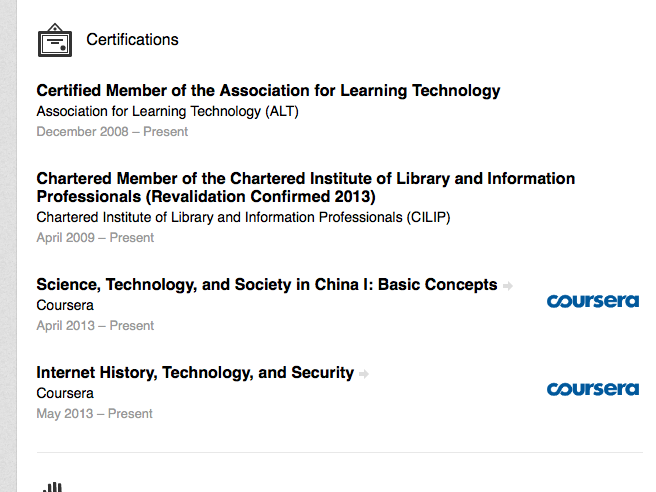
I have complained before about some of LinkedIn’s functionality but I thought I would give it a go. Indeed, I do like LinkedIn for what it has done to transform business communication and have been impressed with the company, not least that they were one of the first to develop cross-platform mobile apps which actually made best use of mobile use cases. Here is what the Coursera content looks like when added to my profile:
Coursera on LinkedIn
A little odd that this seems to be presuming that completion of a Coursera short course is ‘certification’ rather than education, especially when the business model for many contributors is potentially tied to issuing university credits. It also seems odd that when MOOCs are proving the value of short courses (without the disproportion high costs of many short courses) they represent these with individual listings on LinkedIn, I doubt anyone lists every short course they have done. This becomes especially problematic when you think of the full range of informal learning that someone can do, is a Coursera certification more valuable than a Tweet of praise, a positive Slideshare comment, etc?
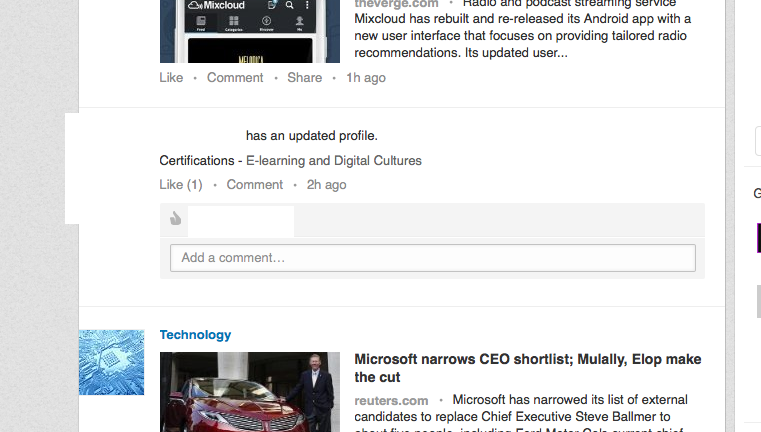
This then makes you think they are likely to be an advertising piece for Coursera. However, thankfully, this does not seem to be the case as they appear as non-descript certifications:
News feed of contact’s Coursera-ing
However, this comes with problems as they seem relatively random updates. Potentially you could appear certified in “Archaeology’s Dirty Little Secrets” without any context.
So, how could they be better? Well Tin Can and/or Open Badges might offer a solution in feeding to LinkedIn selected development activities that you want to present. These could appear in their own section rather than forced into certifications. Indeed the problem I am having with these changes is perhaps that they are leading to ‘scroll of death’ on profiles, would it not be better to link out to a store such as a Tin Can LRS profile, much in the same way you have ‘personal website’ links to allow you to show reflection on your blog?
Presumably Coursera is just the start (or might not be and I just have not realized this already existed) and LinkedIn will be looking to aggregate, in place of Open Badges, work done on other platforms. Overall, a riveting development but another which threatens to put too much information into LinkedIn profiles and create barriers to career-centric conversations.
Last week I was something of an impostor, attending the LearningPool user community’s third and final regional conference of the season.
A dog yesterday
The session I attended on LearningPool itself introduced the organization under their four service offerings:
Content
Off-the-shelf resources, including some customer generated eLearning modules.
Core catalogs are compliance, health & safety and public sector (including health care).
What they develop is based on the customer base (for example they have gained housing sector customers and have responded appropriately).
They also offer customers ebooks, resources, image libraries, etc for their own content.
Authoring tool (moving to online, producing adaptive content, from desktop) to help you build your own eLearning.
Platform
Dynamic Learning Environment (DLE) based on Moodle. Includes some customizations, such as ‘classroom connect’ for booking onto f-2-f environments.
Second solution is based on Totara version of Moodle with more development mapping tools (including user-owned aspirational paths), rather than just a focus on courses, and management tracking dashboards.
Support
Offer first line support to customers’ platform users.
Learning consultants to help you with your designs and blended experiences.
Community
Events such as this one, online communities, sharing of resources, tips, etc.
The event also saw advertising for their new Encore product, a tool for learning reinforcement via mobile application, helping to tackle the forgetting curve.
I have been aware of LearningPool and their services for a while and whilst most of the attendees were from their public sector-centric user base the list of speakers suggested it was worth me attending. This proved the case, with me coming away reinvigorated.
Learning Futures: How new & emerging technologies will impact learning and development
The day started with Steve Wheeler on the ‘developing possibilities’ for future learning. I have seen Steve present a few times before and this was on some similar lines, indeed he even mentioned how his own views and conference presentations have changed over time. The biggest shift in his thinking of late being the role of pervasive tech, the web everywhere, rather than being specifically about ‘mobile’ devices.
The biggest eyebrow raising moment on my desk was when Steve argued that Learning and Development staff can no longer be happy working a 9-5. Now I have mixed feelings on this. In my current role I have been lucky enough to get in and out of the office largely on my contracted terms, this is quite different to my previous role – not least in that I am contracted for 30 minutes a day less anyway. However, whilst this means I am home on good time to entertain my puppy (gratuitous photo included) I am then checking Tweetdeck, attending webinars, reading emails, checking my employer’s social network via the mobile app, etc. This ‘informal’ learning may or may not help my employers directly in the future but will build up my personal abilities in the knowledge economy. I would argue that you need to be flexible but that is for all staff. However, as the recent Dispatches episode showed, you need to be careful in moving toward flexible hours, etc. That said, you have to agree with Steve that, in many ways, you are lucky if you do have a job in the current environment and as such should look to develop yourself to offer a great service in every way possible.
This all said, L&D departments must surely now recognize that their technology enhanced learning solutions must support 24/7 learning. Steve advocated that this is now developing away from just-in-time (JIT) to just-for-me (JFM) via the personalization options afforded by technology, such as augmented reality, with employer supplied learning options just part of an individual’s personal learning network (PLN). Digital literacies will be needed to make best use of this and L&D can help develop staff along an evolutionary path, described as:
skills > competencies > literacies > mastery
Within this changing environment, Open Badges were advocated as the way to support the 70 of 70/20/10 and accredit that development activities and competency developments are actually happening. One term, if not theory, I think was new to me was ipsative assessment – assessing you against your own previous attainment rather than that of others. These assessment methods are useful when dealing with specialists where bench-marking is difficult due to limited numbers/data and is closely associated with some of the ideas around gamification and motivation.
Why does Employee Engagement matter?
I thought the pieces on PLNs and motivation were interesting in light of the following presentation by Dan Hardaker. Dan argued that off-the-shelf surveys, such as those supplied by management consultants and ‘best places to work’ surveys, do not tell the correct picture. What really matters is the combination of engagement, involvement and direction. Using tips from engageforsuccess.org Genesis Housing created quadrants to label staff from their annual staff survey data. These quadrants used deliberately provocative names to foster internal discussions which has helped create a participatory organization and speed up the authoring of policies and agreement on ways forward. Overall, the message was that getting people involved is more important than surveys and other such reports – this is how you get people to ‘offer more of their capability’.
I would agree with much of what Dan said, emotional involvement and a feeling you are making a difference will be key for many staff and opening up decision making will help with this.
Getting the most from your DLE
Andrew Jacobs presented on Lambeth Council’s approach to L&D, now that their team has gone from 7 to 2 with 45% funding cuts. What Andrew presented is not dissimilar to the approach I designed at my previous employer, using your VLE/LMS/DLE for JIT and self service learning. Lambeth now offer no face-to-face training bar some classroom health and safety content, with some synchronous learning via virtual briefings.
Subject Matter Experts (SMEs) are responsible for maintaining their subject on the Moodle pages with links to ebooks, videos, LinkedIn, eLearning, etc as appropriate. Andrew’s team offering fairly minimal support on this. It is then up to the business and those SMEs to determine the success of what is offered in terms of impact on work and what might need to change.
This is not dissimilar to academic environments where the teacher/lecturer will manage the online environment and be supported by learning technologists. Andrew may yet be a trailblazer for bringing this model to a corporate environment, albeit one where the business needs to take responsibility for elements they have previously passed on to a support department. Overall, the approach has brought a culture change where people feel more empowered and the presumption that solution equals ‘course’ has disappeared. Of course, this partly comes down to what a course is – and the corporate presumption that it is ‘classroom training’ is somewhat disparate to the academic which tends to assume some sort of blended learning these days.
Some of the points in this talk raised eyebrows near me again, including:
People can learn what they need via internal networking – external accreditation is facilitating people to leave so your L&D department should not pay for it.
I would say this is partly true but it is an interesting one in light of PLNs and that going forward your career may be based more on an ability to demonstrate prowess in multiple ways across multiple media. However, I would advocate that external training still has a role for bringing in skills to your organization when they are missing, often more economically than hiring an expert or consultant in that area. The problem comes when you encourage someone to develop via an MBA, or similar development activity, only to then not empower them to use that internally.
No training calendar.
Before working in corporate L&D I never realized how big a deal this was, enough said?
Without face-to-face training budgets they have instead given people a set amount of time that they should be seeking out personal development, for example in a public library.
Interesting but I do worry about the future of ‘time tracking’ in organizations and if it is simply unfeasible in the blurred world of learning anytime anywhere. The need to set such guidelines seems to always suggest, to me, that the relationship between staff and their managers is not working. However, it does at least give prominence to the idea of learning in the way Google’s 20% time gave prominence to internal innovation.
The argument was that, overall, we need to be the facilitators of training/learning in an organization, not simply the provider of courses. I asked if Lambeth have a standalone Knowledge Management department, they do not, and I do think their DLE is ultimately being a success partly because it is performing the important task of structuring learning around tacit knowledge. This is a similar chain of thought that led to me previously querying if Corporate Universities are dead.
The web has shown the way. eLearning needs to follow to be relevant
This presentation from the BBC Academy pointed out some of the old problems with eLearning and suggested some ways forward. The presenter argued against the course/LMS centric model and that too much is signed off by L&D/HR rather than the consumers. The point seemed to be to encourage a more open mindset, including breaking the course model to recognize the possibilities of the web (i.e. curating resources).
For what eLearning the BBC does have, an example was shown:
It looked nice
Navigation was standardized across modules for ease of use
Navigation was for discovery not locking progress
Visual elements were used throughout
Design for mobile first
Include onward navigation to web resources
I would hope most people would recognize these are relevant/appropriate, would anyone really disagree? The only point I would perhaps criticize is a ‘mobile first’ approach as what is possible on different devices should be recognized and those different experiences levered in appropriate ways.
Move from course production to products which are improved continuously
Getting out of the Classroom
From the Houses of Parliament ICT training team – talking about shifting support for their 7000 staff from the classroom toward performance support and JIT.
Part of the change has been winning a battle with IT support to break the model of engineers taking calls which were assessed through metrics to one where staff perform floor walks and can immediately go to someone’s desk, having taken a first line call, to help people with what they are trying to do. In my opinion this is a much more suitable approach in a world where everyone has different skill sets and you/they do not know what they do not know – a major problem in the new world at work and one where Grovo and others offer solutions. I am a keen advocate of this, having seen how much help I could be to people in the past when pulling myself away from my desk to offer VLE/LMS support serendipitously. To an extent this is not new, work-shadowing by support teams having been advocated in the past, but is perhaps something which has fallen away as organizations have looked to decrease the relative size of support teams.
This has all been done with the trainers supporting the IT engineers and as such the IT team have found their interpersonal and support skills have improved. Morale has also jumped in that they are now clearly helping people and are seeing the faces at the other end of the line.
This was an interesting point to end on. How much is this a success of personal, in-person, support versus making the IT department more transparent which could have been done via social networking, DLEs and other approaches?
Their IT helpline has been rebranded as ‘customer advice and support’ – answering calls with ‘what can I do for you today?’ The challenge for L&D today is, perhaps, how to make sure that all members of staff think ‘what can I do better today?’ with L&D offering the supporting infrastructure to ensure that can happen.
A number of webinars and blogs have, of late, considered where social media fits within the wider landscape of innovation. Some of the conversations have been fueled by Twitter’s flotation, as one put it, the self-proclaimed town hall/pubic square is becoming a shopping mall, everyone will be there but you will have to pay for a space.
An episode of the Economist podcast called upon the idea of earlier ecosystems for sharing ‘on the wall’, including the impact of previous technologies/resources such as slave labor in Rome, the printing press, etc.
ELESIG’s recent webinar, meanwhile, considered the Internet as the global Coffee House, which were once described as ‘penny universities’ as you could talk with, and learn from, some of the great minds of London. These conversations leading to, amongst other things, the London Stock Exchange.
Overall, as so often, it is useful to learn from history and realise the latest technologies are not the end game. Beyond communicating with other planets, what else might we expect to see which will help foster better collaboration, communication and innovation? Here are some ideas:
Mind controlled/powered computers, ideas captured in real-time.
Better translation, as the web is still being dominated by English-writing power. China and other locations will start to export research and ideas more prominently.
Openness to continue to spread, including (hopefully) participatory ownership (including government).
A 4th and final option might be for the web to become cleverer, for example, if I start to describe an existing theory in a blog post then the system recognizes that and suggests I read the original first. Some systems exist in this area but tend to link blog posts by the terms used, they do not try to minimize the information overload by being clever enough to actually recognize new ideas from old – due to all the difficulties of processing language in that way.
The second LSG webinar this week was unfortunately cut short by technical problems. At the time I was trying to play devil’s advocate in arguing against some of the ideas being put forward. This is unusual for me as I watch lots of webinars but tend to do just that, watch, on Thursday though I felt the need to rock the boat a bit. Why?
Well, I worry sometimes when attending webinars that it all feels a bit like politics. Everyone seems to want to grab an imaginary middle ground. This ‘middle ground’ in the organizational environment being control/involvement in ‘the way forward’ – the current focus of which being around establishing more collaborative, communicative, organizations with silos broken down. My problem is that multiple departments all seem to want to do this in ways based on their traditional areas of responsibility, including:
Learning and development,
Learning technology,
Library/information services,
Knowledge management,
Organizational development,
Corporate strategy,
Information technology,
Internal communications.
How broken down or isolated such departments are, of course, varies enormously by organization. It is perhaps useful to remember that whilst many of these have emerged as specialisms we perhaps could move back toward a shared ideology, using the catch-all of ‘knowledge work’.
I totally agreed with the point made in the LSGwebinar presentation that learning needs to be embedded and recognized throughout an organization. What I disagree with is the idea of Learning and Development professionals having to constantly change. If the organization is well structured and recognizes learning across the 70/20/10 divide then there is, potentially depending on the organization’s needs, a use for traditional ‘courses’. Indeed, combine in-house and external courses and you can lay the groundwork for a workforce’s knowledge and skills. After all, there remain a lot of jobs where you would not want someone to simply go out and work in risky/dangerous environments without foundational courses, even if they need to incorporate, say, 3d simulations. I’ve written before that if L&D are too quick to abandon the ‘training ghetto’ it might do an organization more harm than good whilst the use of ‘Corporate University’ models have given L&D a brand, albeit one based around courses.
One point someone raised with me on the call was that L&D should not just take ‘orders’ of courses but instead challenge the business on what is the appropriate learning solution, not being afraid to say a course is not what is needed. I replied that I would not disagree, but, its also correct to say that a course might be the correct solution. This said, I probably have quite a different take on what a course is compared to some people in L&D roles; I would never advocate, for example, a standalone SCORM course with no resources, reinforcement, reflection or JIT support. Course-centrality can be a working model provided the organization is doing effective communication, knowledge sharing, etc. If that is not happening then, obviously, L&D professionals can help resolve that problem. However, yet if you have a good information service I would not expect the L&D department to go it alone doing lots of curation for learning, if you have good knowledge management systems you would not expect a social Learning Management System to replace it, etc.
Ultimately what I am trying to say is that if you work for a well organized institution you might find that L&D’s role is to manage a curriculum of appropriate interventions, i.e. courses. The trick will be to ensure they are so good that they remain relevant, otherwise L&D may go the role of information services and other departments that have seen outsourcing and redundancies. Yet is wrong to presume ‘the business’ does not do coaching, communication or other elements of the ‘way forward’ well without L&D involvement just because we ‘want in’.
These are notes from the above CILIP in London evening meeting…I was asked to write the event up for the newsletter so thought I might as well post the longer version of my notes here.
Speaker: Nancy Pontika, Repository Manager, Royal Holloway College, University of London
Nancy gave us a taste of life working with scholarly communication repositories, including challenges within the current Open Access (OA) and copyright environment.
She began with a history of the OA movement, starting from the Budapest Open Access Initiative. Whilst OA seems simple at first, being materials available at “no cost to the consumer”, the presentation focused on the complexity that exists in different OA journal models (‘gold’ OA) and the implications for institutional and subject repositories (‘green’ OA).
Much of the talk concentrated on the difficulties in populating repositories. Repository owners are not in a position to perform quality reviews and are, therefore, reliant on the existing journal’s peer-review models. What repository managers can do is ensure their systems correctly implement the available OA metadata harvesting protocols to ensure transparency to search engines and, therefore, avoid the creation of silos.
What repository managers are allowed to deposit depends on copyright. This can be very complex as different publishers have different rules over issues such as the length of the embargo period between publication and deposit, versions of documents that can be deposited (very rarely the formatted PDF of final publication) and the copyright applied (normally publishers desire all rights reserved).
An interesting point from Nancy was that she thinks we need to talk about copyrights not copyright. Such a shift in the language enables easier discussion over which rights a publisher or author seeks to keep. OA advocates have pushed for this so that people can apply the Creative Commons (CC) licence they find appropriate, for example, not opening their work to commercial use. It was argued that in many ways the most important element of CC licences is that, by being machine readable, they allow information to pass between systems including ensuring they comply with Google’s advanced search filters. A template[1] allows researchers to easily set out what they want to maintain in terms of copyrights in digital distribution prior to seeking publication.
There has been hope in the OA community that research funders might help swing the arguments away from continuing subscription based journal models. However, there was disappointment with RCUK who pushed out a gold OA/journal-centric OA policy that depressed the repositories community. Problems with this include that there are not many big OA journals outside of medicine and that it does not give any encouragement to academics to change their practice as career progressions remain based on prestige and, in most subjects, this means subscription journals (including those who ‘double dip’ by also charging the author processing fees). The RCUK providing funding to pay for processing charges but it was not enough to cover the costs. Overall, it was argued that RCUK had left most sides in the process disappointed as this lack of funding is then forcing universities to go down the repositories route while publishers disliked their demands for the CC-BY licence to be applied. HEFCE meanwhile are supporting an OA future for the Research Excellence Framework but with a focus on repositories over journals, complicating matters even further for those seeking funds from RCUK.
The Q&A session following the talk expanded the discussion to consider how repositories can be used beyond peer-reviewed journal articles. There was discussion over the value of repositories hosting learning materials and under/postgraduate research papers, could they be used more as a storage backbone to Virtual Learning Environments with the VLE software adding the collaboration and assessment elements of a course? There was also some discussion around the statistics available from repository platforms, and the resistance to expose these in case it makes repositories or particular academics look underused. The challenges in managing data in place of, or in addition to, text based research papers were also outlined.
As for the future, the message was very much that things will continue to change and there remains scope for further experimentation. Nancy’s personal take being that repository owners ideally need a balance of good OA and subscription journals, but the expense of the latter may not make this feasible. Overall, the talk provided an extensive background to OA and repositories past, present and future. This was timely as, later in the same week, Creative Commons called for further reform to copyright[2]. Slide basis of the presentation available at: http://www.slideshare.net/NancyPontika/cilip-27241430


 Whose Education Is It Anyway?