When I reflected on the winter Learning Technologies event I felt the main message was that Learning and Development professionals, collectively, seemed to be failing. In contrast, the summer event seemed to have a feel of ‘things are getting better’. Certainly, in the case of my own practice, I can say we have been able to have more of the right kinds of conversations internally – much more about appropriate performance support, via a blend of solutions and that these conversations are starting to happen with senior leadership very much engaged.
In the context of the first paragraph, the final session I attended at the Summer Forum, on Learning Leadership, was perhaps of most interest. 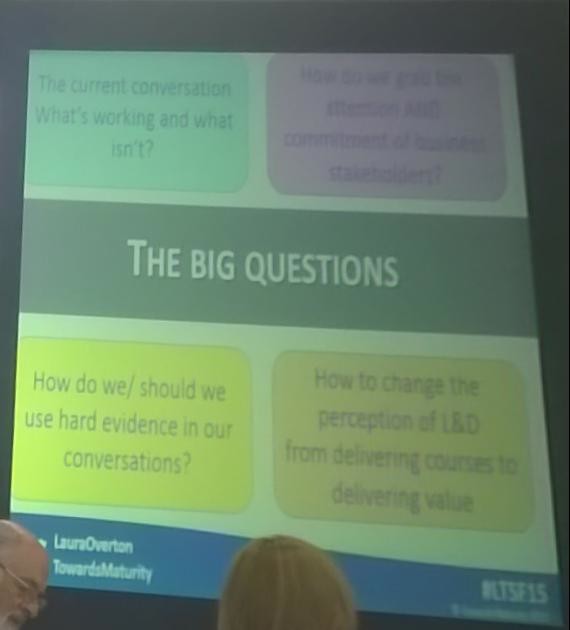 The focus was on practical things we can do to have great conversations, with a vision for the future beyond order taking. Based on the good work of Towards Maturity there was an opportunity to tackle ‘the big questions’ (see pic) via a group workshop to capture some of the crowd’s wisdom. Overall, the message slowly seems to be getting through that you need an evidence based approach, using data to back conversations with the business (which in turn need to be in business, not L&D, language). A point was made that, as we have not read L&D’s postmortem, the doomsayers were wrong, I’d say the key thing here is ‘not right yet’. Things might be getting better there’s undoubtedly a lot still to do for many organizations.
Prior to the above session, the others I attended were:
- Opening Keynote: The Power of Play – Deborah Frances-White. A very invigorating and funny opening keynote. The theme was familiar, as children we play (learning in the process) but we get scared to fail as we get older, but there some fun activities involved which I could try in groups as icebreakers in the future. As the presenter pointed out, play and work can be both be seen as processes – which is appropriate depends on what you are trying to achieve (I particularly liked the idea that you cant ‘work on a relationship’ to save a marriage: you have to re-inject play). The presentation ended with a mass game of rock, paper, scissors – with you told to cheer on who you lost to and then their conquerors, and so on. It was provided as something you could do in your office to inject play and change culture – I wonder how many people have been brave enough to try it since!
- Video for Learning – was made up of two parts, one a video with some tips on technique and equipment. The second an update on where BP have got to with their video usage.
There were two interesting bits in the first section:
- some tips on making sure your mobile phone footage is good quality
- a very good video which managed to capture emotion, including by playing an interview over real footage – rather than just talking heads.
The BP experience is interesting, to me, in how in the in-house video solution has been owned by learning, and allows for user generated content, whilst the team includes people with marketing and journalism backgrounds to ensure the right skills are in place. In other words, the learning team did not wait for someone else to get the platform in place for them (it would seem).
- Mobile Learning – some tips from Telefonica on their experiences. Unlike Qualcomm’s winter presentation that showed an app store with multiple in-house apps, Telefonica have gone down the single app route via CM Group. The app is heavily used but, similar to tools like CampusM in Higher Education, it offers other elements (like bus timetables) so is not ‘learning’ in a pure sense. However, the argument was this is more of what was needed for new graduate hires and had advantages, such as offline access.
Conversations around the event space included a number of topics. There was some concern that eLearning vendors are not really ‘stepping up to the plate’ with some kind of truly engaging paradigm in our new mobile/HTML5 world. I also had some conversations around the continuing value of big library solutions (Skillsoft, Lynda, etc) and if L&D are best to retract to ‘in-house’ and allow people to source other generic things elsewhere, possibly via LinkedIn Lynda subscription (since the event I have had an email from LinkedIn offering a seven day trial for subscription to Lynda so that acquisition seems to be leading to some new models already).

