Reflections on a first trip to Asia – and implications on (Instructional Design) training

The MSc I studied is no longer offered as the awarding university opted against running any further cohorts (declining student numbers against a need to update the content).  This is a shame, in my opinion, as it was about the only course I could find, in the UK at the time, that specifically called out “instructional design” (ID) in its content.  The take on ID was probably different to how the more numerous American ID courses viewed the subject but ID was there nonetheless.

Anyway, due to work I recently found myself in Malaysia – my first ever trip to Asia.  All in all, this was an enjoyable experience.  One very obvious thing in Malaysia was the clear messaging that the distinct ethnic groups in the country should support its “unity”, for example this fountain:


Malaysia three bowl fountainMessage of Malaysian unity

This was particularly interesting as I was there during the week of the Scottish Referendum vote, not to mention the ongoing fragmentation within ethnic and religious groups the world over – not least in Syria and Iraq.

On coming back from Malaysia it was then coincidence to see an article on instructional designer training in that country:

On becoming a civic-minded instructional designer: An ethnographic study of an instructional design experience

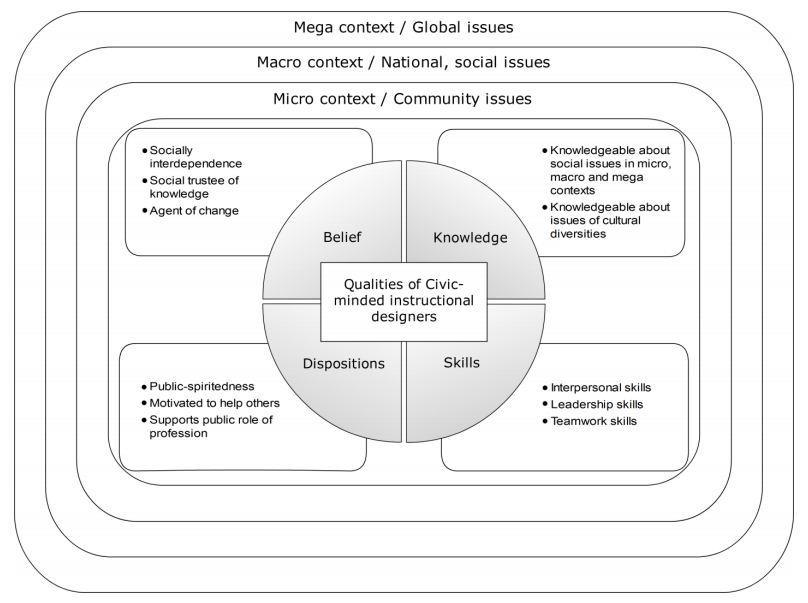
Now the model created in the article:

The civic-minded instructional designers framework
Source: sorry, I seem to have lost the link to the site this was on

could, in many ways, be applicable to any profession/industry.  However, the suggestion of social responsibility for all is, no doubt, missing in most university education.  Would training bankers in such a way have helped avoid previous crashes?

The article suggests a focus on simply technical skills fails to develop designers of the type that are needed.  This made we wonder – perhaps if there was more universal consideration of social responsibility there would be less reason for so many companies to feel the need to train staff into values that cross-borders and get everyone onto ‘the same page’?  My hope would be, from a Learning and Development perspective, that any values or other cultural change program does not ignore the wider environment (as included in the above ID training model).

The conclusion of the article suggests the need for civic responsibility to increase in the balance against the “career-centric and technically orientated” content of most courses.  However, perhaps too much of a shift would have a negative impact on Malaysia in decreasing the technical ability to compete with, say, India in the global ID marketplace?  “The needs of the design industry” perhaps need to be better articulated with more cross border understanding of ID as a concept, after all my UK MSc almost certainly took a different angle to the predominate North American viewpoint.  Here, through ID, is an interesting example of where we could look to benchmark skills globally whilst providing what a society feels it needs locally, regionally and globally (or micro, macro and mega).

Anyway, something of a rambling post but interesting that some of what I could see as an issue for a country in general is quite clearly embedded into the professional conversation of what it means to be a (ID) professional.
The inevitable backlash to ‘curation’

One of the popular terms of the last eighteen months or so, both on the wider web and specifically in L&D circles, has been ‘curation’ – indeed I mentioned it back in August 2013.

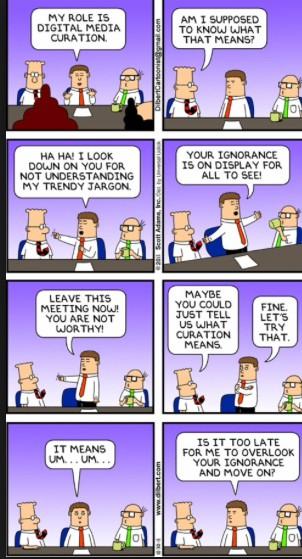
Well, inevitably the backlash has begun:

What does Curation mean?
Source: https://pbs.twimg.com/media/BzPoCRHIIAAQ0mD.jpg

or at least the backlash against people who “don’t get it”.  Ultimately my take on this has not really changed…

Curation is nothing new.

Directories drove the early web until search improved.  We now see ‘live’, largely automated, directories aggregating content on an ongoing basis – albeit at the risk of rehashing old ideas and not moving the conversation forward.  Quality curation is one way to raise, above the noise, genuinely new insight, research, data, etc.

Information skills are essential to any non-automated approach and there would certainly be an argument that where ‘time is money’ some level of automated curation (as part of a personal learning and information system) could be supplemented by people focusing on information management/curation and distribution in your organisation (rather than the potential for duplication of effort, etc by everyone spending time managing their own).  However, I see two major challenges:

  1. Personal network versus “supported learning network”.  The inevitable problem for any kind of internal awareness, communication or learning curation will be that it has already been captured by an individual’s personal system.  For example, a colleague may share something on my team’s internal social tool which I have already engaged with via Twitter.  We have moved past restrictions enforcing only ‘work tools on work time’ so how can we balance this without boring ourselves and our audiences via multiple sharing/discussion streams?
  2. ‘Human touch’ curation capabilities are limited.  The cutbacks of recent decades to information-related teams mean that the focus is more likely to fall on the individual, supported by groups such as internal communications (for distributing key messages) and knowledge/record management (for longer term curation).  I see the recent focus of L&D on curation, to capture quality content and share appropriately as one area where my information background and learning technologies crossover – quality content has been the core reason for libraries and now we are seeing transformation of learning away from ‘our stuff’ to recognizing the value in UGC and integration with 3rd party materials.  Ultimately we would want everyone’s daily work to be built around a single company virtual space which can do everything we might need around learning, sharing, communication, etc.  The challenge is that this system realistically does not exist and, in all probability, existing businesses face fragmentation and silos.

So I would say lets strive to ensure our organizations appropriately curate but recognize it will have failings and is not the solution to every form of learning/content need.

Microsoft publishing redux?

I recently reached out to the ALT-members list to see if anyone had had chance to use OfficeMix:

This followed a tweet which received a reply from Techsmith:

Surprisingly no one on the ALT (Association of Learning Technology) list replied, which might be a sign that MS are struggling to keep UK Higher Education clients (or at least keeping them on the latest versions).  Someone at my work did though say they have tried it and are very impressed.  My main interest is in distribution models considering the potential use for this kind of output in eLearning.

Hot on the heels of all of this is the release of this video on Sway:

I have requested beta access to Sway.  Whatever happens with these two tools, kudos to Microsoft for trying to reimagine publishing – let’s face it, the Word and PowerPoint domination has not been very helpful for creativity in business.  Microsoft’s approach with these tools seems to be to aim for cross-device web accessibility in the publishing (and app based authoring), in contrast to Apple’s app future via iBooks (which is probably the nearest thing?).

Personally I’m more of a web than App fan so I’ll be looking forward to that Sway invite coming through 😉  It will be interesting to see if OfficeMix picks up most use (via the PowerPoint user base) or people can be swayed to a different tool (and Sway will finally be the death knell for Publisher?).

Selling virtual learning – via rap?

I’ve recently been in touch with ON24 about their quite fun webinar advert:

Alas, they chose to concentrate on sales in their rap, hence the suggestion for a learning orientated one.

So can we perhaps come up with something?

Got to be better than the usual way of advertising synchronous virtual learning?

Disclaimer: whilst I have a, guilty secret, soft spot for Epic Rap Battles I'd suggest something with cleaner language.

Why L&D needs to stop thinking “how big is it?” and worry more about “it’s what you do with it that counts”

I pondered previously if ‘Corporate University’ branding was killing Learning and Development departments by keeping their focus on formal learning events or, in other words, the ’10’ of 70/20/10.

A new post from Elliott Masie made me think again.  The “administrative realities” (as he calls them) of CPE requirements, busy calendars, day-to-day work requirements, etc. have contributed to the creation of the webinar/classroom/self-study hybrid he identifies.  However, there have been admin advantages for L&D to keep a less varied service going than, say, what you might see in a coffee shop.  The problem is, more relevantly, that L&D service offerings often appear less varied than what you would see outside of the corporate environment.

MOOCs may have re-exposed workplace professionals to what is happening in the delivery of university, and other, courses.  Unfortunately these have largely been based around video lectures, reading text and discussion boards, again limiting expectations.  The buzz around MOOCs only helps perpetuate the focus on the ‘C’ourse rather than the wider issue of workplace learning (for example as mapped out by Jane Hart here).

A colleague queried recently if classroom learning is ultimately better than self study and webinars due to the loss of attention that can happen with those mediums, i.e. classroom may cost more but is more efficient in the long run.  My response was that an individual’s ability to pick out what is relevant for them should not be underestimated.  Just because we now have video, audio, ebooks, infographics, webinars, virtual classrooms and other media to deliver the messages does not mean that dipping in and out is any worse than when someone would skim read a book or just read the bits they had recommended to them.  Indeed Masie points out that the model of books was influenced more by the economics of publishing than learning outcomes.

The Masie article’s proposed venti/grande model goes some way to solving the problems.  However, we should not forget that a coffee shop can be a disorientating place for the uninitiated.  Even relatively simple menus can be confusing, and if you know your Starbucks terminology you may be out your depth at, for example, Taylor St (been there done that).  In my opinion, the sensible approach to take is for topic-centric construction of learning support (I’m deliberately avoiding ‘module’ there).  In deploying the kind of ideas Masie outlines we need to present it in a way where learning leads from one item/topic to another, not deploying a series of standalone events.  This is about user interface design but, I would argue, this can not be separated from instructional design in the modern age.  For example, a topic (say ‘Leading a Team’) might be:

  1. Self diagnostic quick quiz (help them recognize previous understanding)
  2. Introduction to topic > Advance understanding (increasing complexity around the topic delivered via different media so people can choose how they pick up, this might involve an in-person course if it can be used in a cost effective manner)
  3. Around all of the content covered in 2 add some level of appropriate social/sharing
  4. Around all topics add self-reflection (ePorfolio?)
  5. Coaching elements to support points 3 & 4.

There is, of course, an argument for implementing a structure such as this in a fairly consistent manner to avoid user burn out and confusion.  However, none of the above lends itself to forced sizing purely for the sake of consistency.  The layout of the material to the user can overcome any confusion from a lack of consistent sizing.  This is perfectly possible via the hues of Moodle that are used in corporate environments, not to mention many other Learning Management Systems (or an ecosystem of different online tools one of which may be LMS-like to enable any required tracking).  After all, do you avoid watching YouTube videos because they are not all consistently 5 minutes long?

A LinkedIn contact recently reminded me of one of my old presentations.  Looking back at it, there was a certain suggestion in the model of set numbers of weeks, lectures and seminars – the advantage corporate learning teams have is that this should not have to be the case and we need to realize and enjoy this flexibility.  Masie suggests it can start in K-12 and move through to corporate, I would instead argue that as co-location is not a restriction on L&D (unlike the laws governing most schools) we (learning and development teams) instead have flexibility to contribute to learning organizations.  ‘Schools’ (in their different formats for 4-22 year old formal education) will instead remain learning providers only really fully engaging the learner in a complete learning environment if they move onto teaching as part of a wider masters or PHd program.  Corporate L&D may have been slower than, some in, Higher Education to adopt new ways of learning (via the Web 2.0 movement) but the potential going forward can be greater in having no restriction in how long it takes to achieve a learning outcome – its not the size of the learning intervention/program/model that counts but the ultimate delivered change and outcome.

Overall, let’s embrace the diversity we can offer learners, embed it in an appropriate user interface (which may well not be a traditional LMS/VLE and may well be what most would call Knowledge Management) and make the most of our learning (not worrying about trying to measure size/length).