What every Learning and Development professional needs to know about the International Baccalaureate (IB)

Having just recently started to work on IB programmes I have been really impressed, from a learning design perspective, with the intentions of the IB Middle Years (UK equivalent up-to GCSE) and Diploma (UK 6th form/A-Levels) qualifications.

A lot of what I have found interesting I’m going to share here – particularly for a Learning and Development (L&D) audience – as the growth of the IB has not really been recognised in my experience of the L&D profession. This might be as the IB has been historically ‘niche’ and for wealthy children in certain hubs of international business. However, there has been considerable growth in IB Schools since the year 2000 (see these slides for example). As these programmes grow in popularity (which is likely to continue with increasing globalisation) there will be potential implications in how we (companies and particularly L&D teams) encourage people to develop in the workplace…

Some Background:

IB mission statement

The International Baccalaureate aims to develop inquiring, knowledgeable and caring young people who help to create a better and more peaceful world through intercultural understanding and respect.

To this end the organization works with schools, governments and international organizations to develop challenging programmes of international education and rigorous assessment.

These programmes encourage students across the world to become active, compassionate and lifelong learners who understand that other people, with their differences, can also be right.

The IB Learner Profile

The IB includes a ‘learner profile’, akin to the kind of attribute/value set most L&D teams will be reinforcing at organisational levels. The profile aims to develop learners who are:

  • Inquirers
  • Knowledgeable
  • Thinkers
  • Communicators
  • Principled
  • Open-minded
  • Caring
  • Risk-takers
  • Balanced
  • Reflective

Approaches to teaching and learning (ATL)

Perhaps more directly related to learning (and development) are the ATL. These are quite complex and have become increasingly important of late (see this blog for more). In many ways the ATL and learner profile encourage the kind of reflection and self-directed, lifelong, learning that L&D teams have long pushed for. The challenge for IB teachers with the ATL can seem similar to concerns L&D has faced, as Dianne McKenzie puts it on that blog post:

Why is…[embedding the ATL] such a hard thing? Is it because it has never been a priority? Is it because content has been king, with good pedagogy and skills coming in as the poor cousin?

http://librarygrits.blogspot.com/2015/05/repackaging-skills.html

As well as my previous experience in workplace learning these issues also ring a lot of bells for those who work in higher education. Indeed skills over content was a focus of an undergraduate module I supported and presented on a while back – yet Higher Education continues to be criticised as not fit for purpose by employers and other groups.

Similarly the Ways of Knowing and wider Theory of Knowledge attempts to install what feels like a detailed consideration of learning in students (and their educators):

language
sense perception
emotion
reason
imagination
faith
intuition
memory

Ways of Knowing

At what stage to develop all of this?

Personally, I suspect I’m not alone in getting to some of this level of self-understanding (around attributes like those in the learner profile) later than the IB age range at university and beyond. Indeed a recent alumni newsletter from one of my universities summed this up nicely:

My time at university taught me that your rewards are directly proportional to the effort you put in during your studies…
have a commitment to lifelong learning – never stop reading and actively keep up-to-date with your industry, following any changes and innovations.

Richard Robinson … Managing Director of holiday villa specialist, Sun-hat Villas & Resorts

The suggestion from the IB would seem to be that successful programmes would bring this through to school levels.

Therefore as well as L&D teams, university instructional design would do well to treat IB undergrads differently. The extensive Extended Essay research project of the diploma, for example, teaches many of the skills that libraries and universities spend time on in the first year of study.

So what might IB graduates expect of L&D teams?

If IB graduates are truly reflective, they should soon realise that ‘learning is work and work is learning’. So how might the IB graduates of the future understand the role of L&D if they are (even more than people in the past) used to managing their own learning?

Well, the IB’s definition of the school library is not far removed from L&D’s desire to shift to multi-modal facilitation of performance improvement:

The IB definition of a library is designed to focus on maximising its effectiveness: “Libraries” are combinations of people, places, collections and services that aid and extend learning and teaching.

Ideal libraries: A guide for schools (International Baccalaureate)

Indeed the role of the IB library is to support many areas that L&D professionals talk about for the workplace:

1. Curating

2. Caretaking

3. Catalyzing

4. Connecting

5. Co-creating

6. Challenging

7. +1 Catering

Six practices that energize learning and inquiry, and one that tends not to (from ‘Ideal libraries’).

All of the above will sound similar to the role L&D performs in many organisations, or at least try to carve out for themselves. Indeed the +1 to avoid (Catering) relates to just doing what the organisation wishes – or the classic, much maligned, L&D ‘order taker’.

The IB programmes also encourage inquiry within students in a number of ways that L&D pros often discuss as things they try to facilitate (with mixed success) in adults:

Social and emotional learning: relating to the growth and personal development of learners, and by extension the school community.

Service learning: relating to the knowledge and wisdom gained through serving the community.

Experiential learning: relating to what is learned through experience, experimentation, and reflection upon both (specific to the Diploma Programme [DP]).

Play: relating to the use of different forms of play and games, and reflection on the process and outcomes of them (specific to the Primary Years Programme [PYP]).

Ideal libraries (again).

With regards to the above, the IB’s Ideal Libraries report considers the resource centre as a form of conduit for learning, relating to the above forms of learning in addition to the dreaded (in some L&D circles) c-word – no, not that one…this:

Curriculum: relating directly to the content teachers are responsible to facilitate, and for students to learn. Research is a form of inquiry, and commonly associated with the curriculum.

Ideal libraries (again).

Therefore, an IB graduate might actually be more demanding of L&D than a ‘traditional’ school/university graduate as they are used to personalised support and facilitation of their own development from others (primarily teachers and ‘librarians’) whilst exposed directly to learning theory and concepts in ways others may not have been.


Learning and libraries: Will efforts to change always be Sisyphean?

A while back I tweeted challenging a view that L&D teams are still behind modern learner expectations:

Transformation is difficult in this world. For example, the need for libraries to be more open and engage with their communities exists – but a recent high-profile example shows the challenges. Whilst libraries may want to transform, do the users really want it? If the ‘customer’ does not want change then why are they trying it in the first place?

Here learning support services (such as L&D and library teams) have the challenge of trying to do what they think best versus non-domain expert/customer expectations. This is perhaps an effort that is so difficult, but needed, we have to recognise it is Sisyphean to some extent. One suspects it is an issue for all support staff? For example data protection pros slowly trying to improve practice, IT pros trying to get people to use tech better, etc. ??

Some reflections on learning from recent weeks in a new role

Not working directly in a workplace L&D team for a little while has been nice in some ways.

It has allowed me to reflect once more on the nature of learning and what we are trying to achieve via investments in ‘workplace learning’ teams and initiatives.

This time has only reinforced in mind the reality that everyone at work is learning, all the time.  Those of us who might consider ourselves as ‘learning pros’ are really only able to support this through appropriate infrastructures/scaffolds, interventions, etc.  At the same time trying to ensure, from an employee engagement perspective, that people feel valued and supported.

As I am working in formal education again (albeit now in the 2-18 age range which is mostly new to me) I’ve also gained new insights into what we really mean by ‘learning’, ‘performance improvement’, etc.  It is also clearer to me than ever that the idea school teachers are educators stuck in didactic formal learning (sage on stage/chalk n talk type stuff stymied from change) couldn’t be further from the truth.  This, in part, reinforces my old view about how stuck-up/presumptive a lot of the L&D industry’s focus is.  It also makes the case for more interaction between schools, colleges/universities and workplaces to better leverage technology and better understand what we are all trying to achieve (or “business needs to stop complaining about talent and do more with schools and apprenticeships” as I’ve put it in the past).

More thoughts will no doubt come out of these experiences in coming weeks – first up is a feeling…

Corporate change and the hamster wheel

…A feeling that workplace learning conversations, continue to be stuck like a hamster on a wheel.  This has been triggered by seeing some of the old workplace learning arguments coming up once again on social media in recent weeks and also from a quick flick through of “Beyond Knowledge Management: Dialogue, creativity and the corporate curriculum” which I’ve recently picked up (Bob Garvey and Bill Williamson, 2002 – BKM from here on).

BKM’s forward (by Rosemary Harrison) suggests the book is a “response to…turbulent competitive conditions” and considers/suggests how to tackle this via “the competencies and ethical issues involved in working in a continuous learning environment”.  Here we effectively see the L&D staple of VUCA vs the need for learning organisations to tackle such uncertainty and continuous change.  The point though is that this is from 2002, before VUCA became the standard descriptor.  Consider that with another recent excerpt I got from a book:

href=”https://twitter.com/iangardnergb/status/1092430958437883904″

The answer to the question in the tweet is 1975

The Hawleys were talking about the growing volume of media in the ’70s (TV, magazines, newspapers, etc.) but I thought the quote clearly felt contemporary in the ‘information overload due to the Internet’ era. 

Overall these examples show that, for decades, we’ve been talking about the same issues and really wasting effort in tackling them.  Another recent-ish tweet of mine considered how Mad Men picked up on this in showing that whilst some things have clearly changed, although in areas like racism perhaps not as much as we’d like to think, there are other aspects where the same conversations are happening ad nauseam.  The specific example in my tweet being the rise of the machines:

https://twitter.com/iangardnergb/status/1089955996607434752

That issue being particularly appropriate given that AI, automation and associated technologies are very much the vogue topics in 2019.

The difference in BKM’s title to the more modern conversations would perhaps be that the “corporate curriculum” has come and gone in preference to learning ‘in the workflow’ via increasingly bitesize and flexible provision.  That said, I can consider my own personal experiences in the interim years with global curriculum management (2012-2015) and redefining a UK learning curriculum from local practice to national and accredited (2016-2018).  Compare those six years to someone delivering a traditional curriculum, for example, a traditional ‘trainer’ doing the rounds and you hit the classic of “doing the same thing for six years is one year’s experience versus doing different things for six years is six years’ experience”.  Thus, we hit another L&D trap – an assumption that ‘in workflow’ is the way to go rather than more formalized approaches.  This is in part the snobbery I mentioned previously where white-collar knowledge work is all anyone does (to be fair, BKM is specifically considering issues stemming from the rise of knowledge workers).

Working in a school I’ve already made the point multiple times to pupils that time is the commodity they do not realize is most important.  They will come to realise this in the workplace, of course, but supporting the international baccalaureate is an eyeopener in the specific focus on what we mean by knowledge/learning and what the profile of a learner looks like.  I’d be tempted to say every L&D professional should familiarize themselves with this as, if you are hiring IB graduates, you should have a very different breed of new-hire than if not.  Certainly different than I was at 18 and probably still so after the extra academic skills and instruction of university to 21 and travel/reflection to 22.

So what about dealing with that VUCA world?  Well it was interesting to see the 20th anniversary comments on Office Space (http://www.bbc.com/capital/story/20190205-office-space-turns-20-how-the-film-changed-work) and the “Is this good for the company?” culture of the 90s versus the employee wellbeing and engagement culture that is increasing the case today.

One thing where we can be happy to stay on the wheel is in agreeing that learning is continuous, good for the organisation and good for the organisation’s people.

What is the point of charity regulation?

With food banks on the rise, government cutbacks and a general malaise in society over issues such as Brexit the ‘third sector’ is becoming more and more important.

There have of course been long running concerns with charities – not least the links with government and the headlines over excessive executive pay. However, I’ve always presumed they are reasonably reliable given the process of having to apply to become one seemingly being fairly robust.

A bad recent experience

I’ve recently had my first really bad experience with a charity so thought I would capture it here…particularly as they seem free to act as they wish.

What happened…

I recently had a call from an organisation that claimed to be a charity. This quickly escalated into a very aggressive phone call, well beyond how cold-callers tend to just give up on you or repeat a script until you have to hangup.

Regulation failure

Due to my surprise at this experience I took to the Charity Commission website to report this. Long story short, I was told “It might be helpful if I explain that we are the regulator of charities and not a complaints ombudsman.” Patronising and not helpful in equal measure.

Surely a regulator needs to be aware of misuse? Even if just to track if any charity number is repeatedly being accused of aggressive behaviour.

Their advice was even worse…

I advise you to go back to the organisation and complain directly to them.

RAU Gateway Team [and, no, it did not explain on the email what RAU means]

This would be the same organisation that I’ve told you cold-called me, on my work mobile number, and that I already complained to them about their practice. They were aggressive when I queried how they got the phone number they used and how they can be selling debt management services. This doesn’t even go into the ethics of the above quoted response – what, for example, if you were telling someone with dementia or other mental health issues to contact an organisation that has already acted aggressively to them via unsolicited communication.

This seems a complete failure of a regulator whose Risk Framework fails to identify the level of risk to other charities being aggressive, acting as a cover for cold-calling and hard-selling services (such as debt management). This seems to be a risk to genuine charities in the way ‘chugging’ damaged views of the sector. Ultimately this appears to be an example of regulation failing the public, I specifically pointed out I was reporting this in case there are others doing the same about the charity yet this seems to have been ignored – despite the framework full text stating they will “use data and information effectively to identify risk and to pursue abuse of charity”.

Overall, there seems to be a disconnect between reputational risk and the process controls in place.

The often ignored realities of talent management (#4): A little bit of appreciation can go a long way

Employee engagement remains a key issue in business discussions and literature. It has even combined with other trends/buzzwords – such as in a blockchain solutions for dealing with disengagement.

I’ve been lucky to have line managers who have been very supportive of my career but that feedback rarely goes beyond the one-to-one relationship. Indeed our traditional 360 and other feedback mechanisms, usually tied to annual review, have often over complicated these arrangements. Such issues have encouraged me in the past to look at simpler solutions, like Rypple. Therefore, I thought I would give a shout out to my new employer and the ‘staff shout out’ wall – where anyone can stick up a post-it with a message to the team, thanks to a team member, etc.

A simple and really nice idea.

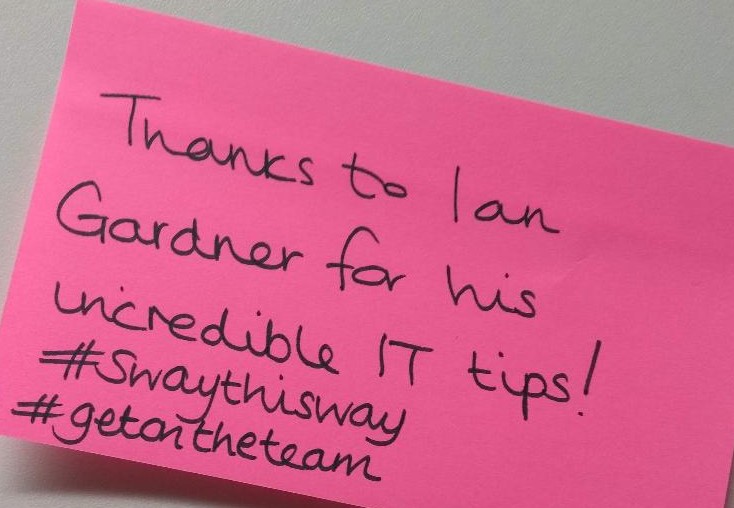
Also nice to pick up some thanks for some of the IT support I’ve been giving in my first few weeks:

One of the many problems with Office365 is people need time to take a look at it and be aware of some of the options – so great to be facilitating some productivity improvements through Sway and Teams!