It has been a little while since I’ve engaged at all with a MOOC. I continue to sign up for the odd one but having moved into a house which is now proving a ‘money pit‘ my spare time has largely been taken up with cleaning, worrying about money and general panic about the years of work we’re facing.
This has been educational in itself – full building surveys are there for a reason, do not buy houses based purely on character, garden sheds are difficult/impossible to fix, foxes are very similar to dogs, etc etc but I am trying to get back into further personal development (including the recent splurge of posts here).
Anyway, the WFE MOOC seems to have picked up a bit of traction with people I follow online and whilst I largely ignored Week 1, the activities for week 2 are a bit more interesting:
1 – the discussion task
Offer an example of someone who is considered to be intelligent or gifted BUT who has had to be an expert learner. Tell us something about that person (they could be real, someone you know well, or a celebrity or fictional character). Outline why you think they are a “good” learner. THEN choose two posts from the discussion forum (not your own) and post a response to them: why do you think their learner is a good example: what does it tell us about intelligence and learning? Please read our forum posting policies before posting or starting a new thread.
Now I find this task description a little complicated, the need to use BUT and THEN in the way they have kind of highlights that there could/should have at least been use of bullets to better set out the instruction. From one of the staff replies, to someone seeking clarification, there is also something clearly missing in the above description:
“The idea is to consider the learning process of people who are considered to be gifted or intelligent.
There are examples of people who are highly successful who were even at some point in their life considered to have learning or other difficulties, overcoming this by developing expert learner skills
A little reading up on people who you consider to be particularly intelligent or gifted might give you some ideas. (musicians, businesspeople, scientists, nobel prize winners etc)”
There is a clear difference here between identifying a good learner (lets say Napoleon as an example of someone who studied hard at military school and quickly learned on the job afterwards) against someone who has overcome a learning or other difficult by becoming an expert learner (Stephen Hawking type examples here I guess or the business leaders for whom ‘school didn’t work’ only for them to still be a success and find out later that they had severe dyslexia or something similar).
This all highlighting one problem of running a MOOC – that you open yourself up to a world of nitpicking!
2 – the reflection activity
During your own education, how has your “intelligence” been assessed?
How has this affected the educational opportunities you have been given?
What judgments have people made about you that have been affected by an assessment of your “intelligence”?
Do you consider yourself to be a “learner”? why
Personally I would say all animals are learners, in incremental ways we change our behavior continuously from dealing with basic needs, such as sourcing food, to highly technical skill development. The education system typically assesses our recollection of information (exams) or ability to research, analyse and articulate (essays/vivas). Recollection can be more complex, for example in Mathematics, but rarely would my formal education have assessed in more detailed ways. Few opportunities were given for more detailed investigation, coursework in practical subjects at school would have at least combined physical skills with mental activities. Intelligence can of course be judged in many ways, Howard Gardner etc etc, but as the image in course menu suggested, we revert to ‘clever’, ‘brainy’, ‘smart’ and many negative options too. Ultimately we will all learn but combinations of our neurology, previous experiences and environment will impact what this means in reality.
I have often seen adverts for potentially useful LIKE (London Information & Knowledge Exchange) events without being able to go. However, last week, I made it to one – the main presentation from the BrilliantNoise digital agency:
The evening mixed presentation about the 6Ps (using the above slides) with participant groups (organised via seating by what food people had ordered in advance – which worked as quite an effective way to get people to mix) thinking about the 6Ps in relation to their work in a way similar to what BrilliantNoise would do with clients in a 2-day workshop. This was tailored somewhat to the audience, with the presenter not going into specific areas in too much detail, especially items such as taxonomies where she recognized the audience probably held expert level understanding already. The appendix in the slides is the handout we worked through.
I felt I somewhat took over my group’s conversations and we tended to start our discussions with considering content in terms of my department’s work. However, we did get a mix of views and others in the group elaborated on their experiences (mostly in law and accountancy firms) in regards to handling training materials and other content via intranets, content management systems, etc.
I found the 6P model a sensible one, recognizing many of its considerations from how I have worked in the past. Indeed I may articulate these more explicitly when considering ‘Content Strategy’ type work in the future.
The notes I made, to add detail to the above slides, included:
Purpose: Why the content exists, this can match your overall business goal. [This depends on the purpose of your team and how niche it is in the organization?]
Principles: examples include gov.uk’s “10 Needs” [I think this was talking about these from gov.uk]. Mentioned work with Nokia on their social media strategy, key outcome principle was “consider social opportunity in everything we do”. Argued these should be high level with support of detailed style guides, etc. Issue identified in the room was compliance and that getting people to follow principles and processes often proves impossible. You should also consider how you work in existing company principles, values and other issues.
Platforms: included a mention for wikis, Yammer and Diigo (the latter apparently used by a lot of their clients). There was discussion in the room around corporate buy in to Microsoft products versus the productivity people have found via use of Web2 tech. However, whilst the criticism of Office, SharePoint and CMS systems was predictable it was good to hear the point that ‘amplifying’ content is more than just Facebook and Twitter. It was also acknowledged that content work is too often led by platforms with the tools leading the strategy [same could be said for Learning Management Systems, Authoring Tools, etc].
Processes: these need to be clear, including who needs to be involved at the different stages. It was argued that this is key for ROI and that you should not view in-house authoring/content as ‘free’. The group activity again highlighted that, like with principles, whilst things can be clearly set out there remains the tendency for other priorities to overcome work, such as client work meaning people are not available [i.e. “everyone is too busy syndrome”].
People: who is going to be involved, for example, who will be the editors, etc. Suggestion was that there is no set way of doing things as team roles in relation to content really vary by how the individual business works. Chief Content Officers are emerging as another c-level acronym, for example, at The Telegraph group. The logic behind such roles being to encourage people to look beyond traditional editorial duties now that we are working in digital domains. Challenges were identified in the room, including the silos created by different departments and how to tackle ‘enthusiasm’ where you need to find balance between a free for all of creation by proactive staff against too rigid a structure of control. Finally, on this point, there was some discussion as to what ‘decency’ means internally with one person in the room telling a story about internal plagiarism of research and how you might need to ensure that recognition of original authorship/research is included in your content policies.
Performance: is not just about page views, ‘likes’ and shares [mention for Forrester’s Engagement Framework (slide 31)]. Research has shown social media sharers often do not read the whole article or even spend much time on the page. Instead you should try and seek feedback and intervention is key, if something is not being used then you need to think “why?”. There was a nod here to making people more digitally literate and if content is not being used if there is a need for the author to attend some kind of training. Benchmarks are difficult, you really need to base them on your hopes and expectations as well as what people have done in the past.
All in all it was an interesting evening [even though I had to leave soon after the main talk finished] and the 6P model is certainly something I will try to keep in mind going forward for making the key considerations, in many areas beyond content too, more explicit.
As predicted, there was much interest in multi-device learning and this seemed to have replaced previous conversations, such as Apps versus HTML5 browser, etc. as mobile learning evolves. The challenge now seems to be to decide if you want a SaaS authoring tool (such as GoMo), a local desktop application or a hybrid model. The functionality gap between the SaaS and desktop is decreasing so the issue then becomes more about your workflows (for example if you want collaborative authoring etc). Cm-Group’s Luminosity is an interesting middle ground with the Studio tool offering rapid authoring and a cloud file storage allowing for collaborative authoring but with appropriate locking of files, etc.
There was not too much in the way of new stalls, with the usual split between big systems doing multiple things (such as Cornerstone), smaller specific systems (such as SpiderGap in the 360 feedback space), eLearning providers and classroom/skills training providers. One new stall was KPMG Learning Academy’s showing the ability of big organizations to try and leverage their existing expertise into providing services in the space. Another area where there seemed to be an increase in stalls was with iTunes-esque aggregators for people to sell eLearning and other materials via single sources, such as opensesame.com. In a related space, I was slightly surprised to not see more of re-emergence for IT Training considering the implications of Windows 8, new versions of Office, etc.
Similarly the talks I attended were largely updates on the on-going evolution of tools and ideas, rough notes below:
User generated content part of people’s persona and online personality whereas people are turned off by business systems as they don’t appear as relevant, easy-to-use, etc.
Budgets help but big IT can go wrong – especially if designed around tech not user. Need to be more Netflix and less Healthcare.gov.
Get better by developing a deep understanding of your audience.
Should communicate purpose at every point, for example, Facebook does not offer you a blank space, it asks ‘whats on your mind’.
Make users understand benefits, seek to innovate experiences around familiar conventions, spot engagement trends and always follow policy of continuous testing using real user input.
Push your communication to users, do this by use of notifications, etc. with a call to act. It should not be about revisiting a website constantly, you don’t want to be ‘another place people have to visit.
Take inspiration from emerging trends, for example, MindMeld helps engagement through suggested content.
Can we learn from curation techniques of social media? They are designed around the moment, different to how it is used in workplace. Need clear objective, what should go in and out? What trying to achieve?
Brightwave took this on to think about user experience:
Learning tech has been developing rapidly, for example Tin Can.
People don’t tend to want to go to LMS, TC offer new approach via capturing informal – Tesselo built around this concept.
Capture TC learning experiences via apps (for example scan book or QR code to record) and bookmarklet. Don’t have to be on website to capture learning.
Then drive social through sharing and communication.
Curator role is SME to pick best resources from social feeds to turn learning experience into resource.
But what about motivation? Working in Open Badges (‘allow you to show off outside’) and reputation points for internal recognition.
Encourage a circle of activity: collaborate, share, currate and motivation.
How can social learning work with LMS? Pick out best of LMS content into social (Tesselo does inc Scorm but is a SSO back to LMS too). (beyond any use of badges – interesting badges mentioned before this?)
KPMG on deploying successful social media:
Talking about PEN – partner development program. PEN online launched as social media via Tessello.
Change management has recently become much bigger part of business. Interest in change management really came from VC project, treated as IT project but didn’t really work out. So wanted to improve this project – business requirements, vision, support, behaviours and success criteria.
Key to success was clear business requirements before going out to vendor.
Vision very succient and clear to what wanted to do.
To overcome faculty resistance – gatecrashed faculty day, keep them in the platform, support the supporters step-by-step.
Also need to train IT helpdesks, especially to avoid signin problems.
Behaviours – know what you want them to do, role model behaviours for sharing, etc.
In the end, users were ‘overengaged’! Actually succeeded criteria.
Group of seniors so were allowed to go off and use it, good level of engagement but ultimately a small group and had support of faculty. Also did ensure people had agreed to social media guidelines before hand.
eLearning authoring tool that has come out of Epic, spin out company but still default tool Epic use when building content for customers. Looks to have evolved nicely and worked smoother than when I have seen demos previously.
Based around responsive content: auto scaling, auto ammend menus to page, etc. Need to think about layout design differently for multidevice. There approach is to think about column layouts.
Cloud based SaS – no software for collaborative authoring, includes locking of content and content reviews for team-based authoring. Includes standard eLearning functionality like drag and drop activities.
Can create corporate theme for colour schemes and branding, etc. However, showed how easy it can be to tweak fonts, colorpickers, etc. as needed.
Multiview previews built in. Don’t have to deploy to devices for testing. All HTML5 but can also be packaged as native apps.
Can choose between vertical and horizontal sliders/scroll for paging. If in phone can have horizontal scroll combine with down (“sensible scrolling” – set restriction on how long scroll will last to avoid ‘scroll of death’).
eLearning authoring tool that has come out of Epic, spin out company but still default tool Epic use when building content for customers. Looks to have evolved nicely and worked smoother than when I have seen demos previously.
Based around responsive content: auto scaling, auto ammend menus to page, etc. Need to think about layout design differently for multidevice. There approach is to think about column layouts.
Cloud based SaS – no software for collaborative authoring, includes locking of content and content reviews for team-based authoring. Includes standard eLearning functionality like drag and drop activities.
Can create corporate theme for colour schemes and branding, etc. However, showed how easy it can be to tweak fonts, colorpickers, etc. as needed.
Multiview previews built in. Don’t have to deploy to devices for testing. All HTML5 but can also be packaged as native apps.
Can choose between vertical and horizontal sliders/scroll for paging. If in phone can have horizontal scroll combine with down (“sensible scrolling” – set restriction on how long scroll will last to avoid ‘scroll of death’).
Is your learning strategy aligned to your business needs? How learning impacts all your business? Learning worked throughout workflows?
Business environment more complex than ever: Increased regulation, more global, doing more with less, war for talent so retention is key.
What business critical issues related to learning? Need to identify, pull out and highlight. If fail can lead to business failures, bad PR, etc.
Learning tech must do more than automate. Need just-in-time, real time collab with experts, targeted for career development, etc.
Context key, like how Facebook (one of their clients) targets adverts and other material to you. Mobile isn’t future, its context. For example, pervasive learning including SumTotal learning embedded through Salesforce and retail platform.
Key argument: context and pervasive. BYOD helps with pervasive, access learning from top of telegraph poll to a meeting room. Snippets of content, rather than length courses, help ‘integrated learning’ this is critical if it drives performance.
Examples where this can work – quicker onboarding, link learning to development, learning to career plans, improve social/informal learning, succession based planning (identify risks of person losing and where training need would come), drive compensation incentives for learning (completed courses drive compensation), single record for all learners (one place for complete view, HR, payrol, learning, etc).
Followed on from a session last year, how mobile has moved on as it is no longer hype:
Only about 30% of audience doing mobile learning when asked, presenter was surprised not more (Towards Maturity suggests has been bigger adoption in general).
Two examples shown:
O2, had lot of old eLearning, looked to migrate. But BYOD so not onesize fits all. Flash to html5 wasn’t good enough as still inconsistent outputs. Instead building much more detailed specification to try and ensure consistency. Motivation to do it was that staff expected to be access things on mobile and expect it to work.
Kaplan Financial Mobile app. Support 30,000 students – 67% said wanted material to be available, downloaded, on device. Students are presented with material related to course they’ve paid for. Included flash cards for learning reinforcement, key topic video clips and quiz practice. Have had 6500 downloads from 50 countries.
Best practice tips:
Delivering eLearning via mobile or developing mobile learning (impact on content design)?
Keep it simple (ensure cross device usability – inc swipe functionality over use of buttons).
Design for multiple device (responsive).
Mobile friendly media (video increasingly so but remember formats and file sizes).
Repurposing existing eLearning:
Think about what actually works for mobile.
Aspects like shelf life and business case matter: don’t just shrink rethink; interactions need redesign? Do you need to rewrite the text?
The future:
More and more tablets
Video (inc 4G)
Mobile features (enhanced devices to take advantage of)
Content creation tools on mobile.
Argued that generational changes are impacting how we need to use learning to retain younger staff (especially as LinkedIn has made it very easy to jump ship).
An LMS used to work, but they do not work for our organizations or us now. We are all generation C(onnected).
How move from top-down to Just-In-Time, but global, where everyone is different? Can we make sure there is no ‘skills gap’ anywhere, no matter what people doing or where on earth they are doing it? Yes, technology can help by coming in as social tool for a global audience.
Move from being about learning management system to technology being the backbone of a learning organization.
Argued most of us are generalists – less SMEs as can find what we need rather than being font of all knowledge on specific things.
Prescribed/push content is valid but in learner-centric, learning organization, want them to absorb learning, i.e. be free to pull learning that is available.
Forgetting curve shows classroom doesn’t work. Need to think longer term, learning as just part of work processes, seamless to working life.
BUT admit this idea of learning organization is not easy to create.
Argued against Tin Can as it is not important to track informal – allow people to be free and play. Focus should be on sewing together learning activities and work to form true blended learning.
L&D cant try and do everything, has to be shared ownership amongst everyone (especially managers and experts)
LMS has never been a place people live, they use different systems. So you need ‘invisible jacket’ of learning across workplace.
Move from managing learning to delivering experience: learning experience system, a new approach they have built out in last year.
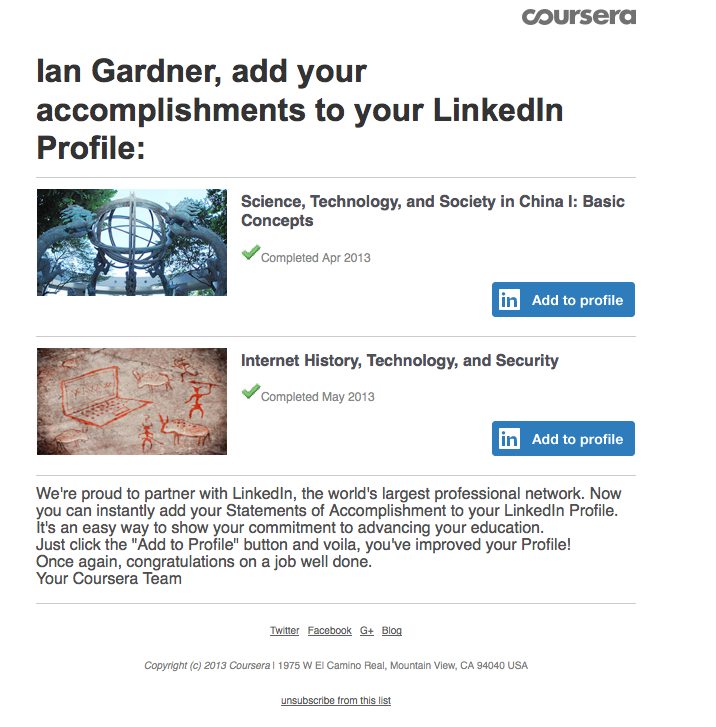
An email today alerted me to a new option for easily adding Coursera module completions to your LinkedIn profile:
LinkedIn Coursera Email
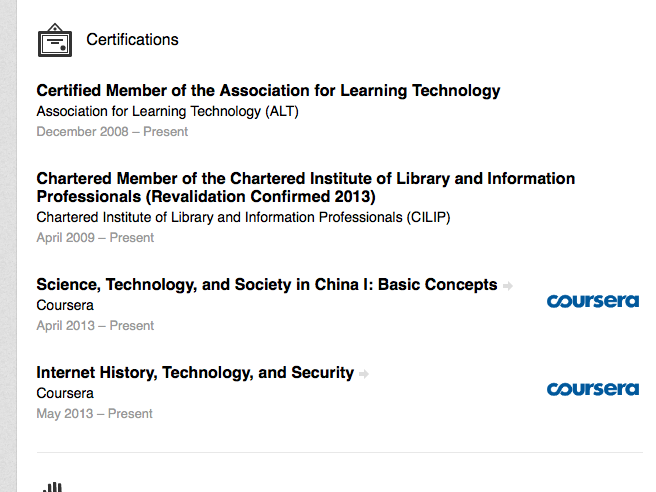
I have complained before about some of LinkedIn’s functionality but I thought I would give it a go. Indeed, I do like LinkedIn for what it has done to transform business communication and have been impressed with the company, not least that they were one of the first to develop cross-platform mobile apps which actually made best use of mobile use cases. Here is what the Coursera content looks like when added to my profile:
Coursera on LinkedIn
A little odd that this seems to be presuming that completion of a Coursera short course is ‘certification’ rather than education, especially when the business model for many contributors is potentially tied to issuing university credits. It also seems odd that when MOOCs are proving the value of short courses (without the disproportion high costs of many short courses) they represent these with individual listings on LinkedIn, I doubt anyone lists every short course they have done. This becomes especially problematic when you think of the full range of informal learning that someone can do, is a Coursera certification more valuable than a Tweet of praise, a positive Slideshare comment, etc?
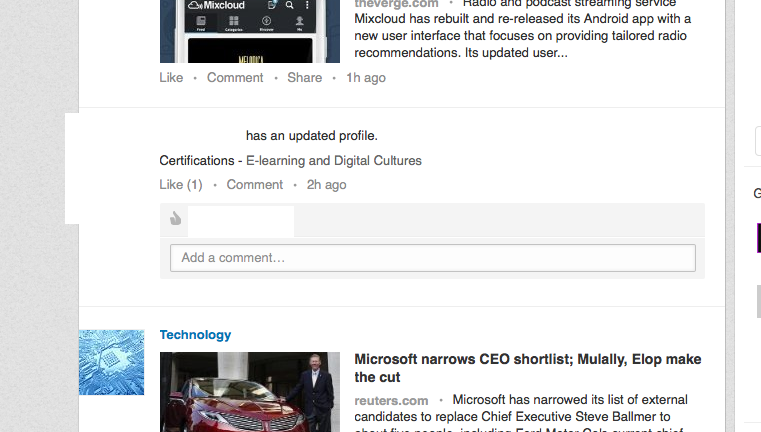
This then makes you think they are likely to be an advertising piece for Coursera. However, thankfully, this does not seem to be the case as they appear as non-descript certifications:
News feed of contact’s Coursera-ing
However, this comes with problems as they seem relatively random updates. Potentially you could appear certified in “Archaeology’s Dirty Little Secrets” without any context.
So, how could they be better? Well Tin Can and/or Open Badges might offer a solution in feeding to LinkedIn selected development activities that you want to present. These could appear in their own section rather than forced into certifications. Indeed the problem I am having with these changes is perhaps that they are leading to ‘scroll of death’ on profiles, would it not be better to link out to a store such as a Tin Can LRS profile, much in the same way you have ‘personal website’ links to allow you to show reflection on your blog?
Presumably Coursera is just the start (or might not be and I just have not realized this already existed) and LinkedIn will be looking to aggregate, in place of Open Badges, work done on other platforms. Overall, a riveting development but another which threatens to put too much information into LinkedIn profiles and create barriers to career-centric conversations.
Last week I was something of an impostor, attending the LearningPool user community’s third and final regional conference of the season.
A dog yesterday
The session I attended on LearningPool itself introduced the organization under their four service offerings:
Content
Off-the-shelf resources, including some customer generated eLearning modules.
Core catalogs are compliance, health & safety and public sector (including health care).
What they develop is based on the customer base (for example they have gained housing sector customers and have responded appropriately).
They also offer customers ebooks, resources, image libraries, etc for their own content.
Authoring tool (moving to online, producing adaptive content, from desktop) to help you build your own eLearning.
Platform
Dynamic Learning Environment (DLE) based on Moodle. Includes some customizations, such as ‘classroom connect’ for booking onto f-2-f environments.
Second solution is based on Totara version of Moodle with more development mapping tools (including user-owned aspirational paths), rather than just a focus on courses, and management tracking dashboards.
Support
Offer first line support to customers’ platform users.
Learning consultants to help you with your designs and blended experiences.
Community
Events such as this one, online communities, sharing of resources, tips, etc.
The event also saw advertising for their new Encore product, a tool for learning reinforcement via mobile application, helping to tackle the forgetting curve.
I have been aware of LearningPool and their services for a while and whilst most of the attendees were from their public sector-centric user base the list of speakers suggested it was worth me attending. This proved the case, with me coming away reinvigorated.
Learning Futures: How new & emerging technologies will impact learning and development
The day started with Steve Wheeler on the ‘developing possibilities’ for future learning. I have seen Steve present a few times before and this was on some similar lines, indeed he even mentioned how his own views and conference presentations have changed over time. The biggest shift in his thinking of late being the role of pervasive tech, the web everywhere, rather than being specifically about ‘mobile’ devices.
The biggest eyebrow raising moment on my desk was when Steve argued that Learning and Development staff can no longer be happy working a 9-5. Now I have mixed feelings on this. In my current role I have been lucky enough to get in and out of the office largely on my contracted terms, this is quite different to my previous role – not least in that I am contracted for 30 minutes a day less anyway. However, whilst this means I am home on good time to entertain my puppy (gratuitous photo included) I am then checking Tweetdeck, attending webinars, reading emails, checking my employer’s social network via the mobile app, etc. This ‘informal’ learning may or may not help my employers directly in the future but will build up my personal abilities in the knowledge economy. I would argue that you need to be flexible but that is for all staff. However, as the recent Dispatches episode showed, you need to be careful in moving toward flexible hours, etc. That said, you have to agree with Steve that, in many ways, you are lucky if you do have a job in the current environment and as such should look to develop yourself to offer a great service in every way possible.
This all said, L&D departments must surely now recognize that their technology enhanced learning solutions must support 24/7 learning. Steve advocated that this is now developing away from just-in-time (JIT) to just-for-me (JFM) via the personalization options afforded by technology, such as augmented reality, with employer supplied learning options just part of an individual’s personal learning network (PLN). Digital literacies will be needed to make best use of this and L&D can help develop staff along an evolutionary path, described as:
skills > competencies > literacies > mastery
Within this changing environment, Open Badges were advocated as the way to support the 70 of 70/20/10 and accredit that development activities and competency developments are actually happening. One term, if not theory, I think was new to me was ipsative assessment – assessing you against your own previous attainment rather than that of others. These assessment methods are useful when dealing with specialists where bench-marking is difficult due to limited numbers/data and is closely associated with some of the ideas around gamification and motivation.
Why does Employee Engagement matter?
I thought the pieces on PLNs and motivation were interesting in light of the following presentation by Dan Hardaker. Dan argued that off-the-shelf surveys, such as those supplied by management consultants and ‘best places to work’ surveys, do not tell the correct picture. What really matters is the combination of engagement, involvement and direction. Using tips from engageforsuccess.org Genesis Housing created quadrants to label staff from their annual staff survey data. These quadrants used deliberately provocative names to foster internal discussions which has helped create a participatory organization and speed up the authoring of policies and agreement on ways forward. Overall, the message was that getting people involved is more important than surveys and other such reports – this is how you get people to ‘offer more of their capability’.
I would agree with much of what Dan said, emotional involvement and a feeling you are making a difference will be key for many staff and opening up decision making will help with this.
Getting the most from your DLE
Andrew Jacobs presented on Lambeth Council’s approach to L&D, now that their team has gone from 7 to 2 with 45% funding cuts. What Andrew presented is not dissimilar to the approach I designed at my previous employer, using your VLE/LMS/DLE for JIT and self service learning. Lambeth now offer no face-to-face training bar some classroom health and safety content, with some synchronous learning via virtual briefings.
Subject Matter Experts (SMEs) are responsible for maintaining their subject on the Moodle pages with links to ebooks, videos, LinkedIn, eLearning, etc as appropriate. Andrew’s team offering fairly minimal support on this. It is then up to the business and those SMEs to determine the success of what is offered in terms of impact on work and what might need to change.
This is not dissimilar to academic environments where the teacher/lecturer will manage the online environment and be supported by learning technologists. Andrew may yet be a trailblazer for bringing this model to a corporate environment, albeit one where the business needs to take responsibility for elements they have previously passed on to a support department. Overall, the approach has brought a culture change where people feel more empowered and the presumption that solution equals ‘course’ has disappeared. Of course, this partly comes down to what a course is – and the corporate presumption that it is ‘classroom training’ is somewhat disparate to the academic which tends to assume some sort of blended learning these days.
Some of the points in this talk raised eyebrows near me again, including:
People can learn what they need via internal networking – external accreditation is facilitating people to leave so your L&D department should not pay for it.
I would say this is partly true but it is an interesting one in light of PLNs and that going forward your career may be based more on an ability to demonstrate prowess in multiple ways across multiple media. However, I would advocate that external training still has a role for bringing in skills to your organization when they are missing, often more economically than hiring an expert or consultant in that area. The problem comes when you encourage someone to develop via an MBA, or similar development activity, only to then not empower them to use that internally.
No training calendar.
Before working in corporate L&D I never realized how big a deal this was, enough said?
Without face-to-face training budgets they have instead given people a set amount of time that they should be seeking out personal development, for example in a public library.
Interesting but I do worry about the future of ‘time tracking’ in organizations and if it is simply unfeasible in the blurred world of learning anytime anywhere. The need to set such guidelines seems to always suggest, to me, that the relationship between staff and their managers is not working. However, it does at least give prominence to the idea of learning in the way Google’s 20% time gave prominence to internal innovation.
The argument was that, overall, we need to be the facilitators of training/learning in an organization, not simply the provider of courses. I asked if Lambeth have a standalone Knowledge Management department, they do not, and I do think their DLE is ultimately being a success partly because it is performing the important task of structuring learning around tacit knowledge. This is a similar chain of thought that led to me previously querying if Corporate Universities are dead.
The web has shown the way. eLearning needs to follow to be relevant
This presentation from the BBC Academy pointed out some of the old problems with eLearning and suggested some ways forward. The presenter argued against the course/LMS centric model and that too much is signed off by L&D/HR rather than the consumers. The point seemed to be to encourage a more open mindset, including breaking the course model to recognize the possibilities of the web (i.e. curating resources).
For what eLearning the BBC does have, an example was shown:
It looked nice
Navigation was standardized across modules for ease of use
Navigation was for discovery not locking progress
Visual elements were used throughout
Design for mobile first
Include onward navigation to web resources
I would hope most people would recognize these are relevant/appropriate, would anyone really disagree? The only point I would perhaps criticize is a ‘mobile first’ approach as what is possible on different devices should be recognized and those different experiences levered in appropriate ways.
Move from course production to products which are improved continuously
Getting out of the Classroom
From the Houses of Parliament ICT training team – talking about shifting support for their 7000 staff from the classroom toward performance support and JIT.
Part of the change has been winning a battle with IT support to break the model of engineers taking calls which were assessed through metrics to one where staff perform floor walks and can immediately go to someone’s desk, having taken a first line call, to help people with what they are trying to do. In my opinion this is a much more suitable approach in a world where everyone has different skill sets and you/they do not know what they do not know – a major problem in the new world at work and one where Grovo and others offer solutions. I am a keen advocate of this, having seen how much help I could be to people in the past when pulling myself away from my desk to offer VLE/LMS support serendipitously. To an extent this is not new, work-shadowing by support teams having been advocated in the past, but is perhaps something which has fallen away as organizations have looked to decrease the relative size of support teams.
This has all been done with the trainers supporting the IT engineers and as such the IT team have found their interpersonal and support skills have improved. Morale has also jumped in that they are now clearly helping people and are seeing the faces at the other end of the line.
This was an interesting point to end on. How much is this a success of personal, in-person, support versus making the IT department more transparent which could have been done via social networking, DLEs and other approaches?
Their IT helpline has been rebranded as ‘customer advice and support’ – answering calls with ‘what can I do for you today?’ The challenge for L&D today is, perhaps, how to make sure that all members of staff think ‘what can I do better today?’ with L&D offering the supporting infrastructure to ensure that can happen.

 Whose Education Is It Anyway?