Learning Technologies Summer Forum 2015

When I reflected on the winter Learning Technologies event I felt the main message was that Learning and Development professionals, collectively, seemed to be failing.  In contrast, the summer event seemed to have a feel of ‘things are getting better’.  Certainly, in the case of my own practice, I can say we have been able to have more of the right kinds of conversations internally – much more about appropriate performance support, via a blend of solutions and that these conversations are starting to happen with senior leadership very much engaged.

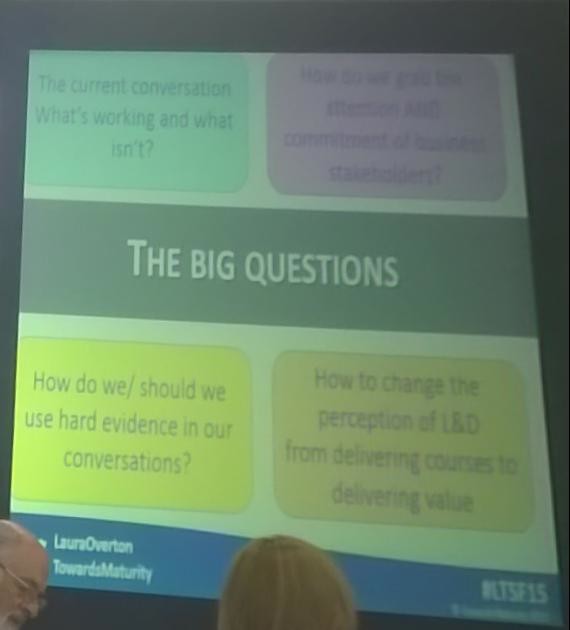
In the context of the first paragraph, the final session I attended at the Summer Forum, on Learning Leadership, was perhaps of most interest.  Learning Leadership Big QuestionsThe focus was on practical things we can do to have great conversations, with a vision for the future beyond order taking.  Based on the good work of Towards Maturity there was an opportunity to tackle ‘the big questions’ (see pic) via a group workshop to capture some of the crowd’s wisdom.  Overall, the message slowly seems to be getting through that you need an evidence based approach, using data to back conversations with the business (which in turn need to be in business, not L&D, language).  A point was made that, as we have not read L&D’s postmortem, the doomsayers were wrong, I’d say the key thing here is ‘not right yet’.  Things might be getting better there’s undoubtedly a lot still to do for many organizations.
Prior to the above session, the others I attended were:

  • Opening Keynote: The Power of Play – Deborah Frances-White.  A very invigorating and funny opening keynote.  The theme was familiar, as children we play (learning in the process) but we get scared to fail as we get older, but there some fun activities involved which I could try in groups as icebreakers in the future.  As the presenter pointed out, play and work can be both be seen as processes – which is appropriate depends on what you are trying to achieve (I particularly liked the idea that you cant ‘work on a relationship’ to save a marriage: you have to re-inject play).  The presentation ended with a mass game of rock, paper, scissors – with you told to cheer on who you lost to and then their conquerors, and so on.  It was provided as something you could do in your office to inject play and change culture – I wonder how many people have been brave enough to try it since!
  • Video for Learning – was made up of two parts, one a video with some tips on technique and equipment.  The second an update on where BP have got to with their video usage.

There were two interesting bits in the first section:

  1. some tips on making sure your mobile phone footage is good quality
  2. a very good video which managed to capture emotion, including by playing an interview over real footage – rather than just talking heads.

The BP experience is interesting, to me, in how in the in-house video solution has been owned by learning, and allows for user generated content, whilst the team includes people with marketing and journalism backgrounds to ensure the right skills are in place.  In other words, the learning team did not wait for someone else to get the platform in place for them (it would seem).

  • Mobile Learning – some tips from Telefonica on their experiences.  Unlike Qualcomm’s winter presentation that showed an app store with multiple in-house apps, Telefonica have gone down the single app route via CM Group.  The app is heavily used but, similar to tools like CampusM in Higher Education, it offers other elements (like bus timetables) so is not ‘learning’ in a pure sense.  However, the argument was this is more of what was needed for new graduate hires and had advantages, such as offline access.

Conversations around the event space included a number of topics.  There was some concern that eLearning vendors are not really ‘stepping up to the plate’ with some kind of truly engaging paradigm in our new mobile/HTML5 world.  I also had some conversations around the continuing value of big library solutions (Skillsoft, Lynda, etc) and if L&D are best to retract to ‘in-house’ and allow people to source other generic things elsewhere, possibly via LinkedIn Lynda subscription (since the event I have had an email from LinkedIn offering a seven day trial for subscription to Lynda so that acquisition seems to be leading to some new models already).

CILIP London Tech Meet Up: June 2015

Bit of context

One advantage of being based in London is the multitude of events that you can go to of professional interest and for networking.  The events come from a wide array of organizations and I once sat on the CILIP in London committee, helping to organize events for LIS professionals.  Indeed one aspect of my role was in setting up a number of digital profiles and initiatives, including a calendar which sought to aggregate London events of interest from CILIP and other bodies (partly to stop us booking events on the same dates as other events!).

I left the committee largely due to time commitments and since then I have not done very well at attending in-person evening events (although I continue to attend large numbers of webinars and have managed to make a number of events ‘in work time’).  Anyway, I did manage to make an event this week (partly as Wednesday is by far the best day for me) and a few notes are below.

The event

The Tech Meet Up promised a number of quick 3 or 7 minute presentations on technologies that people are using which might be of interest to a wider audience.

It was a fantastic example of:

  1. How innovative people can be in thinking of new ways to serve their users/businesses via tech
  2. How varied CILIP’s membership is and the value in the sharing of ideas amongst it.

Presentations included:

  1. Aurasma – for adding augmented reality around displays, guidance, via QR codes to explain how physical tech works, etc.  I particularly like the idea of using augmented reality on a final product to trigger videos showing how it was produced, stills on the production process, etc.
  2. InMagic (new to me) – for easy creation of bespoke databases.  The tool looked ugly but easy to use and, as the presentation stated, it is possible to use it for what would otherwise be expensive systems (for example on independence checking relating to clients).
  3. RSS – this went beyond the basics of RSS (as you might suspect considering the audience – although a number of people admitted abandoning RSS post Google Reader) to how the presenter is using RSS to monitor 2500 companies across 60 countries.  As one might guess considering that scale, he is hacking together a number of tools including the BASE search engine, FireFox plugins (such as Bamboo), twitrss, feed43 and RSSMix.
  4. Learning Apps on VLE – how you can use LearningApps.org (new to me?) to easily create learning objects for embed into a VLE//LMS.
  5. B.scroative (new to me) – audience response with a very nice interface for quizzing with pros/cons vs other systems such as Kahoot.

On top of the above, and a discussion on eBooks, I did a couple of presentations…

My presentations

I let the organizers know that I was happy to do a number of presentations on different tech areas I have been working on.  What I ended up doing is roughly captured in the embedded Slideshare presentation.

I deliberately avoided creating any content myself – instead sourcing the presentations from online sources (please excuse ignoring of creative commons) to talk about the issues related to the space and the kind of technology solutions that can be brought into play.

  1. Learning communities via Enterprise Social Networks (ESN), specifically Tibbr.  A consideration of how ESN functionality has evolved what we can do in relation to online community support.
  2. Capability/competency frameworks and the impact on learning support, including targeting resources, courses, coaching and other support at a more granular level.  Interestingly, “Workplace learning and competency-based frameworks” was a title of an article in the latest CILIP Update.  The article’s suggested approach seemed a sensible evolution, from my more manual mapping using tools such as those in SuccessFactors LMS’s CDP module, to a more data automated approach.

CIPD L&D Show – May 2015: So out of touch with business that ‘VUCA’ is the buzz term

The opening session I attended at this year’s free exhibition considered how coaching can ‘stay ahead of the curve’.  This was quite an appropriate start to a day where my overwhelming feeling, from most of the sessions I attended and conversations I had around them, went something like “yes, obviously” and “we’ve been saying this for years”.

If there was a trend or buzz phrase it seemed to be VUCA; one session I attended specifically had VUCA in the title but at least two others referenced.  However, search online for VUCA and a HBR article shows it was a business buzz term in January 2014, yep, over a year ago.  Whilst it might be excusable to use such a term in formulations based on on ongoing research, such as Toward Maturity’s ‘a kaleidoscope of change’, it felt a little old hat (to me) for exhibition sessions.  This felt especially so when that coaching session started the day with the need for keeping ahead of the curve metaphor.  Towards Maturity’s L&D Evolving Roles, Enhancing Skills report highlighted some good practice in this area, including PwC’s internal L&D team that has “a dedicated research arm, so they can continually scan the horizon for new developments”.  However, I tend to look at this things from the learning industry perspective (rather than just L&D) and being aware of the latest trends was very much part of my learning tech and instructional design team’s remit back in c.2010.  Again, when it comes to workplace “L&D” something seems to act as a log jam.  Perhaps it is a tendency for deliberation rather than action, the coaching session mentioning that attempts to lock coaching down have failed as needs continue to evolve, including trying to understand a world that is too complex.  That said, from the show of hands of who had heard of VUCA in some of the sessions you suspect too many people are still not keeping their ears open for trends – attending a CIPD exhibition once a year is certainly not enough – and both CIPD and Towards Maturity were again stressing the need for L&D staff development to plug the skills gap.

I will not publish my full notes from the different talks here but in rough summary this is what I took away from them on the Wednesday (timetable here):

  1. 9.15 – Coaching – argued that attempts to embed coaching models have largely failed whilst other things, such as revisions to goal setting approaches and the rise of mindfulness have crossed over into the related space.  Overall, the suggestion was that coaching needs to be seen as part of the wider global value conversation.  The couple of enclosed images were fairly typical of lines which outlined some of the current state and future state propositions:
    Is your coaching heading down the wrong path?
    Is your coaching heading down the wrong path?

    Starting to see more...
    Some characteristics of more evolved coaching models
  2. 10.00 – How learning has changed, at the OU.  Coming from a background in HE I’m always interested in what the OU is up to.  This session considered developments at the OU (FutureLearn, iTunesU, Brainwave, OpenLearn, OUAnywhere) and argued L&D teams should be looking at similar for ways to scale [the counter argument presumably being that they’ve weakened their brand via multiple platforms and solutions].  Overall, there is increasing focus on breaking things down to short items allowing for “determine need in the morning and deploy in the afternoon” learning – and they are looking for more corporate accounts.  Large scale use is partly enabled by predictive analytics [although the examples given weren’t much more than what Starfish was doing about 10 years ago].
  3. 10.45 – Belbin for supporting innovation – what can we learn from start-ups?  Some interesting research from Belbin on their profiling of start-ups and what it means for the rest of us.  Basic argument was that it’s not enough to hire ‘plants’, you need to be able to implement too.  In reality, over time, the organization needs a changing skill spread from the initial founders through to getting more practical – so you need a mix of Belbin roles [nothing new in the message but pitched a little different to normal at least].  L&D can learn from this in helping to attract, nurture and retain talent needed to form a great team (and encourage innovative cultures without job title snobbery).
  4. 11.30 – VUCA world: Argued to clearly focus on value in the world we now face and for what the individual learner needs, organizing out of chaos wont work.  I would certainly agree with the three calls to action: develop self-directed learners (a learning org), ensure you master the fundamentals (get roadblocks out-of-the-way – including easy wins like meeting skills training) and develop digital skills.  I also liked one point which certainly was timely – imagine if your organization was as wrong as the pre-election polls: that’s why we all need to be smarter, including developing appropriate analytics.
  5. 13.00 – Organizational Development.  I recently had an interesting chat with someone around OD.  They had OD in their job title (amongst other things) and I expressed my interested in OD being that it is a topic where you can not clearly draw the boundaries.  The session I attended at the show considered the evolution of OD from just worrying about org charts to something more important, emotional not just rational.  Personally, I have always struggled with OD as a concept in that, with social media and electronic communications, any structure (and certainly a hierarchy) really only has a primary use of ensuring clarity and responsibilities.  Actual positioning within the organization, to me, should not really matter considering silos should be broken down if your culture encourages social media – the Towards Maturity skills report putting it as such for L&D professionals: “it doesn’t matter where you sit, alignment is king”.  This power of a social culture is what I was suggesting in this tweet and the session considered that we are moving through forms of OD digital maturity (see image) – toward autonomy and thinking beyond traditional structures. L&D’s role is to foster a mindset where people will collaborate, be prepared to fail and be agile.

    Suggested forms of org structure
    Suggested forms of digital org structure maturity
  6. 13.45 – L&D in a digital world.  Started down the ‘workplace learning is a switch off as it’s not as good as what you can do at home for free’ line [I’m fine with this but it’s not down to quality but the feeling you actually want to do something].  VUCA was again brought in to argue we need to evolve quicker, digital is everywhere and L&D departments can be ignored if people wish.  We need to think about digital in areas such as supporting communities of practice [and, yes, they actually encouraged people to get on Twitter].  CIPD explained that they have updated their qualifications and Home Learning College and other providers are delivering these via a better learning mix.
  7. 14.30 – author of Fire Free Workday.  Some useful suggestions for being more productive.  Rather nicely you could text to get a free PDF of the book.  It was a nice reminder to believe in yourself and motivate yourself to get things done appropriately.  The ’12 mins learning a day is 6 days worth’ is a useful message to take to business leaders [in my opinion].
  8. 15.15 – current state of the L&D professional.  Every year we consider that things are changing but we need to continue to drive that conversation – embrace change.  Focus on capability, not training hours.  Break down the barriers L&D artificially creates.  Challenge the business by saying “if you do this, then this will happen” – show the benefits!  We can no longer be custodians of knowledge – we need to be seen as beyond that.  Be partners with the business, including using their languages.  [All fair points but you’d hope people are aware of it by now!]

Without a budget to spend my time with the stalls was really just to glance at any changes, it was interesting to see:

  1. The coming together of intranet, LMS and other platforms in the shape of things like kokm – a model I’ve worked towards in the past and certainly would work for many orgs.
  2. SquaredOnline and Home Learning College, both from the Floream portfolio and both sounding like bringing high quality virtual experiences [not too dissimilar to what university students might be familiar with] into workplace learning.

Anyway, useful to check in on what people in the L&D space are thinking even if (like me) you might go to these kinds of things too often to get full value.

CILIP Update March 2015: Digital workplaces and metrics

I tend to skim CILIP Update magazine when on the train.  This month, a couple of articles jumped out – both felt like they needed a bit more reflection.

The first (“Information management leaders – we have work to do”) would sound familiar to a lot of support services (such as HR, L&D. etc).  The article argues for a strategic future for information management as CILIP’s IM Project progresses.  The article mentions major trends, such as Big Data, and it ends with a summary of the role in that “most of our information management enhancing [sic] the digital workplace”.  This will sound similar to some of my posts here and what I’ve argued elsewhere.  In the article the focus is on being “strategic information advisors” ensuring “easy to access, relevant and valid information”, but this could be swapped out depending on your personal focus to learning and other areas.  Personally, the blurring of these areas is become such that we perhaps should be looking at the skills, such as those related to mobile development and data analysis, rather than the expertise background.  Unfortunately this would involve a lot of organizational transformation, and challenges for organizations such as CILIP – created around ‘professions’.

“Using metrics to demonstrate the value of your service” was the second article looking at some of the automatic statistics and more qualitative approaches that can be used.  This went back to some extent to a previous event I attended.

I recently argued with a colleague that, in L&D, we will fail if we are seen as ‘a breed apart’.  People will learn in their own ways.  There is perhaps a need for support services to be the ‘go to experts’, after all we’ve seen what ‘learning’ looks like to some people, but so embedded this is just part of common practice.  The centralized, decentralized, embedded, etc. arguments will rage on for support services but if we operate in a digital workplace environment then that blurring may help the support rather than concentrating on the service.