My name is Ian Gardner and I am interested in various topics that can be seen as related to learning, technology and information.
To see what I am reading elsewhere, follow me on The Old Reader (I.gardner.gb) or LinkedIn.
I’ve been lucky to have line managers who have been very supportive of my career but that feedback rarely goes beyond the one-to-one relationship. Indeed our traditional 360 and other feedback mechanisms, usually tied to annual review, have often over complicated these arrangements. Such issues have encouraged me in the past to look at simpler solutions, like Rypple. Therefore, I thought I would give a shout out to my new employer and the ‘staff shout out’ wall – where anyone can stick up a post-it with a message to the team, thanks to a team member, etc.
A simple and really nice idea.
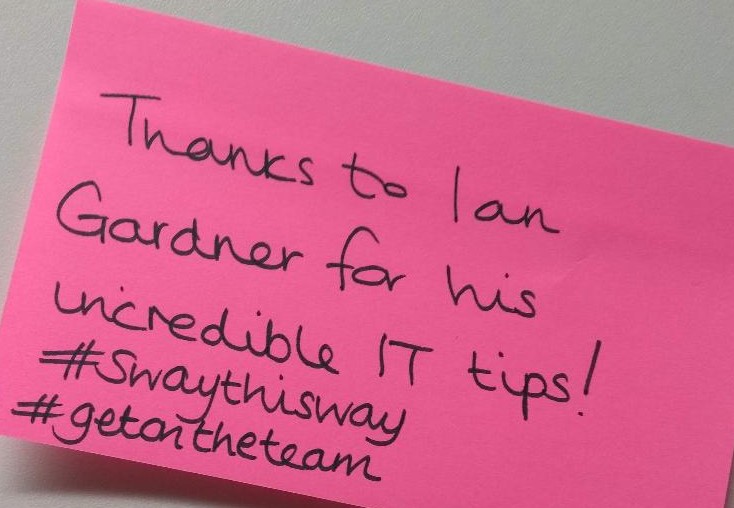
Also nice to pick up some thanks for some of the IT support I’ve been giving in my first few weeks:
One of the many problems with Office365 is people need time to take a look at it and be aware of some of the options – so great to be facilitating some productivity improvements through Sway and Teams!
It’s then interesting to see SAP go big with their more recent acquisition of Qualtrics.
With Qualtrics the talk is of an “experience management platform” – something which of course aligns with the full ‘digital transformation’ buzzword bingo. This is where the challenge comes, is a tool like Qualtrics simply its core functionality (which has multiple competitors) compared to the value in existing customer bases (as this article mentions)?
I’ve briefly used Qualtrics tools in the past but the fee seems huge and the you suspect that the people/data as a product age is really upon us with this expensive deal.
But the issue surely is if people can hide behind pointless tasks, email or other activities then there is something fundamentally at fault with your workforce planning. Here is the bigger challenge going forward – people appearing/claiming to be busy as that is the ‘norm’ and what should be accepted. It has negative effects on many things, for example people being hesitant to contribute to ESN/LMS systems as it might be a sign they are not ‘busy enough’. This is another area where honesty is needed and where trust and transparency needs to be (re)built – with clarity for talent via HR key.
Following on from my reflective posts in recent weeks about my experience, things I have seen in the workplace and the challenges the world faces I have come up with a title for myself: The Learning Reducer.
The inspiration for this title is a combination of music producer/reducer Rick Rubin and what I have realised during this period of reflection. Further logic behind the ‘reducer’ moniker:
“Girls” is indicative of Rubin, who initially portrayed his role as “reducer,” not “producer.” 1980s music had a lot of needless flourishes and additives. Rubin’s mission was to boil off excess and serve the essence. Rick is often portrayed as a producer who does almost nothing to the music he touches. Which isn’t to say that he does nothing. The opposite, in fact, is true. Like a great chef, he chooses the best ingredients and lets them speak for themselves. The genius is in the selection and arrangement of those ingredients.
In the case of “Girls,” it’s one part drums, one part piano, and four parts asshole.
In part my adoption of Reducer is based on some things that have really stood out to me during my time working in learning over the years, including:
Subject Matter Experts (or worse people responsible for something who are not even an SME) throwing requirements ‘over the fence’ to L&D whilst refusing to engage or find time for proper needs analysis.
Mandatory ‘training’ stipulated by government and other groups with no consideration for personalisation, real outcomes or other needs.
Bloatware learning where learning is elongated by everything from a corporate logo (even just for 5 seconds) at the start of a video through to fixing ‘learning’ into an arbitrary schedule of an hour, a work day, etc. As a result organisations have been left with lots of legacy learning content that is difficult to manage, update and makes little us of the opportunities AI, AR and other tech gives us.
Inefficiency – we hear a lot about productivity gaps but do very little about the basics around skills, process, etc. There have been improvements in encouraging honesty and learning from mistakes but tackling fundamental bad practice, for example with Microsoft Office, remains an issue.
Self importance. Unfortunately we all fall into the trap of thinking our piece of the pie is most important. Realistically, the product/service of our organisation is most important and in big organisations we only contribute to (or sell) it. Therefore, the need for learning to drive self aware and reflective practitioners is all important – what we don’t need are bloated learning (or other support teams) expecting the impossible or putting self interest ahead of the shared vision/goals. There is also the snobbery issue here in self importance of learning professionals and a failure to support all learners – too often focusing on leadership and high level concepts.
The learning industry is in need of shedding a lot of dead weight (learning styles, Myers Briggs, etc). We are seeing new ideas emerging but often people are clinging to ideas (like 70/20/10 in totally the wrong kinds of ways). As an industry/profession it feels like learning pros constantly beat themselves up but are far too slow (still) in shedding the old sheep dip training for something that adds more value. Admittedly because too often things are thrown over the fence as ‘requirements’ (see above).
Reducer as critical friend
So – can I be the learning asshole? Well, perhaps I already am – I noticed myself verging into this territory recently when asked to give feedback on pre-launch content from new vendor Thrive and also with the UI of a recruiting platform I was given early access to.
There feels like a value in looking at L&D from the perspective of critical friend. Seperate from industry or SM expertise. If only to ask a question of L&D pros practice: why?
What is applicable to super scientists is applicable to all.
Reducer and curation
Curation is not new – even though some L&D commentators would have you think it is.
Blog followers will know I get a bit of a “bee in my bonnet” about curation as an L&D topic. However, it is a facilitator of ‘reduction’ – pick the best of what is out there and maintain current awareness without excessive build times and other traditional L&D activities.
Curation done well has to be part of a continuous improvement culture.
Reducer and culture
Through a learning reducer focus we can establish true learning organisations.
Agile learning through experience and reflection, combined with ongoing collaboration via digital means. Where face-to-face and virtual classroom are reserved for real value added sharing and relationship building.
Learning can be embedded in work, agile in deployment, is owned by everyone and contributes to learner/employee engagement. This works both in education settings and the workplace.
I think some posts on this topic have been lost on an old blog of mine so it can come in here as the second in this series…
Do you hunch over a laptop? Do you constantly switch between apps, windows and tabs? Are you desk based but just have one monitor?
If you answer yes to any of these questions a simple solution to improve your productivity may be to get more displays.
This is increasingly recognised (see a Guardian article here) and was touched upon at a JISC keynote that I must have seen/been about 10 years ago now.
A short post but a useful one – if your organisation presumes only IT, fx traders or other internal groups are worthy of multiple monitors then they are probably selling you down the river.