What future for education? MOOC – Week 2

It has been a little while since I’ve engaged at all with a MOOC.  I continue to sign up for the odd one but having moved into a house which is now proving a ‘money pit‘ my spare time has largely been taken up with cleaning, worrying about money and general panic about the years of work we’re facing.

This has been educational in itself – full building surveys are there for a reason, do not buy houses based purely on character, garden sheds are difficult/impossible to fix, foxes are very similar to dogs, etc etc but I am trying to get back into further personal development (including the recent splurge of posts here).

Anyway, the WFE MOOC seems to have picked up a bit of traction with people I follow online and whilst I largely ignored Week 1, the activities for week 2 are a bit more interesting:

1 – the discussion task

Offer an example of someone who is considered to be intelligent or gifted BUT who has had to be an expert learner. Tell us something about that person (they could be real, someone you know well, or a celebrity or fictional character). Outline why you think they are a “good” learner. THEN choose two posts from the discussion forum (not your own) and post a response to them: why do you think their learner is a good example: what does it tell us about intelligence and learning? Please read our forum posting policies before posting or starting a new thread.

Now I find this task description a little complicated, the need to use BUT and THEN in the way they have kind of highlights that there could/should have at least been use of bullets to better set out the instruction. From one of the staff replies, to someone seeking clarification, there is also something clearly missing in the above description:

“The idea is to consider the learning process of people who are considered to be gifted or intelligent.
There are examples of people who are highly successful who were even at some point in their life considered to have learning or other difficulties, overcoming this by developing expert learner skills
A little reading up on people who you consider to be particularly intelligent or gifted might give you some ideas. (musicians, businesspeople, scientists, nobel prize winners etc)”

There is a clear difference here between identifying a good learner (lets say Napoleon as an example of someone who studied hard at military school and quickly learned on the job afterwards) against someone who has overcome a learning or other difficult by becoming an expert learner (Stephen Hawking type examples here I guess or the business leaders for whom ‘school didn’t work’ only for them to still be a success and find out later that they had severe dyslexia or something similar).

This all highlighting one problem of running a MOOC – that you open yourself up to a world of nitpicking!

2 – the reflection activity

  1. During your own education, how has your “intelligence” been assessed?
  2. How has this affected the educational opportunities you have been given?
  3. What judgments have people made about you that have been affected by an assessment of your “intelligence”?
  4. Do you consider yourself to be a “learner”? why

Personally I would say all animals are learners, in incremental ways we change our behavior continuously from dealing with basic needs, such as sourcing food, to highly technical skill development.  The education system typically assesses our recollection of information (exams) or ability to research, analyse and articulate (essays/vivas).  Recollection can be more complex, for example in Mathematics, but rarely would my formal education have assessed in more detailed ways.  Few opportunities were given for more detailed investigation, coursework in practical subjects at school would have at least combined physical skills with mental activities.  Intelligence can of course be judged in many ways, Howard Gardner etc etc, but as the image in course menu suggested, we revert to ‘clever’, ‘brainy’, ‘smart’ and many negative options too.  Ultimately we will all learn but combinations of our neurology, previous experiences and environment will impact what this means in reality.

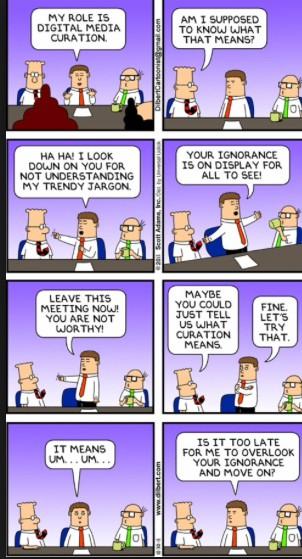
The inevitable backlash to ‘curation’

One of the popular terms of the last eighteen months or so, both on the wider web and specifically in L&D circles, has been ‘curation’ – indeed I mentioned it back in August 2013.

Well, inevitably the backlash has begun:

What does Curation mean?
Source: https://pbs.twimg.com/media/BzPoCRHIIAAQ0mD.jpg

or at least the backlash against people who “don’t get it”.  Ultimately my take on this has not really changed…

Curation is nothing new.

Directories drove the early web until search improved.  We now see ‘live’, largely automated, directories aggregating content on an ongoing basis – albeit at the risk of rehashing old ideas and not moving the conversation forward.  Quality curation is one way to raise, above the noise, genuinely new insight, research, data, etc.

Information skills are essential to any non-automated approach and there would certainly be an argument that where ‘time is money’ some level of automated curation (as part of a personal learning and information system) could be supplemented by people focusing on information management/curation and distribution in your organisation (rather than the potential for duplication of effort, etc by everyone spending time managing their own).  However, I see two major challenges:

  1. Personal network versus “supported learning network”.  The inevitable problem for any kind of internal awareness, communication or learning curation will be that it has already been captured by an individual’s personal system.  For example, a colleague may share something on my team’s internal social tool which I have already engaged with via Twitter.  We have moved past restrictions enforcing only ‘work tools on work time’ so how can we balance this without boring ourselves and our audiences via multiple sharing/discussion streams?
  2. ‘Human touch’ curation capabilities are limited.  The cutbacks of recent decades to information-related teams mean that the focus is more likely to fall on the individual, supported by groups such as internal communications (for distributing key messages) and knowledge/record management (for longer term curation).  I see the recent focus of L&D on curation, to capture quality content and share appropriately as one area where my information background and learning technologies crossover – quality content has been the core reason for libraries and now we are seeing transformation of learning away from ‘our stuff’ to recognizing the value in UGC and integration with 3rd party materials.  Ultimately we would want everyone’s daily work to be built around a single company virtual space which can do everything we might need around learning, sharing, communication, etc.  The challenge is that this system realistically does not exist and, in all probability, existing businesses face fragmentation and silos.

So I would say lets strive to ensure our organizations appropriately curate but recognize it will have failings and is not the solution to every form of learning/content need.

Professional past / professional futures

My recent promotion, has led to me thinking again about my career and professional status.  This probably would have happened anyway, for example I need to set myself new workplace goals aligned to my new position, but contact from one of my dissertation supervisors has led to me thinking about my past as well as my future.  My former supervisor asked if I would be willing to be contacted by one of the school’s marketing/alumni people in relation to my career path as they might be able to pull out some bits for their marketing and website.

My initial reply pointed out that my role is not as senior as the title (as wonderfully simple as ‘Manager’) might suggest.  However, I am a keen believer in that alumni stories should be shared (a couple of alumni coming to talk to us when I was a student proved very helpful at the time in thinking about the job market).  Indeed I would have loved LinkedIn to have been more in place when I finished my Undergraduate and first Postgraduate qualifications so I could have done a better job of keeping in touch with people from those programs.

Anyway, what did the marketing/alumni form trigger in terms of reflection?  Well, they asked the below questions:

  1. What did you like most about your degree?
  2. What was your best experience during your time in the Information School?
  3. What made you choose to study at the Information School at the University of Sheffield?
  4. What would you say to someone who was considering studying at the Information School at the University of Sheffield?
  5. What have you done since completing your degree from the Information School at the University of Sheffield?
  6. Which, if any, parts of your degree do you use in your working life?
  7. Has your degree helped you in your working life? If it has, how has it helped you?

In general my responses were that my skill development has continued via further study and work, in other words my ‘professional’ qualification was very much the beginning, not the end.  However, completing the form was quite tricky.  I could only really answer question 2 with a general comment and 6/7 verged into the same territory.

This leads to thinking about where I might go next.  Obviously my path, so far, has been far from straight forward but I do tend to return to that Venn diagram for ‘Educational Informatics’ – thinking that it will be somewhere in the intersection of education, technology and information.  Ultimately, I may return to more of a learning technology focus or continue on a path via generalist Learning and Development.  However, I certainly would not say those are my only two options and it will be interesting to see what happens!

Microsoft publishing redux?

I recently reached out to the ALT-members list to see if anyone had had chance to use OfficeMix:

This followed a tweet which received a reply from Techsmith:

Surprisingly no one on the ALT (Association of Learning Technology) list replied, which might be a sign that MS are struggling to keep UK Higher Education clients (or at least keeping them on the latest versions).  Someone at my work did though say they have tried it and are very impressed.  My main interest is in distribution models considering the potential use for this kind of output in eLearning.

Hot on the heels of all of this is the release of this video on Sway:

I have requested beta access to Sway.  Whatever happens with these two tools, kudos to Microsoft for trying to reimagine publishing – let’s face it, the Word and PowerPoint domination has not been very helpful for creativity in business.  Microsoft’s approach with these tools seems to be to aim for cross-device web accessibility in the publishing (and app based authoring), in contrast to Apple’s app future via iBooks (which is probably the nearest thing?).

Personally I’m more of a web than App fan so I’ll be looking forward to that Sway invite coming through 😉  It will be interesting to see if OfficeMix picks up most use (via the PowerPoint user base) or people can be swayed to a different tool (and Sway will finally be the death knell for Publisher?).

Selling virtual learning – via rap?

I’ve recently been in touch with ON24 about their quite fun webinar advert:

Alas, they chose to concentrate on sales in their rap, hence the suggestion for a learning orientated one.

So can we perhaps come up with something?

Got to be better than the usual way of advertising synchronous virtual learning?

Disclaimer: whilst I have a, guilty secret, soft spot for Epic Rap Battles I'd suggest something with cleaner language.